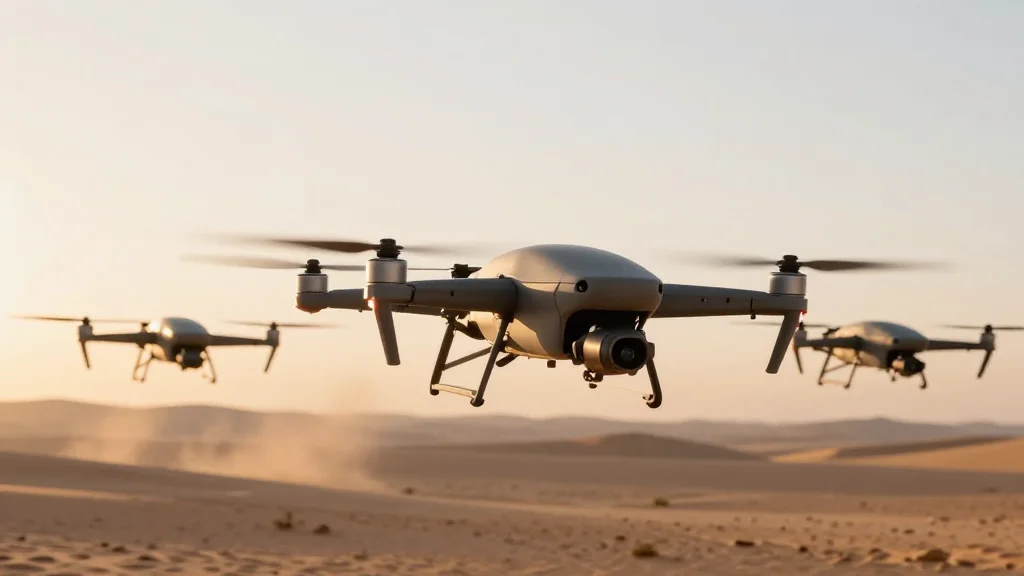
Pentagon Picks Shield AI to Add Swarm Pilot to Low‑Cost LUCAS Drone

Companies Mentioned
Why It Matters
Embedding AI‑driven swarm software into a sub‑$30,000 combat drone marks a paradigm shift in aerospace defense procurement. It demonstrates that advanced autonomy is no longer limited to high‑cost, manned platforms but can be scaled across mass‑produced, expendable systems. This could erode the traditional cost advantage held by adversaries that field cheap drones, forcing a re‑evaluation of air‑defense investments and tactics. The development also highlights the growing convergence of AI and aerospace engineering, where software capabilities become the primary differentiator. As the Defense Department pours billions into autonomy, successful integration on LUCAS could set a template for future programs, accelerating the adoption of collaborative autonomy across the services and influencing commercial drone markets worldwide.
Key Takeaways
- •Pentagon selects Shield AI to embed Hivemind swarm software into LUCAS drone.
- •Hivemind will act as an AI pilot, allowing a single operator to command multiple autonomous drones.
- •LUCAS costs roughly $20,000‑$30,000 per unit, far cheaper than traditional strike platforms.
- •Demonstration of integrated swarm capability slated for fall 2026.
- •FY 2027 budget requests $53.6 billion for autonomy and drone platforms, underscoring strategic priority.
Pulse Analysis
The Shield AI‑LUCAS partnership illustrates a decisive move toward ‘swarm‑centric’ warfare, where the value of a system is measured in numbers rather than individual capability. Historically, the U.S. has relied on high‑performance, high‑cost aircraft to dominate the skies. By contrast, the LUCAS model leverages economies of scale and AI to achieve a similar effect through volume and coordination. This mirrors commercial trends in logistics and agriculture, where fleets of inexpensive drones are coordinated by sophisticated software.
From a market perspective, the decision could catalyze a wave of private‑sector investment in low‑cost, AI‑enabled UAVs. Companies that have focused on high‑end ISR platforms may need to pivot toward modular software that can be licensed across multiple airframes. The defense industrial base, long accustomed to lengthy, high‑budget programs, may see a new procurement cadence driven by rapid software iterations and incremental hardware upgrades.
Looking ahead, the key risk lies in the operational validation of Hivemind under contested conditions. If the fall demonstration proves the system can reliably navigate jamming, electronic warfare and dynamic threat environments, it will likely unlock a cascade of follow‑on contracts. Conversely, any shortfall could stall the broader push for collaborative autonomy, prompting the services to double‑down on more traditional, albeit expensive, platforms. The outcome will shape not only the future of U.S. aerospace strategy but also the global arms race in autonomous swarm technology.
Pentagon Picks Shield AI to Add Swarm Pilot to Low‑Cost LUCAS Drone
Comments
Want to join the conversation?
Loading comments...