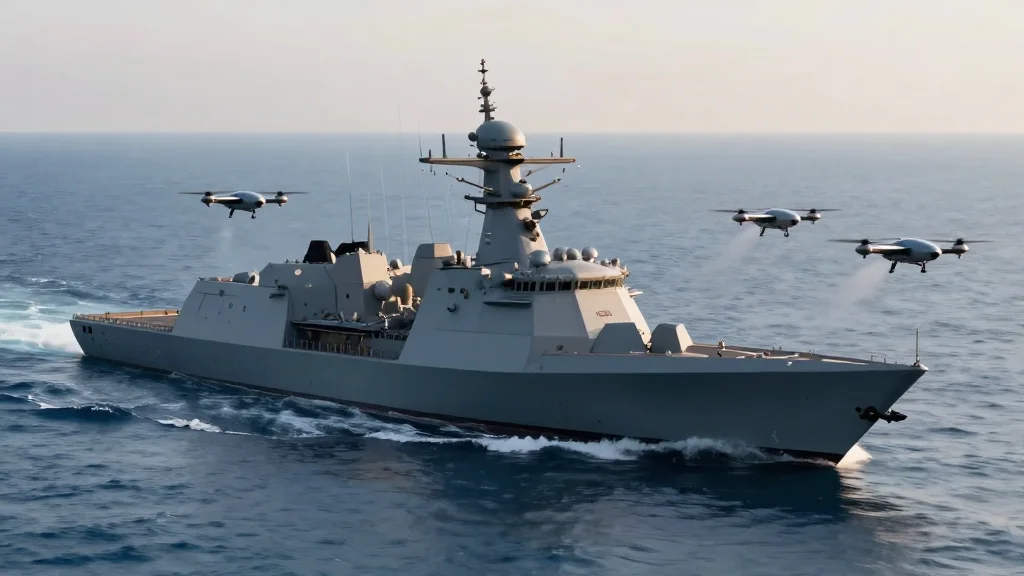
Portugal Commissions €132 Million Drone Carrier, Europe’s First Unmanned Platform

Companies Mentioned
Why It Matters
The NRP D. Joao II illustrates how autonomous technology is reshaping naval strategy, offering a viable alternative to multi‑billion‑dollar carriers. By proving that a relatively modest investment can field a platform capable of coordinating air, surface and subsurface drones, Portugal is setting a benchmark for other navies facing budget constraints and demographic challenges. If the ship’s sea‑trial performance meets expectations, it could accelerate a global pivot toward modular, AI‑centric warships. This shift would not only alter procurement patterns but also influence the aerospace supply chain, driving demand for lightweight drone airframes, advanced catapult systems and integrated command‑and‑control software.
Key Takeaways
- •Portugal’s NRP D. Joao II costs €132 million (≈$140 million), under 1 % of a U.S. Ford‑class carrier
- •The 353‑foot vessel can operate fixed‑wing drones, loitering munitions, UUVs, USVs and helicopters from a 308‑foot flight deck
- •Crew requirement is 48 permanent members plus 42 mission specialists, far fewer than traditional carriers
- •EU’s Recovery and Resilience Facility helped fund the project, highlighting political support for autonomous platforms
- •South Korea’s “Navy Sea Ghost” program may accelerate investment in similar unmanned systems in response to Portugal’s launch
Pulse Analysis
Portugal’s decision to field an unmanned drone carrier reflects a growing consensus that future naval power will be measured in algorithms, not tonnage. The economics are stark: a $140 million platform delivering multi‑domain autonomy versus a $14.7 billion nuclear‑powered carrier that requires a crew of several hundred. This cost differential is likely to resonate with European allies that have been forced to tighten defense budgets after the pandemic and the war in Ukraine.
Historically, naval innovation has been driven by breakthroughs in propulsion or firepower; today, the disruptive factor is AI‑enabled autonomy. The NRP D. Joao II’s design integrates a catapult launch system, a feature once reserved for super‑carriers, into a vessel the size of a large frigate. That convergence suggests a future where the line between combatant and support ship blurs, and where modular payload bays allow rapid reconfiguration for surveillance, strike or humanitarian missions. Shipyards that can adapt to this modular philosophy—like Damen—stand to capture a new market segment, while traditional carriers may need to offer hybrid manned‑unmanned capabilities to stay relevant.
For the broader aerospace sector, the ripple effect could be profound. Drone manufacturers will see increased demand for carrier‑compatible airframes, while sensor and communications firms will race to provide the low‑latency, secure links required for real‑time swarm coordination. Moreover, the reduced crew footprint may lower training and lifecycle costs, making autonomous platforms attractive to nations with limited human resources. As more navies test the operational viability of such ships, the strategic calculus of maritime deterrence could shift from sheer firepower to the speed and adaptability of AI‑driven fleets.
Portugal commissions €132 million drone carrier, Europe’s first unmanned platform
Comments
Want to join the conversation?
Loading comments...