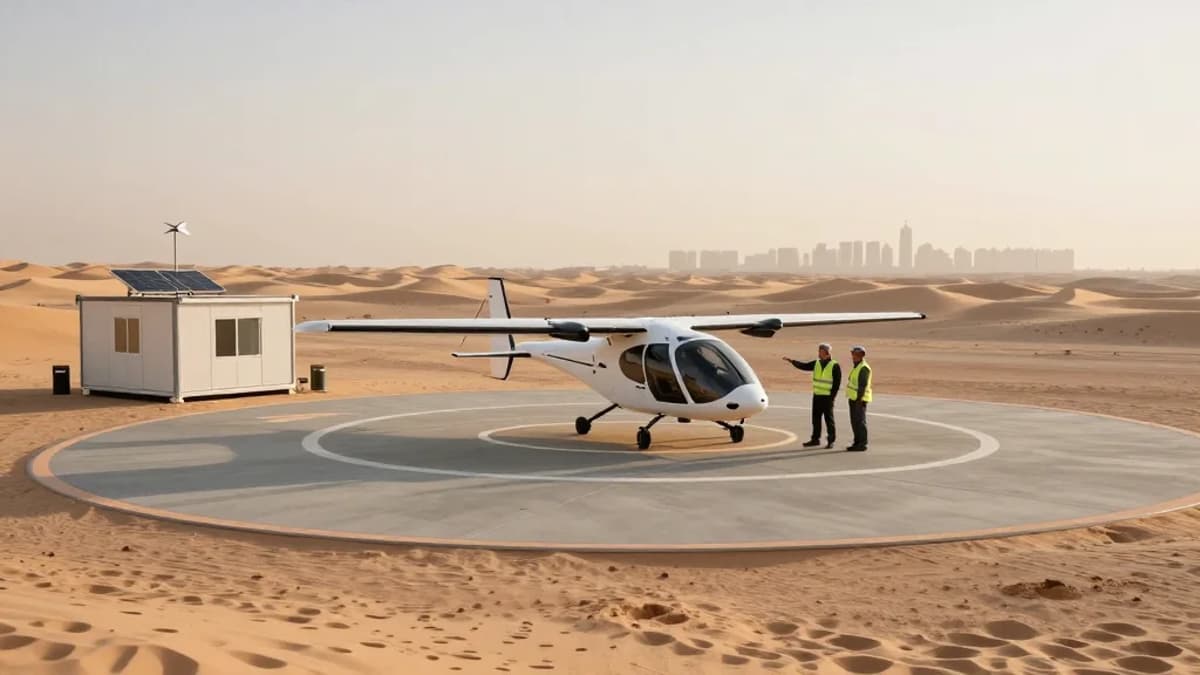
SALAAM.earth to Launch AAM Test Site in Saudi Arabia in Q1 2026
•February 24, 2026
0
Why It Matters
The test site accelerates AAM commercialization in the Middle East, providing a real‑world proving ground that aligns with Saudi Arabia’s diversification and smart‑mobility goals. It also offers manufacturers and regulators critical data to shape safety standards and market entry strategies.
Key Takeaways
- •First SALAAM.earth sandbox in Riyadh, Q1 2026.
- •FlyNow eCopter: 50 km range, 130 km/h, two passengers.
- •Partners provide vertiports, digital ATC, cybersecurity, integration.
- •Tests include passenger, cargo, firefighting, medical evacuation.
- •Supports Saudi Vision 2030 AAM goals.
Pulse Analysis
The race to commercialize advanced air mobility (AAM) has accelerated worldwide, with governments and private firms racing to certify electric vertical take‑off and landing (eVTOL) platforms for urban transport, cargo, and emergency services. Europe, the United States, and Asia have already earmarked billions of dollars for test corridors and regulatory frameworks. Saudi Arabia, leveraging its Vision 2030 diversification agenda, is positioning itself as a Middle‑East hub for next‑generation aviation. By inviting international partners and investing in dedicated infrastructure, the kingdom aims to shorten the gap between prototype flights and fully operational air‑mobility networks.
The SALAAM.earth sandbox in Riyadh, slated to become operational in the first quarter of 2026, will function as a controlled real‑world validation environment for AAM technologies. The site integrates vertiport facilities, a digital air‑traffic‑management layer from Skyroads, and hardened cybersecurity services supplied by Quadron, creating a holistic ecosystem for safe low‑altitude operations. The inaugural aircraft, FlyNow’s eCopter, is an electric unmanned air taxi capable of 50 km range at 130 km/h, carrying two passengers or 200 kg of cargo. Test scenarios will span urban passenger shuttles, logistics deliveries, and critical missions such as firefighting and medical evacuation.
Beyond proving the eCopter’s performance, the Riyadh sandbox is designed to accommodate future eVTOL designs, offering manufacturers a ready‑made testbed that mirrors commercial conditions. This collaborative model reduces time‑to‑market and provides regulators with data to shape safety standards. For Saudi Arabia, the project aligns directly with Vision 2030’s goal to diversify the economy, create high‑tech jobs, and establish the kingdom as a regional aerospace hub. Successful outcomes could attract further foreign investment, stimulate local supply chains, and accelerate the rollout of passenger‑centric AAM services across major Saudi cities.
SALAAM.earth to launch AAM test site in Saudi Arabia in Q1 2026
0
Comments
Want to join the conversation?
Loading comments...