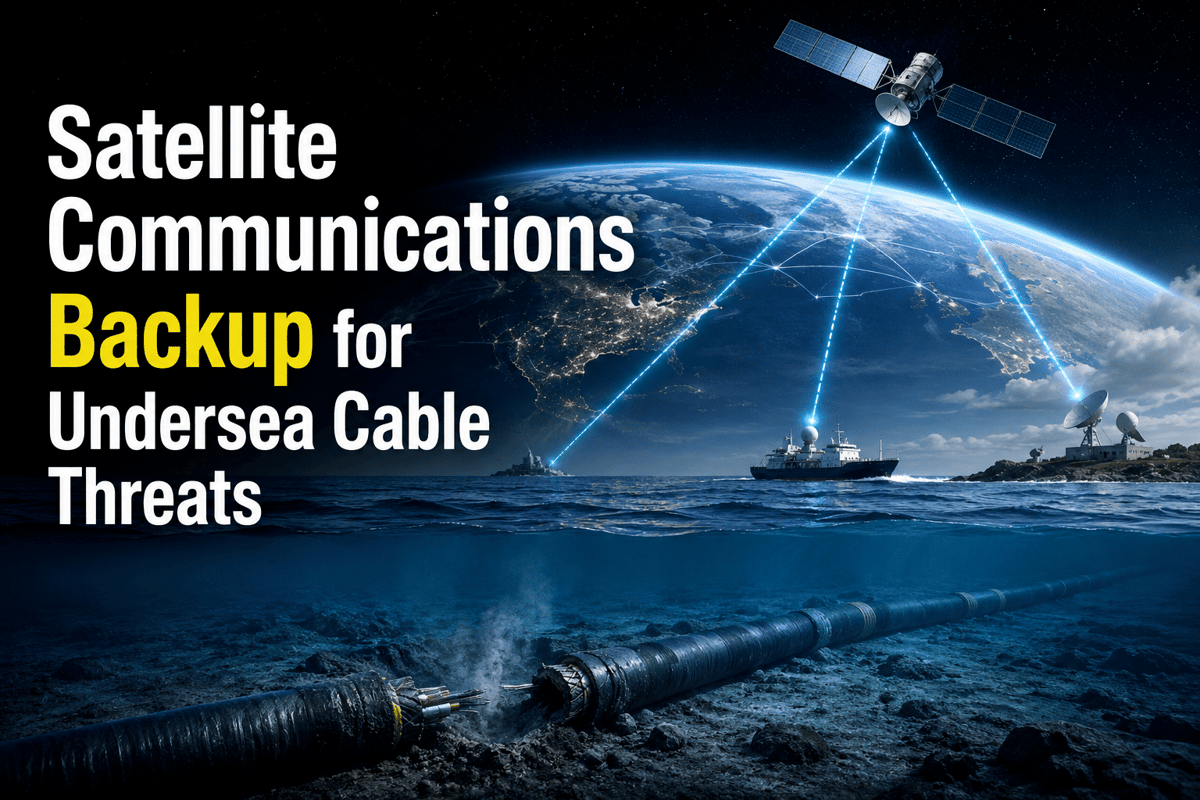
Satellite Communications Backup for Undersea Cable Threats
Why It Matters
A cable outage can cripple financial markets, government communications, and critical services; satellite backup provides a resilient, albeit limited, channel to sustain continuity during such disruptions.
Key Takeaways
- •99% of global data traffic travels via submarine cables.
- •Daily financial transactions worth ~$10 trillion depend on those cables.
- •Multi‑orbit satellite constellations offer tiered backup for critical traffic.
- •Redundancy gaps exist for islands and chokepoints vulnerable to sabotage.
- •Effective backup requires traffic classification, testing, and multi‑provider contracts.
Pulse Analysis
The backbone of the internet—submarine fiber—now transports almost all cross‑border data, underpinning everything from cloud services to high‑frequency trading. With an estimated $10 trillion of daily financial activity flowing through these cables, any disruption—whether caused by fishing gear, anchoring, or deliberate gray‑zone actions—poses outsized economic and security risks. Recent events in the Baltic Sea, the Red Sea, and around Taiwan illustrate how a single cut can force operators to reroute traffic, delay market data, and expose concentration points where multiple routes share the same landing stations or wet‑cable corridors.
Satellite communications address this vulnerability by offering a physically separate path that bypasses damaged subsea segments. Low‑Earth‑Orbit constellations such as Starlink and OneWeb provide broadband latency suitable for high‑priority internet access, while Medium‑Earth‑Orbit systems like O3b mPOWER deliver carrier‑grade performance for mission‑critical applications. L‑band networks (e.g., Iridium Certus) ensure voice, messaging, and telemetry survive even adverse weather. A layered approach—assigning critical command traffic to L‑band, operational data to LEO/MEO, and bulk public traffic to terrestrial or GEO links—creates a resilient communications hierarchy that can be activated within minutes.
Turning satellite links into a reliable backup demands disciplined planning. Enterprises must map essential communications, segment traffic into command, operational, and public layers, and secure contracts with multiple providers across different orbits. Procurement should embed service‑level guarantees, geographic coverage, and cyber‑security controls, while regular drills simulate partial fiber loss and enforce activation protocols. Policy initiatives, such as the Strategic Subsea Cables Act of 2026, further reinforce resilience by encouraging information sharing and sanctioning sabotage. As the global economy leans ever more on real‑time data, integrating multi‑orbit satellite redundancy will become a standard component of enterprise continuity strategies.
Satellite Communications Backup for Undersea Cable Threats
Comments
Want to join the conversation?
Loading comments...