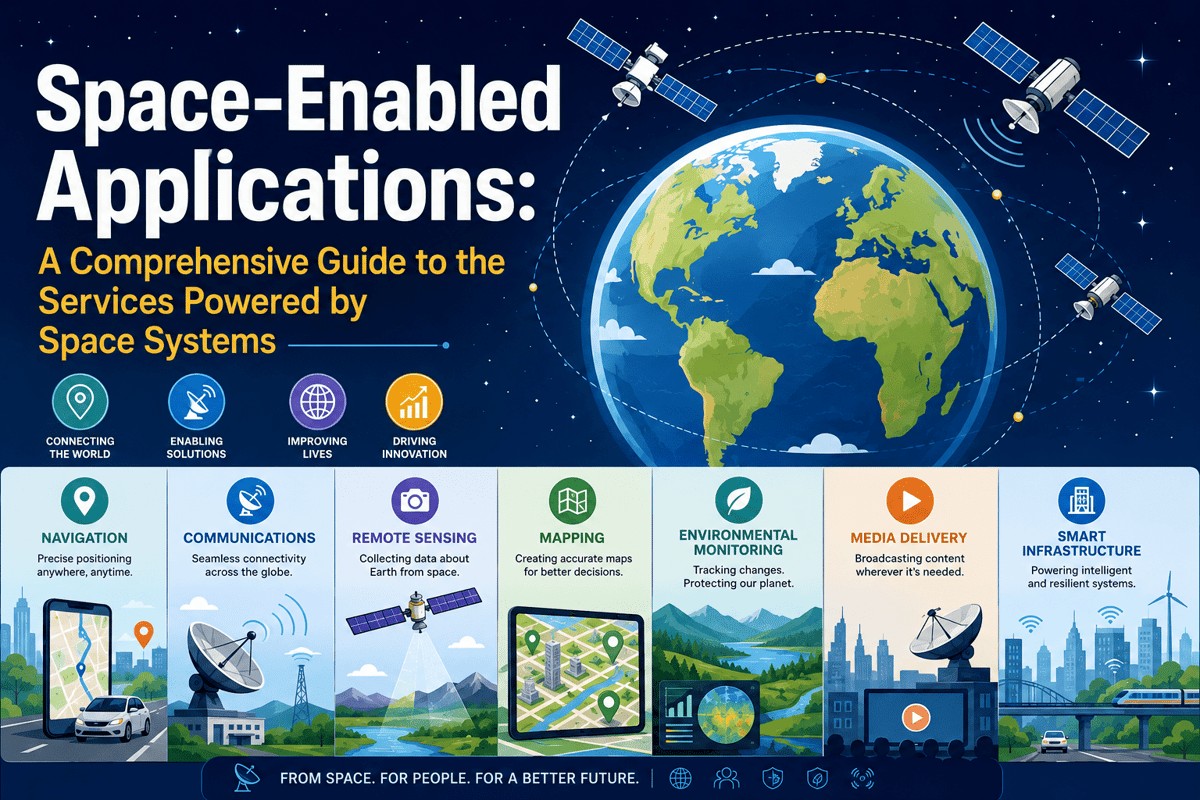
Space-Enabled Applications: A Comprehensive Guide to the Services Powered by Space Systems
Why It Matters
Space‑enabled services now underpin critical operations from logistics to finance, so their growth reshapes revenue models and competitive dynamics across virtually every industry.
Key Takeaways
- •Space economy projected to reach $1.8 trillion by 2035.
- •Satellite communications, PNT, and Earth observation drive most services.
- •Integration with cellular, cloud, and IoT expands satellite use cases.
- •Copernicus and Landsat provide free data, spurring private analytics.
Pulse Analysis
The rapid expansion of space‑enabled applications reflects a shift from niche aerospace products to a foundational utility layer for the global economy. By 2035, the sector is expected to generate nearly $2 trillion in revenue, driven largely by downstream services that translate raw satellite data into actionable insights. Communications satellites now deliver broadband to remote clinics, ships, and disaster zones, while positioning signals synchronize financial markets, power‑grid operations, and autonomous vehicles. Earth‑observation platforms, ranging from optical imagers to synthetic‑aperture radar, feed precision‑agriculture models, climate‑risk assessments, and urban‑planning tools, creating new value streams for data‑analytics firms.
A key trend reshaping the market is the deep integration of space assets with terrestrial networks and cloud ecosystems. Satellite operators are partnering with telecom carriers to provide hybrid backhaul that blends fiber, 5G, and low‑Earth‑orbit links, delivering seamless connectivity for IoT devices and edge‑computing workloads. Meanwhile, multi‑constellation GNSS receivers combined with inertial and terrestrial timing sources enhance resilience for critical infrastructure, mitigating jamming and spoofing threats. This convergence enables end‑to‑end solutions—such as disaster‑response platforms that fuse real‑time weather feeds, SAR imagery, and GPS‑tagged field reports—unlocking higher‑margin services for both incumbents and startups.
Looking ahead, regulatory harmonisation and data‑access policies will dictate the pace of innovation. Open‑source programs like Copernicus and Landsat lower entry barriers, but commercial providers must navigate licensing, export‑control, and spectrum‑allocation challenges. Investment is flowing into higher‑resolution sensors, on‑orbit processing, and AI‑driven analytics, promising faster revisit times and more precise products. As industries increasingly rely on space‑derived timing, positioning, and imagery, the sector’s growth will be measured not just by launch counts but by the breadth of downstream revenue it fuels across logistics, finance, energy, and public‑safety domains.
Space-Enabled Applications: A Comprehensive Guide to the Services Powered by Space Systems
Comments
Want to join the conversation?
Loading comments...