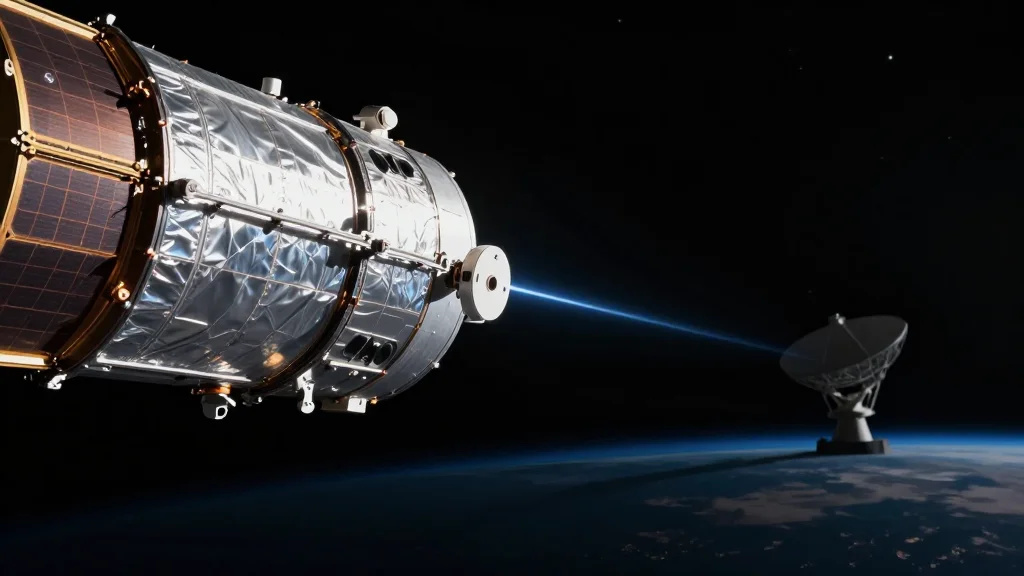
Space Force Picks K2 Space’s Gravitas for $7.3 M Laser‑comm Test in Missile‑defense Push

Why It Matters
The Gravitas laser‑comm test addresses a critical vulnerability in the United States’ missile‑defense architecture: the ability to move massive sensor data streams quickly enough to enable timely intercept decisions. By proving high‑throughput links from MEO, the program could shrink decision cycles from minutes to seconds, dramatically improving the odds of neutralizing advanced ballistic threats. Moreover, the demonstration could catalyze a new market for MEO‑grade optical terminals, expanding commercial opportunities and reducing reliance on legacy radio‑frequency links that are more susceptible to jamming. Beyond the immediate defense implications, the initiative signals a shift toward integrated, data‑centric space systems. As the Pentagon modernizes OPIR capabilities, the need for seamless, secure, and rapid data exchange will drive broader adoption of laser communications across both military and civilian constellations, reshaping the economics of satellite networking and potentially lowering costs for high‑bandwidth services worldwide.
Key Takeaways
- •U.S. Space Force selects K2 Space’s Gravitas satellite for laser‑comm test under SMI.
- •$7.3 million allocated for crosslink demo within a $180 million FY 2027 budget.
- •Gravitas launched March 30; two‑ton, 20 kW power, carries 12 payloads.
- •Tests aim to validate MEO optical links for the Golden Dome missile‑defense network.
- •Success could open a commercial market for MEO laser‑communication terminals.
Pulse Analysis
The decision to fund K2’s MEO laser‑comm experiment reflects a strategic pivot from legacy RF architectures toward optical networking, a trend that has already transformed commercial LEO constellations. Historically, missile‑defense systems have suffered from data bottlenecks; the latency between sensor detection and interceptor launch can be the difference between a successful defense and a missed shot. By moving the data path into the optical domain, the Space Force not only gains bandwidth but also benefits from the inherent resistance of laser links to electronic interference, a crucial advantage against sophisticated adversary jamming.
From a market perspective, the $7.3 million earmark is modest compared with the overall SMI budget, but it serves as a proof‑of‑concept that could unlock larger contracts. If K2 demonstrates reliable MEO crosslinks, the Pentagon may issue follow‑on solicitations for a fleet of laser‑enabled satellites, creating a supply chain for high‑power optical terminals, precision pointing mechanisms, and radiation‑hardened components. Commercial players, already eyeing the lucrative LEO market, could diversify into MEO services, offering high‑throughput links for Earth‑observation data, broadband backhaul, and even deep‑space telemetry.
Strategically, the test underscores the growing convergence of defense and commercial space sectors. The Pentagon’s reliance on a private‑sector firm to pioneer a capability that has yet to be fielded in MEO suggests a willingness to outsource high‑risk R&D, leveraging commercial agility while retaining oversight. Should the demonstration succeed, it will likely accelerate the timeline for the Golden Dome architecture, positioning the United States with a more resilient, near‑real‑time missile‑warning network that can counter emerging hypersonic threats. Conversely, any technical setbacks could delay the integration of optical links, forcing the service to fall back on incremental upgrades to existing RF systems. The outcome will therefore shape both the defense posture and the commercial satellite communications market for years to come.
Space Force picks K2 Space’s Gravitas for $7.3 M laser‑comm test in missile‑defense push
Comments
Want to join the conversation?
Loading comments...