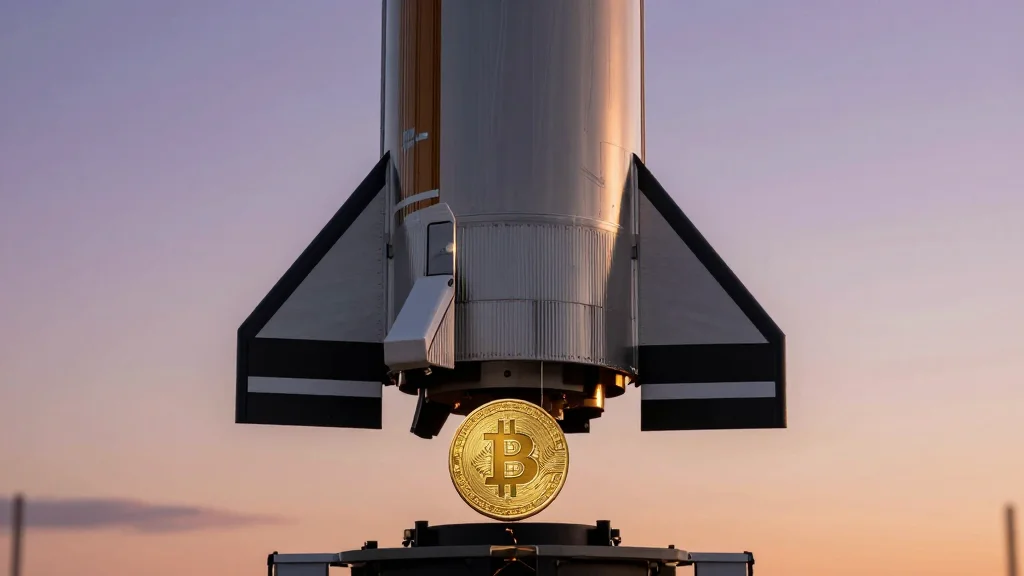
SpaceX Holds $637 Million in Bitcoin Ahead of $75 Billion IPO

Companies Mentioned

Why It Matters
SpaceX’s Bitcoin holding highlights a growing trend of non‑traditional assets entering the balance sheets of capital‑intensive industries. For aerospace firms, which often require billions of dollars for R&D, launch infrastructure, and satellite constellations, a crypto reserve can provide liquidity flexibility and a hedge against currency fluctuations. However, it also introduces price volatility that could affect investor sentiment, especially among defense‑oriented funds that prioritize financial stability. The IPO itself could reshape the aerospace financing landscape. A $75 billion raise would dwarf previous aerospace listings, potentially lowering the cost of capital for future projects across the sector. Competitors may feel pressure to explore alternative funding mechanisms, including private equity, sovereign wealth funds, or even digital‑asset strategies, to keep pace with SpaceX’s aggressive growth plans.
Key Takeaways
- •SpaceX holds 8,285 Bitcoin, valued at about $637 million (Finbold, May 18).
- •IPO targets a $1.75 trillion valuation and a $75 billion capital raise.
- •Bitcoin position is the fourth‑largest among private companies, trailing Block.one, Tether Holdings, and Stone Ridge.
- •The crypto stash has generated an unrealized profit of over $360 million since 2022.
- •IPO filing expected May 20; roadshow week of June 8; Nasdaq debut set for June 12, 2026.
Pulse Analysis
SpaceX’s decision to retain a $637 million Bitcoin position ahead of its historic IPO reflects Elon Musk’s broader philosophy of integrating high‑risk, high‑reward assets across his business empire. While the aerospace sector traditionally relies on government contracts and institutional investors, SpaceX is courting a new breed of capital that includes crypto‑savvy investors and retail participants drawn to the speculative upside of digital currencies. This hybrid financing model could lower the effective cost of capital if the Bitcoin appreciation offsets equity dilution, but it also adds a layer of market‑driven volatility that could complicate valuation models.
Historically, aerospace IPOs have been modest in size—think Boeing’s 1962 public offering or Lockheed Martin’s 1995 listing—because of the sector’s long development cycles and heavy regulatory oversight. SpaceX’s $75 billion raise, if achieved, would set a new benchmark, potentially encouraging other private launch providers to consider public markets as a viable path to scale. However, the success of this approach hinges on the company’s ability to manage the dual narrative of rocket innovation and crypto exposure. A misstep in either arena—such as a launch failure or a sharp Bitcoin correction—could reverberate across the offering, testing investor tolerance for blended risk.
Looking ahead, the market will watch how SpaceX integrates its crypto assets into its broader financial strategy. If the IPO proceeds smoothly and the Bitcoin holding remains a net positive, we may see a wave of aerospace firms experimenting with alternative assets, from tokenized satellite capacity to blockchain‑based supply‑chain financing. Conversely, a rocky debut could reinforce the sector’s preference for traditional, low‑volatility funding sources. Either outcome will have lasting implications for how capital is raised and allocated in the next generation of space exploration.
SpaceX Holds $637 Million in Bitcoin Ahead of $75 Billion IPO
Comments
Want to join the conversation?
Loading comments...