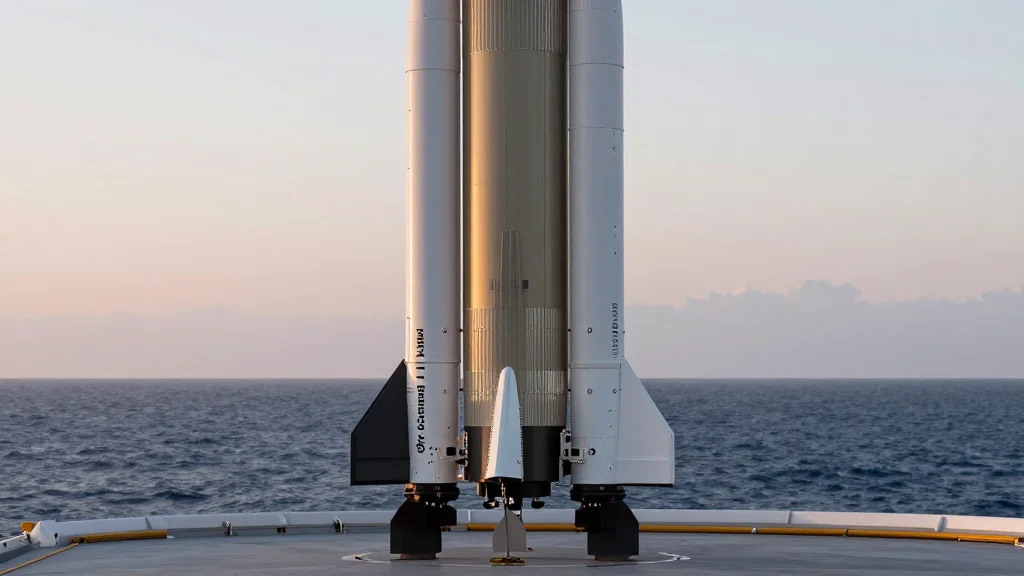
SpaceX Marks 600th Rocket Landing on Falcon 9 During Starlink Launch

Companies Mentioned

Why It Matters
The 600th successful booster recovery demonstrates that reusable launch technology has moved from experimental to operational at scale. Each landing saves an estimated $30‑$40 million in manufacturing and refurbishment costs, directly lowering launch prices for customers and expanding access to space for a wider range of missions. This cost compression is a key driver behind the rapid growth of satellite constellations, broadband services, and emerging low‑Earth‑orbit applications such as Earth observation and in‑space manufacturing. Beyond economics, the milestone signals a shift in industry standards. Competitors are now compelled to accelerate their own reusability programs or risk losing market share. Moreover, the sheer volume of Starlink satellites underscores the need for robust space traffic management frameworks, as the orbital environment becomes increasingly congested. The interplay between cost‑driven launch frequency and orbital safety will shape regulatory and technical developments in the aerospace sector for years to come.
Key Takeaways
- •SpaceX completed its 600th successful orbital‑class booster landing on the droneship "Of Course I Still Love You".
- •The Falcon 9 launch deployed 25 new Starlink satellites, bringing the constellation to over 10,275 units.
- •Booster B1097 performed its landing maneuver eight minutes after liftoff from Vandenberg Space Force Base.
- •Reusable launch technology is estimated to save $30‑$40 million per flight compared with expendable rockets.
- •The milestone intensifies competition in the launch market and raises orbital safety concerns as constellations expand.
Pulse Analysis
SpaceX’s 600th landing is more than a headline; it validates a business model that hinges on rapid, low‑cost turnarounds. Historically, the aerospace industry has struggled with high launch costs that limited market entry to a handful of well‑funded players. By proving that a single booster can be recovered and reflown hundreds of times, SpaceX has effectively rewritten the cost curve for access to space. This has a cascading effect: satellite operators can launch larger constellations at lower unit costs, which in turn fuels demand for even more launches, creating a virtuous cycle that entrenches SpaceX’s market dominance.
The competitive response will be critical. United Launch Alliance’s upcoming Vulcan rocket incorporates partial reusability, but its first flight is still months away. Meanwhile, European and Chinese launch providers are accelerating their own reusable designs. If they can match SpaceX’s turnaround times and price points, the monopoly on low‑cost launches could erode. However, SpaceX’s extensive operational data, a growing fleet of recovered boosters, and a vertically integrated supply chain give it a formidable lead that will be hard to close quickly.
Looking forward, the real test will be how SpaceX scales this model to its next‑generation Starship system, which promises full‑stage recovery and payload capacities an order of magnitude larger than Falcon 9. Success there could democratize deep‑space missions, lunar landings, and even Mars colonization efforts. Until then, the 600th landing serves as a benchmark for the reusable era, setting expectations for reliability, cost, and launch cadence that will shape aerospace strategy across the globe.
SpaceX Marks 600th Rocket Landing on Falcon 9 During Starlink Launch
Comments
Want to join the conversation?
Loading comments...