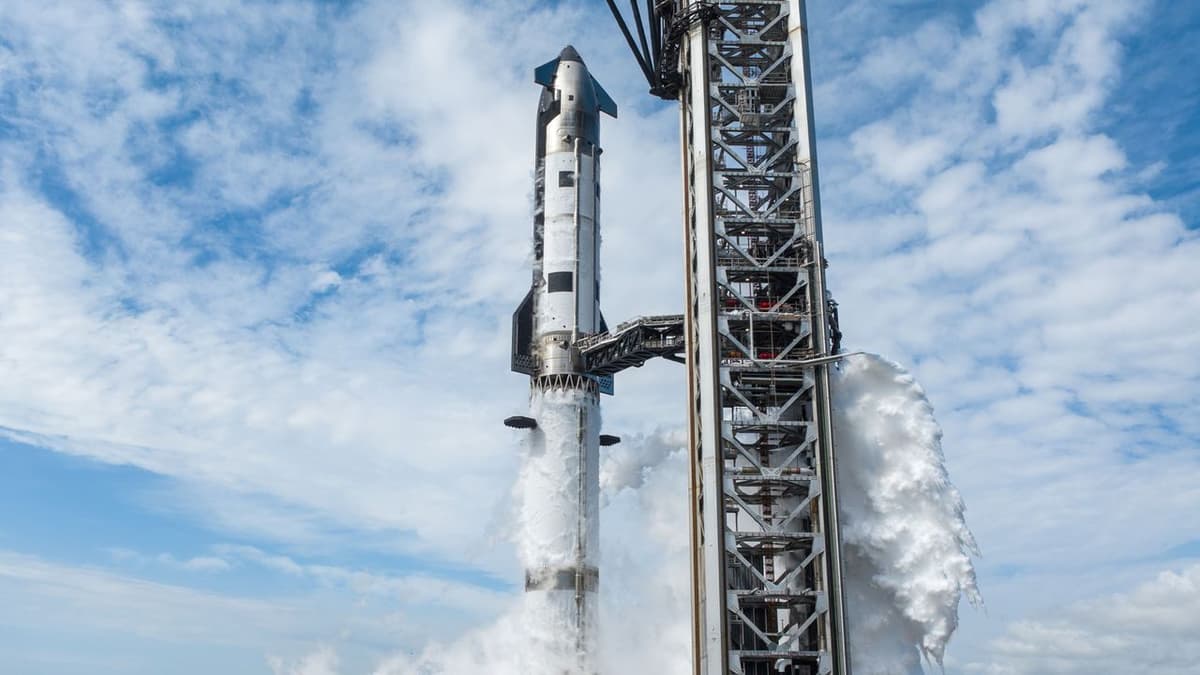
SpaceX Prepares to Launch Next-Generation Starship, the Tallest and Most Powerful Rocket Ever Built
Companies Mentioned


Why It Matters
A successful V3 flight would validate the design upgrades needed for rapid reuse and in‑space propellant transfer, positioning SpaceX as the leading commercial provider for NASA’s 2028 lunar landing.
Key Takeaways
- •Starship V3 stands 407 ft, 85 ft taller than SLS.
- •New Raptor 3 engines increase thrust and enable simultaneous ignition.
- •Test will release 22 Starlink simulator satellites and relight engine.
- •Super Heavy booster aims for Gulf of Mexico water landing.
- •Success advances NASA’s Artemis IV lunar‑lander selection.
Pulse Analysis
SpaceX’s Starship V3 marks a watershed in launch‑vehicle engineering, dwarfing NASA’s Space Launch System by roughly 85 feet and consolidating the company’s claim to the title of the world’s most powerful rocket. The vehicle’s 407‑foot stack integrates a fully reusable Super Heavy booster with a Starship spacecraft, embodying Elon Musk’s vision of rapid, low‑cost access to orbit. After a series of mixed results from earlier prototypes—ranging from fiery debris to a successful 10th flight—V3 represents the first fully redesigned iteration, positioning SpaceX to dominate both satellite deployment and deep‑space missions.
The V3 upgrade centers on the new Raptor 3 engine family, which delivers higher thrust and permits all 33 booster engines to ignite simultaneously via a redesigned fuel‑transfer system. Additional grid fins improve aerodynamic stability during the booster’s flip‑over maneuver, while a larger fuel tank and revamped reaction‑control system give the spacecraft finer steering authority. The test flight will separate the booster for a water landing in the Gulf of Mexico, release 22 Starlink simulator payloads, and conduct an in‑space engine relight—a critical step toward demonstrating reliable in‑orbit refueling and rapid turnaround.
For NASA, a flawless V3 flight could tip the balance in the Artemis IV commercial‑lander competition, where SpaceX’s lunar‑variant of Starship competes against Blue Origin’s Blue Moon. The mission’s success would validate the vehicle’s ability to perform in‑space propellant transfer and rapid reuse, both essential for sustainable lunar logistics and eventual Mars missions. Moreover, the test underscores a broader industry shift toward fully reusable launch systems, promising lower launch costs and accelerated cadence for satellite constellations, scientific payloads, and crewed deep‑space exploration.
SpaceX prepares to launch next-generation Starship, the tallest and most powerful rocket ever built
Comments
Want to join the conversation?
Loading comments...