Airbus

Helsing
The capability lets commanders field swarms that amplify combat mass while freeing pilots to focus on high‑level decision‑making, accelerating the OODA loop across contested airspaces. It also gives European forces a sovereign, rapidly upgradable digital backbone, reducing reliance on non‑European tech.
The Mindshare demonstration marks a watershed moment for AI‑enabled air operations, showing that uncrewed aerial vehicles can coordinate complex missions without continuous human control. By leveraging real‑time data sharing and adaptive threat assessment, the system transforms drones from isolated tools into collaborative teammates that extend a pilot’s situational awareness and strike capacity. This shift not only reduces cognitive load for aircrew but also creates a scalable "combat mass" that can overwhelm sophisticated air‑defence networks, a capability already evident in high‑intensity conflicts.
Underlying this operational leap is Airbus’s software‑defined defence philosophy, which decouples mission logic from airframe lifecycles. The MARS (Multiplatform Autonomous Reconfigurable and Secure) computing architecture provides an open, standards‑based foundation that can host Mindshare, Crossbond communications, and future AI modules across platforms ranging from Eurofighters to tanker aircraft. Because updates are delivered as software patches, capabilities can evolve in weeks rather than years, ensuring that European forces stay ahead of rapidly changing threat spectra. This modularity also simplifies integration with third‑party sensors and weapons, fostering an ecosystem where hardware and software evolve in tandem.
Strategically, the initiative bolsters Europe’s drive for defence sovereignty. By retaining full control over mission‑critical code and data, European air forces diminish dependence on external digital supply chains, a critical advantage amid geopolitical tensions. The open‑system approach also positions Airbus as a system‑of‑systems integrator, attracting partners across the continent and creating a market for interoperable, AI‑driven combat solutions. As nations seek to field resilient, multi‑domain forces, the Mindshare‑MARS‑Crossbond stack offers a replicable blueprint for next‑generation air power that can be exported to allies while preserving indigenous technological advantage.
In October 2024, the skies over a European test range witnessed a landmark step in the evolution of air power. During an AI‑supported joint surveillance mission, two uncrewed aerial vehicles (UAV) executed a complex, synchronised flight pattern that moved with the real‑time precision of collective intelligence rather than pre‑programmed routines.
Airbus Defence and Space’s AI‑enriched mission autonomy software, Mindshare, enabled the UAVs manufactured by the Czech company Primoco to collaborate seamlessly and autonomously. Operating in tandem, they demonstrated advanced threat detection and real‑time data exchange. This mission required only human supervision, shifting away from the traditional model of constant remote control and the restrictive one‑operator‑to‑one‑drone relationship.
Mindshare orchestrates crewed and uncrewed platforms in real time, enabling dynamic mission reconfiguration while decoupling software development cycles from platform development. These capabilities are no longer laboratory experiments but vital operational requirements. In fact, this teaming intelligence will soon be in operational deployment, providing the autonomous “glue” that allows crewed and uncrewed platforms to operate as a single, unified force.
In 2024, Airbus successfully demonstrated how its advanced teaming Intelligence software can autonomously and dynamically manage a group of uncrewed aerial vehicles in real time. This was achieved through flight tests conducted in collaboration with two partners: using Primoco UAVs and incorporating an application from the German company Helsing.
For modern air‑force commanders and pilots, the arrival of collaborative combat fundamentally changes the nature of the mission. Humans alone cannot manage the complexity of contested electromagnetic environments, drone swarms, additional decision‑making cycles and multi‑domain coordination without advanced digital support.
The operational advantage of collaborative combat is twofold:
For pilots: The human role shifts from direct aircraft control to high‑level orchestration. By delegating high‑risk or high‑burden tasks – such as forward sensing, electronic warfare or saturation attacks – to uncrewed teammates, pilots reduce their cognitive load and physical risk while maintaining strategic and ethical oversight.
For commanders: Collaborative systems provide “combat mass” – the ability to overwhelm adversary defences through sheer numbers of uncrewed systems. This shift has been clearly demonstrated in Ukraine, where millions of drones are now deployed annually. They create a more resilient force mix, providing commanders with new tactics to penetrate dense air defence where crewed aircraft cannot safely venture.
Today’s platforms are often technologically advanced but digitally fragmented. They have slow upgrade cycles and poor integration across domains and vendors. Airbus is addressing this by shifting towards a software‑defined defence paradigm that prioritises adaptable, software‑based systems over hardware‑focused platforms. This approach enables rapid updates to military technology, enhanced interoperability and AI‑driven, multi‑domain operations.
“We are moving from platform‑centric development to software‑centric capabilities,” explains Robert van Tilborg, Head of Business Development and Portfolio Management for Future Air Power at Airbus Defence and Space. “By decoupling software from hardware lifecycles, we can upgrade operational capabilities in months, weeks, or even days rather than decades.”
This approach enables air forces to adapt to emerging threats at “software speed,” ensuring that a platform’s mission logic, data processing, and autonomy functions can be updated as quickly as the adversary evolves, explains van Tilborg. “Future combat aircraft will act as nodes and decision makers in a distributed combat network – processing, sharing, and exploiting data in real time and collaborative manner,” he says.
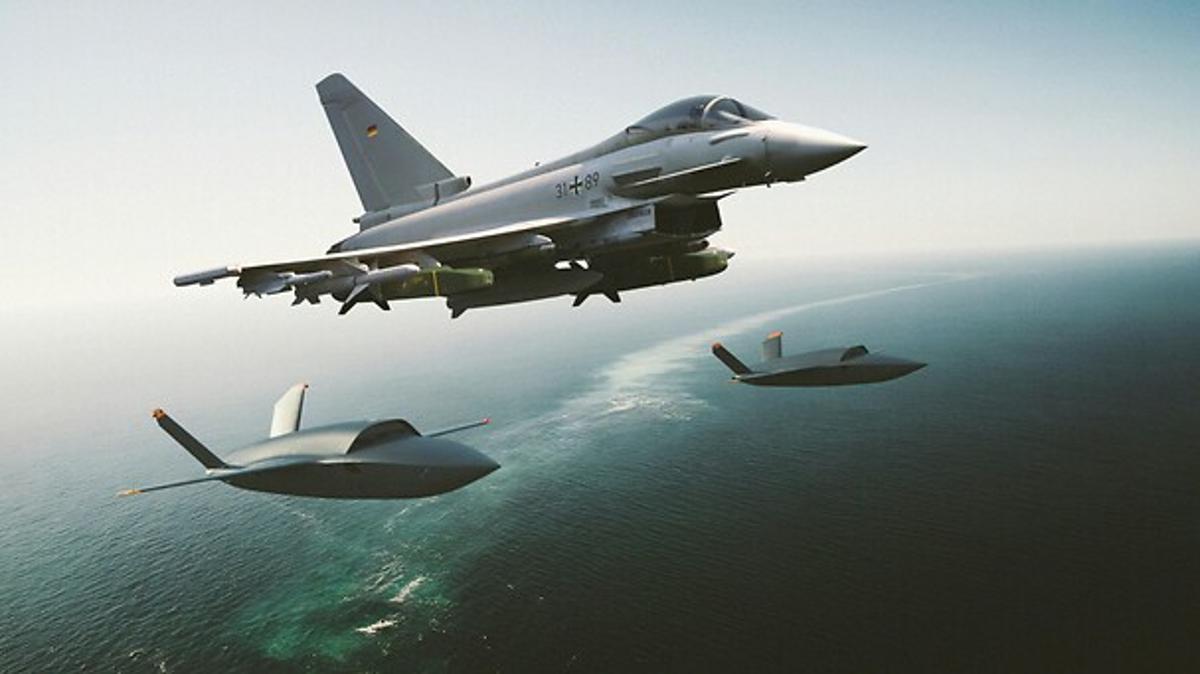
Airbus Defence and Space is developing an open mission system to enable collaborative operations between German Air Force Eurofighters and Uncrewed Collaborative Combat Aircraft (UCCA), starting with a proven UAS platform provided by Kratos. © Kratos 2025
To describe this connectivity ecosystem for collaborative combat, Airbus experts often use a biological analogy:
The brain (Mindshare): Provides the mission autonomy and teaming logic, enabling mission orchestration for multi‑domain operations. This accelerates the OODA loop (Observe, Orient, Decide, Act) in order to outpace adversaries. Mindshare is a standalone product, but it will also be integrated with MARS.
The body (MARS): The onboard computing architecture (Airbus Multiplatform Autonomous Reconfigurable and Secure – MARS) built on open standards, allowing crewed platforms such as Eurofighter to integrate seamlessly with uncrewed collaborative combat aircraft (UCCA) in the near future.
The nervous system (Crossbond): The secure connectivity and interoperability layer that enables airborne platforms to communicate. Airbus is currently testing this indigenous solution on the A330 MRTT tanker, transforming it into a vital communication hub.
“Through the hardware‑agnostic open system architecture approach of MARS, assets from air, sea, land and space domains can be seamlessly integrated into a System of Systems.”
Airbus’ ambition is to play the vital role of System‑of‑Systems integrator within a rapidly evolving technological landscape. The company collaborates closely with defence partners specialising in high‑speed innovation, providing the necessary industrial scale and end‑to‑end solutions to successfully deploy these critical capabilities on the front line.
Beyond technical innovation, these advancements are a fundamental driver for European strategic autonomy. By ensuring full sovereign control over critical technology and data, Airbus’ customers operate within a secure, indigenous framework – effectively eliminating dependence on non‑European digital ecosystems.
“In future air operations, superiority will be determined by the ability to sense, decide and act faster across a network of crewed and uncrewed systems,” van Tilborg concludes. By building this scalable, interoperable ecosystem, Airbus is empowering European nations to be the architects of their own security.
Comments
Want to join the conversation?
Loading comments...