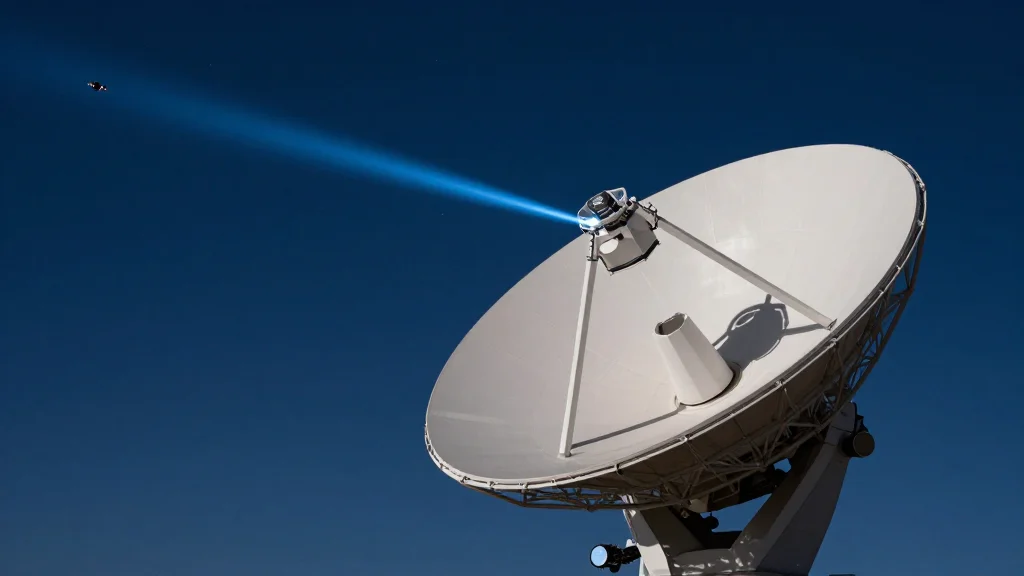
The Deep Space Network Acquires Artemis II Signal
Companies Mentioned

NASA
Why It Matters
The acquisition confirms DSN’s ability to sustain communications with crewed deep‑space vehicles, a critical prerequisite for long‑duration lunar and Martian exploration, and reassures commercial and international partners of reliable infrastructure.
Key Takeaways
- •DSN received Artemis II signal, first crewed deep‑space handoff in 50+ years
- •Handoff occurred after Near Space Network guided Orion post‑launch on April 1, 2026
- •DSN’s three sites (Goldstone, Madrid, Canberra) now track a crewed lunar mission
- •Success bolsters confidence for Artemis III, lunar gateway, and future Mars missions
Pulse Analysis
The Deep Space Network, originally built during the Cold War to track interplanetary probes, has evolved into a cornerstone of NASA’s communications architecture. Its three strategically placed complexes—Goldstone in California, Madrid in Spain, and Canberra in Australia—provide near‑continuous line‑of‑sight to spacecraft beyond low Earth orbit. By integrating advanced Ka‑band antennas and high‑capacity data pipelines, DSN now handles a mix of robotic missions and, increasingly, crewed flights, positioning it as the only global system capable of supporting deep‑space human exploration.
Artemis II’s signal acquisition represents a technical watershed. After launch, the Near Space Network managed the initial phase of Orion’s flight, but the handoff to DSN occurred as the capsule entered deep‑space territory beyond the reach of low‑orbit assets. This transition required precise timing, frequency coordination, and real‑time telemetry validation to ensure uninterrupted command and data flow. The successful reception not only validates the handoff protocol but also demonstrates that DSN’s upgraded receivers can handle the higher data rates and stringent latency demands of crewed missions, a capability that was untested for over half a century.
Looking ahead, the DSN’s proven performance under Artemis II paves the way for more ambitious objectives. Artemis III will rely on DSN for lunar surface communications, while the planned lunar gateway will depend on continuous deep‑space links for navigation and scientific data relay. Moreover, private entities eyeing lunar mining and Mars transport will likely contract DSN services, making its reliability a marketable asset. As NASA charts a path toward sustainable lunar presence and eventual Martian voyages, the Deep Space Network stands as the communication backbone that will keep humanity’s foothold in deep space connected and safe.
The Deep Space Network acquires Artemis II signal
Comments
Want to join the conversation?
Loading comments...