Companies Mentioned
Why It Matters
Without dedicated mitigation, lunar equipment failures will drive up mission costs and limit scientific return, making sustained surface operations economically unviable.
Key Takeaways
- •Lunar dust abrades seals, optics, joints, and radiators
- •Temperature swings from 250 °F to –410 °F cause thermal fatigue
- •Radiation hardening and shielding are essential for lunar electronics
- •Vacuum requires dry lubricants and dust‑tight seals
- •Integrated testing with regolith, thermal‑vacuum, and radiation validates designs
Pulse Analysis
The Moon’s surface presents a perfect storm of hazards that turn everyday hardware into a liability. Fine, angular regolith sticks to surfaces because of static charge, grinding seals, bearings and optics, while the lack of atmosphere produces temperature extremes from over 250 °F in sunlight to below –410 °F in permanent shadow. Those swings induce thermal fatigue, degrade batteries and force radiators to work harder. At the same time, relentless solar wind, cosmic rays and micrometeoroids bombard exposed components, threatening electronics and structural integrity.
Engineers are responding with a suite of specialized mitigations. Dust‑tolerant materials, protective covers, and electrodynamic dust shields use electric fields to repel or lift particles from solar panels, lenses and rover wheels, turning a cleaning problem into a controllable system. Thermal control now relies on high‑emissivity coatings, multilayer insulation and active heaters that keep batteries within operating windows. Radiation‑hardening, shielding and fault‑tolerant software protect processors, while dry lubricants and sealed gearboxes survive vacuum and low‑gravity wear. Each solution adds mass, so trade‑offs are carefully modeled.
Validating these designs demands integrated testing that mimics the Moon’s full environment. Regolith simulants reveal abrasion and adhesion, thermal‑vacuum chambers expose thermal cycling and outgassing, and radiation facilities stress electronic resilience. Because hazards interact—dust on a radiator raises temperature, which accelerates radiation damage—system‑of‑systems thinking is essential. Robust, inspectable hardware reduces the need for costly replacement flights, directly influencing the economics of sustained lunar presence and the scientific return of Artemis and commercial ventures.
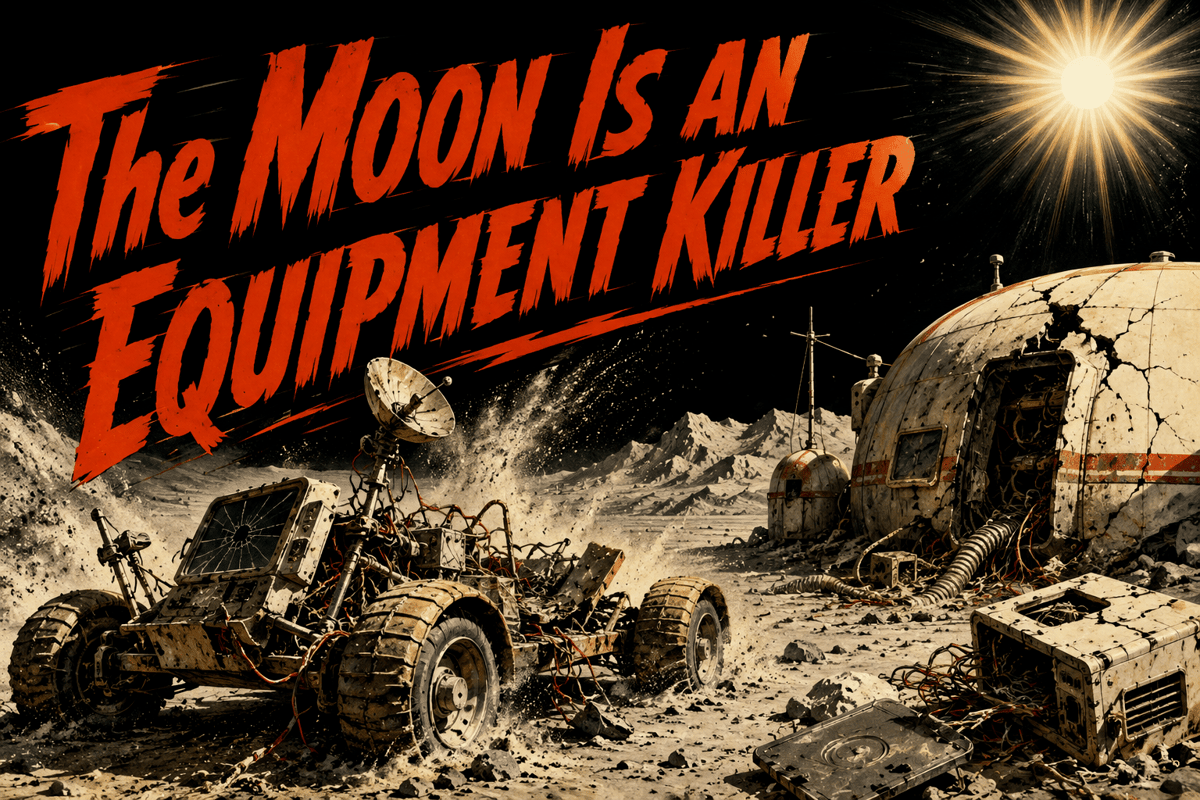
The Moon Is an Equipment Killer
Comments
Want to join the conversation?
Loading comments...