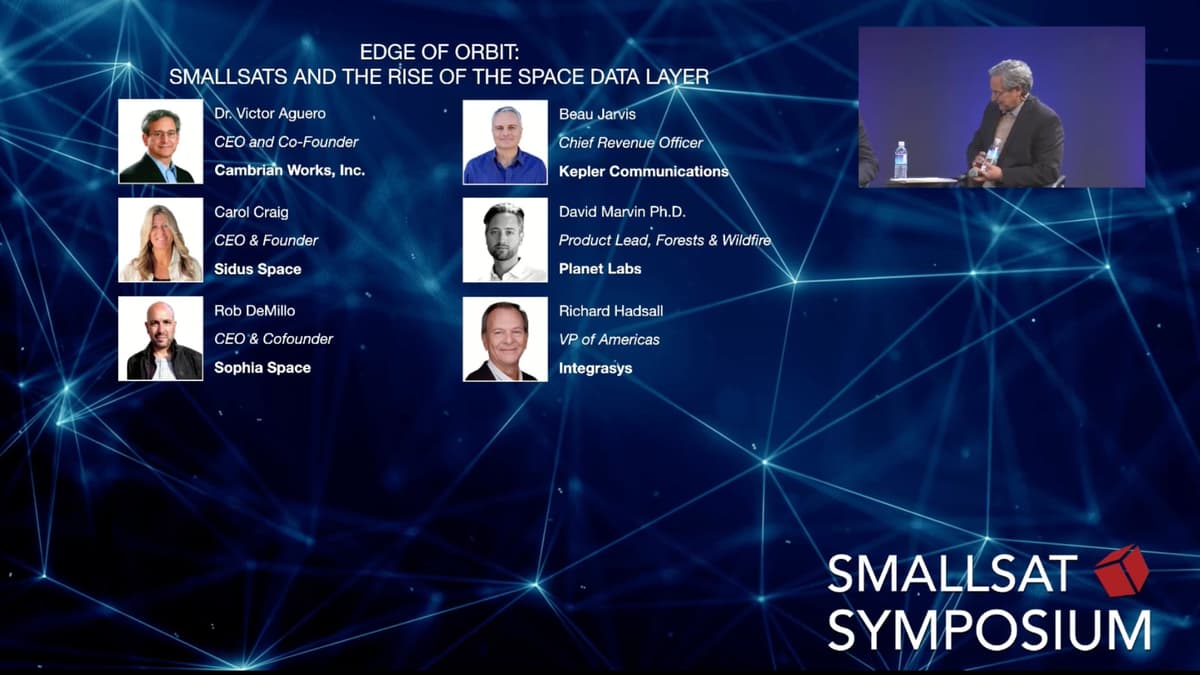
The Space Data Layer – Building an Interoperable Internet in Space
•February 19, 2026
0
Companies Mentioned


Why It Matters
Real‑time, on‑orbit analytics will accelerate decision‑making across industries, while interoperable, secure networks are essential for scaling the burgeoning satellite constellation market.
Key Takeaways
- •Space data layer integrates edge compute, AI, optical links
- •Real‑time satellite data now under one second latency
- •Open standards essential for interoperable multi‑vendor constellations
- •Zero‑trust security required as software‑defined satellites proliferate
- •Full orbital network expected within 3‑10 years
Pulse Analysis
The satellite business is undergoing a paradigm shift that mirrors the evolution of terrestrial IT. After decades of focusing on launch cadence and hardware reliability, operators now prioritize how to turn raw sensor streams into actionable intelligence. The emerging “space data layer” stitches together on‑orbit edge processors, artificial‑intelligence models, and high‑throughput optical links, effectively extending the global network into low‑Earth orbit. By processing imagery or telemetry before it reaches the ground, constellations can deliver sub‑second insights, a capability that reshapes everything from logistics to disaster response.
Interoperability is the linchpin of that vision. Without common protocols, each satellite becomes an isolated island, defeating the purpose of a unified data fabric. Industry leaders are therefore championing “competitive mates” – firms that cooperate on open standards such as the Space Development Agency’s wave‑form specifications and ESA’s cross‑link guidelines. This collaborative approach accelerates the deployment of multi‑vendor constellations and enables use cases like real‑time wildfire mapping, where on‑board analytics transmit only critical fire‑line vectors to first responders within minutes.
Security and spectrum management are the other two pillars that will determine the layer’s viability. As satellites become software‑defined, they inherit the same cyber‑threat surface as data centers, prompting a shift toward zero‑trust architectures that authenticate every inter‑satellite handshake. At the same time, the surge in RF traffic threatens congestion, making optical inter‑satellite links an attractive alternative for high‑bandwidth, low‑latency exchanges. Analysts project that a fully interoperable, secure orbital network could materialize within three to ten years, driven by both commercial demand and government investment in resilient space infrastructure.
The space data layer – Building an interoperable internet in space
0
Comments
Want to join the conversation?
Loading comments...