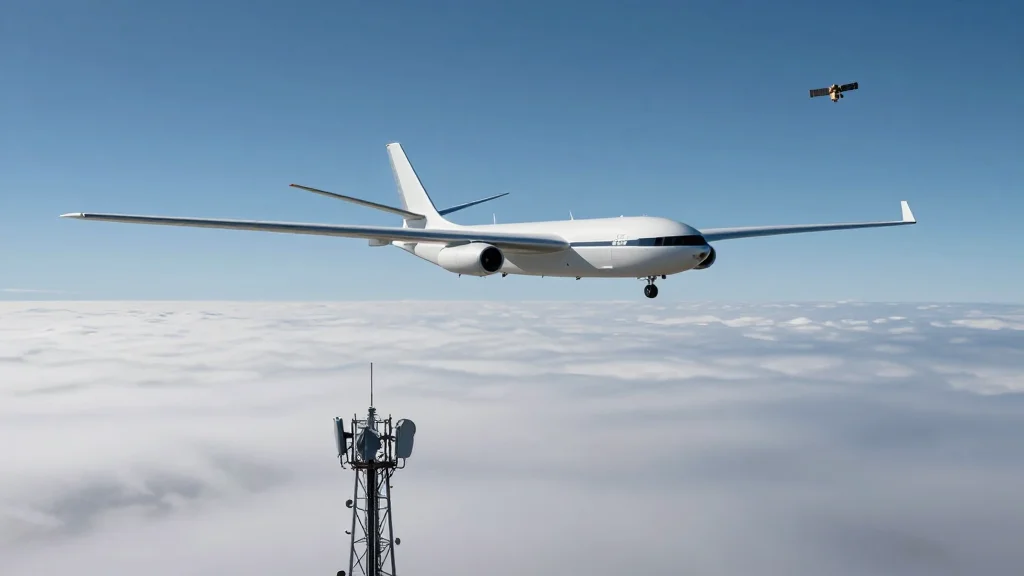
The Stratosphere Race: HAPS Move From Experiment to Commercial Reality
Companies Mentioned

Why It Matters
Providing low‑latency, wide‑area connectivity from the stratosphere can close the global digital divide and give militaries persistent ISR, reshaping telecom and defense markets.
Key Takeaways
- •Aalto's Zephyr logged 67 days aloft, targeting 200‑day missions.
- •Zephyr can replace ~250 ground towers with 5‑10 ms latency.
- •Sceye's SE2 airship demonstrated 12‑day endurance and 500‑tower coverage.
- •Japan’s SoftBank will test SceyeCell 4G/5G node delivering >3.5 Gbps.
- •Defense interest rises as HAPS offer low‑latency ISR and soldier connectivity.
Pulse Analysis
The stratosphere is emerging as a new communications layer that blends the persistence of ground towers with the coverage of satellites. Fixed‑wing HAPS such as Aalto’s Zephyr and Prismatic’s Phasa‑35 exploit solar panels and high‑energy lithium‑ion or lithium‑sulfur batteries to stay aloft for weeks, while air‑ship concepts like Sceye’s SE2 use helium buoyancy to extend endurance without the weight penalties of large wing spans. By operating above commercial air traffic yet below low‑Earth‑orbit, these platforms avoid most atmospheric turbulence and can deliver sub‑10 ms latency, a sweet spot for real‑time applications.
Commercial interest has accelerated dramatically. Japanese operators, led by SoftBank, have pledged $100 million to Aalto and are funding Sceye’s upcoming test flight that will showcase a 4G/5G node capable of more than 3.5 Gbps and coverage equivalent to 500 terrestrial towers. In Indonesia, Telkomsel and Mitradel are evaluating Zephyr‑based broadband for remote islands, while the U.S. Air Force Research Laboratory has awarded a $10 million contract to Prismatic for surveillance missions. The combined market for stratospheric connectivity and Earth‑observation services is projected to exceed $15 billion by 2030, driven by disaster‑response needs and the push for 6G infrastructure.
Beyond civilian broadband, defense planners see HAPS as a force multiplier. Persistent ISR, synthetic‑aperture radar and low‑latency command links can be beamed directly to soldiers, a capability highlighted by recent interest from Ukraine and NATO allies. The dual‑approach of lightweight fixed‑wing aircraft and heavier airships creates a competitive ecosystem that will spur rapid cost reductions and regulatory clarity. As satellite constellations densify, the stratospheric layer will likely become the preferred node for edge computing, autonomous‑vehicle data streams, and global IoT, cementing HAPS as a cornerstone of next‑generation connectivity.
The Stratosphere Race: HAPS Move from Experiment to Commercial Reality
Comments
Want to join the conversation?
Loading comments...