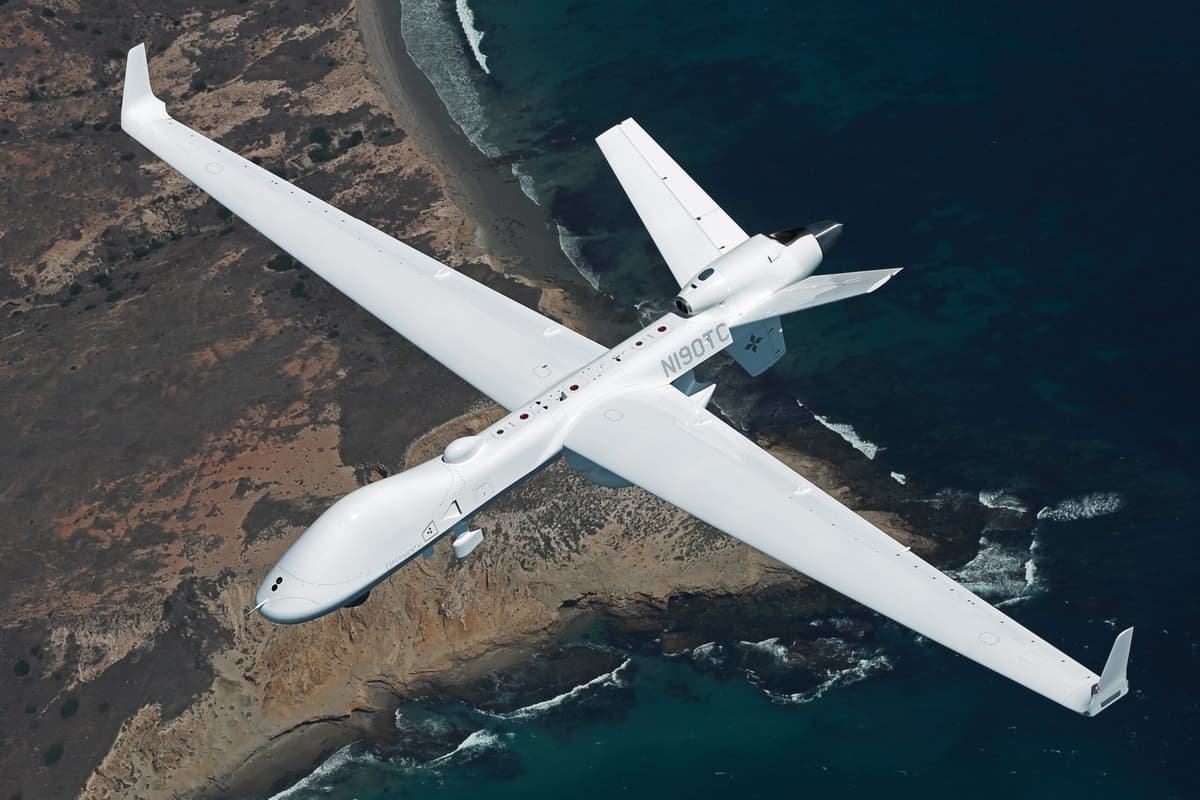
The pairing of MQ‑9B and Gambit platforms gives nations affordable, survivable airpower to counter contested airspace and secure maritime interests, accelerating the shift toward unmanned dominance.
The 2024 Israel‑Iran clash marked the first sustained state‑on‑state drone war, proving that persistent intelligence, surveillance and reconnaissance (ISR) can dictate the tempo of modern conflict. Iran’s swarm tactics forced Israel to rely on layered air defenses and long‑range strikes supported by high‑performance uncrewed platforms. Observers worldwide concluded that survivable, multi‑mission UAS are no longer optional but essential for any nation seeking to protect critical infrastructure and project power. This realization has accelerated procurement cycles across the Gulf, where contested airspace and maritime chokepoints demand constant situational awareness.
General Atomics’ MQ‑9B SkyGuardian and its maritime counterpart, the SeaGuardian, answer that demand with a turboprop airframe capable of 40‑hour endurance, certified airworthiness and interoperable C4ISR suites. The platform’s payload flexibility supports synthetic‑aperture radar, electro‑optical sensors and precision‑guided munitions, enabling both border surveillance and standoff strike from a single asset. Recent sales to Qatar, Japan, Canada and Poland illustrate its global appeal, while the SeaGuardian’s 360‑degree radar and anti‑piracy toolkit make it a cornerstone for Exclusive Economic Zone (EEZ) defense in the Persian Gulf.
The Gambit Series extends the GA‑ASI portfolio into semi‑autonomous combat, leveraging a common core to deliver variants ranging from ISR‑focused Gambit 1 to carrier‑capable Gambit 5 and electronic‑warfare‑ready Gambit 6. Modularity reduces development costs and shortens production timelines, a critical advantage for nations racing to fill capability gaps. By pairing Gambit’s strike and air‑to‑air functions with the MQ‑9B’s endurance, regional air forces can field a layered, cost‑effective force structure that challenges traditional manned fleets. GA‑ASI’s vertically integrated supply chain further ensures rapid scaling, positioning the company as a pivotal supplier in the emerging era of unmanned air dominance.
Recent conflicts have crystalized this truth for nations around the world: Uncrewed Aerial Systems (UAS) have transformed modern warfare.
The 2024 Israel-Iran war, the first sustained state-on-state drone conflict in the Middle East, showcased the strategic necessity of persistent Intelligence, Surveillance, and Reconnaissance (ISR) as well as precision targeting. Iran employed swarms of drones and cruise missiles to attack critical infrastructure, while Israel countered with layered air defenses and long-range strikes supported by advanced UAS platforms.
This shift in warfare has forced nations to reassess their airpower strategies and prioritize survivable multi-mission systems.
For nations like Saudi Arabia, the UAE, and Qatar, the capabilities resident in the MQ-9B SkyGuardian® and SeaGuardian®, produced by General Atomics Aeronautical Systems, Inc. (GA-ASI), are critical for ensuring persistent border surveillance, maritime domain awareness, and deterrence.
At the same time, the Middle East faces growing threats from contested airspace. This dynamic has created demand for survivable semi-autonomous uncrewed platforms that can complement ISR-focused systems like the MQ-9B. Meanwhile, GA-ASI’s Gambit Series, designed for collaborative combat operations, offers a modular solution to extend the strike capacity and survivability of air elements in high-threat environments.
The MQ-9B and Gambit Series represent parallel capabilities that address regional challenges head-on. MQ-9B, a long-endurance turboprop, is ideal for its ISR mission set, while the Gambit Series aircraft are high-performing jet fighters.
More specifically, MQ-9B provides persistent ISR and standoff precision targeting, while Gambit aircraft act as force multipliers, delivering specialized capabilities such as stealth reconnaissance and air-to-air combat.
Together, they form a scalable solution for nations seeking to dominate the modern battlespace. As regional security priorities shift, GA-ASI is uniquely positioned to deliver solutions at the pace of emerging threats. And with a robust vertically integrated manufacturing infrastructure and proven operational platforms, the company is well on its way to helping Middle Eastern nations and their allies transition to next-generation airpower.
The Global Gold Standard in ISR
Designed for long endurance and multi-mission flexibility, the MQ-9B offers certified airworthiness and interoperable C4ISR systems that integrate seamlessly into coalition operations.
Its adaptability for evolving threats has already attracted nations as diverse and far-flung as Japan, Canada, Poland, India, and Germany. Last year, Qatar announced it was seeking to buy eight of the aircraft.
The SeaGuardian variant further enhances maritime security, addressing critical priorities such as anti-piracy, Exclusive Economic Zone (EEZ) defense, and naval interoperability. Equipped with a 360-degree maritime radar, the SeaGuardian provides nations with the tools to safeguard their maritime infrastructure in increasingly contested environments.
These features make the MQ-9B family an indispensable asset for nations seeking to balance affordability, scalability, and operational effectiveness.
Force Multiplier
Complementing the MQ-9B is GA-ASI’s Gambit Series, a modular semi-autonomous platform engineered for collaborative combat operations.
Gambit aircraft are designed to extend the strike capacity and survivability of air wings in high-threat environments. Built around a common core platform, Gambit variants share essential hardware such as the landing gear, avionics, and chassis, reducing costs and accelerating production.

Gambit 6, the latest variant in GA-ASI’s Gambit Series, delivers advanced precision-strike capabilities for air-to-ground missions.
Specialized configurations tailored for missions ranging from ISR and air-to-air combat to stealth reconnaissance and electronic warfare make the Gambit Series highly adaptable to diverse operational needs.
Gambit Variants:
Gambit 1:
Optimized for long-endurance ISR missions
Features high-aspect wings and a fuel-efficient engine for extended patrols
Ideal for early warning and surveillance in contested airspace
Gambit 2:
Equipped with air-to-air weapons for engaging hostile aircraft
Prioritizes combat capability over endurance
Enhances the ability to hold advanced threats at risk
Gambit 3:
Designed for adversary air roles in training scenarios
Supports sorties against integrated air defense systems and fifth-generation assets
Reduces operational costs for training warfighters
Gambit 4:
A stealth combat reconnaissance model with a tail-less design and swept wings
Focused on specialized missions in contested environments
Combines stealth and endurance for high-risk operations
Gambit 5:
Developed for carrier-based operations, expanding the series to naval environments
Features enhanced durability and a compact design for maritime missions
Gambit 6:
Expanded air-to-ground capabilities
Designed for roles such as electronic warfare, suppression of enemy air defenses, and deep precision strike
The Gambit Series reflects GA-ASI’s commitment to delivering cost-effective capabilities that enhance survivability and operational efficiency. By leveraging modularity and advanced autonomy, Gambit aircraft offer tailored solutions for the most demanding missions.
The synergy across the company’s suite of weapons platforms provides Middle Eastern nations with a clear path to air dominance, ensuring readiness to confront both immediate and long-term security challenges. And GA-ASI’s vertical integration enables rapid delivery of these solutions both at scale and at speed.
As regional priorities shift, GA-ASI’s MQ-9B and Gambit Series offer a reliable and innovative means for nations in the Middle East and beyond to seamlessly transition to next-generation airpower.
Comments
Want to join the conversation?
Loading comments...