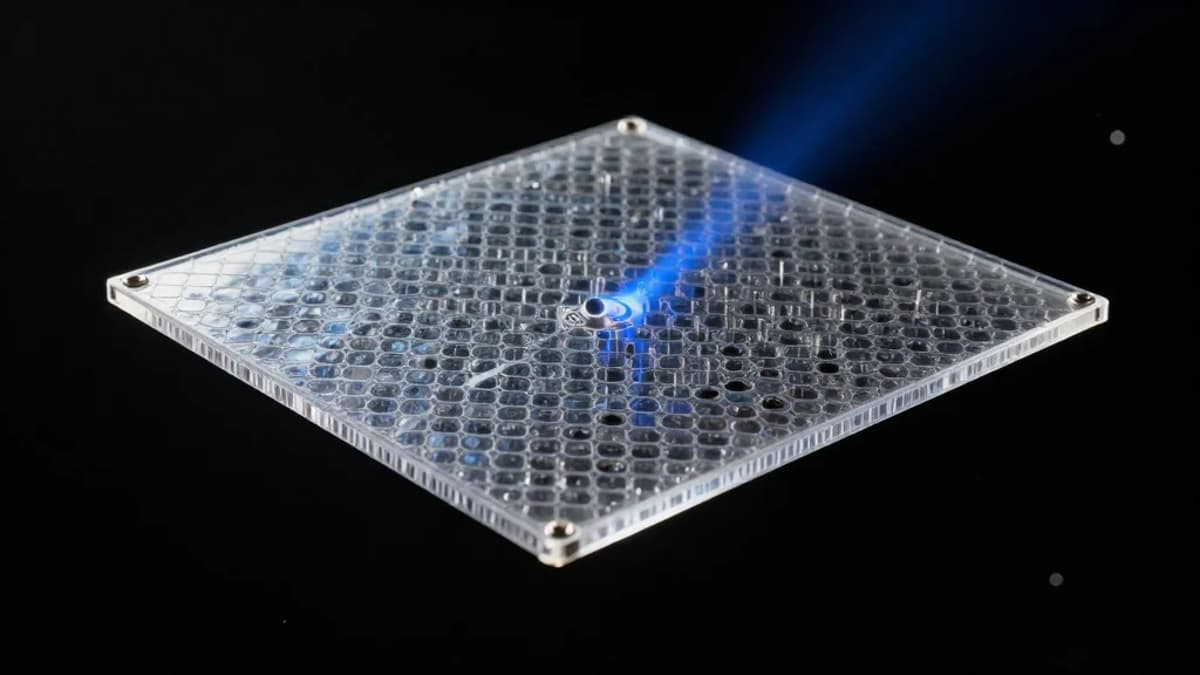
Toward Practical Laser-Driven Light Sails Using Photonic Crystals
•March 5, 2026
0
Why It Matters
The breakthrough shows a scalable, low‑mass method to convert laser power into thrust, potentially reducing reliance on chemical rockets for deep‑space probes. By improving reflectivity without added weight, photonic‑crystal sails could accelerate the adoption of laser‑driven propulsion.
Key Takeaways
- •Three‑dielectric photonic crystal achieves 90% reflectivity at 1.2 µm
- •Fabricated via electron‑beam lithography with sub‑200 nm features
- •1 m² sail under 100 kW laser reaches hundreds m/s in hour
- •Narrow band gap stays transparent to ambient solar light
- •Scalable design could power lightweight interplanetary probes
Pulse Analysis
Laser‑propelled light sails have long promised propulsion without onboard fuel, but conventional metal‑coated films suffer from a trade‑off between reflectivity and mass. Absorbed laser energy heats the sail, demanding thicker coatings that add weight and diminish acceleration. Recent advances in nanophotonics provide a way around this dilemma by engineering materials that manipulate light at sub‑wavelength scales. Photonic crystals, with their periodic dielectric structures, can create band gaps that reflect specific wavelengths while allowing others to pass, offering a path to highly selective, low‑mass reflectors for space applications.
The team led by Dimitar Dimitrov introduced a three‑dielectric photonic‑crystal light sail that integrates germanium pillars, air voids, and a polymer matrix into a 200‑nm‑thick membrane. Using plane‑wave expansion and finite‑difference time‑domain simulations, they tuned a narrow band gap centered at 1.2 µm, achieving roughly 90 % reflectivity at the propulsion laser line. Electron‑beam lithography enabled precise patterning of 100‑nm pillars and 400‑nm holes, confirming the design’s manufacturability. Simulated thrust from a 100‑kW laser on a one‑square‑metre sail suggests acceleration to several hundred meters per second within an hour, a performance level suitable for rapid interplanetary probes.
While still far from the velocities required for interstellar travel, this architecture demonstrates a scalable route to laser‑driven propulsion that could complement or replace chemical rockets for certain missions. The ability to remain transparent to solar radiation reduces thermal load, extending sail lifespan and simplifying thermal management. Commercial interest in high‑power ground‑based lasers and small satellite constellations may accelerate development, but challenges remain in large‑area fabrication, beam‑pointing precision, and integration with spacecraft systems. Continued research could unlock cost‑effective, propellant‑free missions across the inner solar system.
Toward practical laser-driven light sails using photonic crystals
0
Comments
Want to join the conversation?
Loading comments...