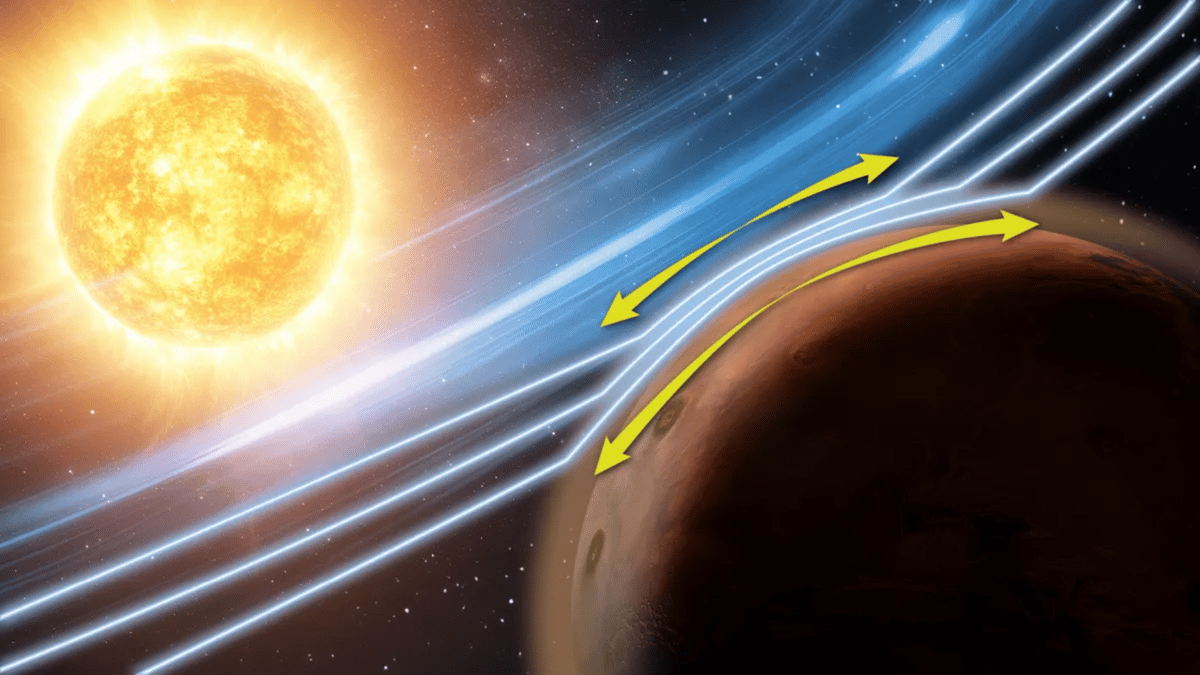
'Very Interesting Wiggles' In Data From Silent NASA Mars Spacecraft Lead to Unexpected Solar Wind Discovery
Why It Matters
The discovery reveals a new mechanism by which solar wind interacts with atmospheres lacking global magnetic fields, reshaping models of space weather for Mars and similar bodies. It also underscores the scientific value of MAVEN’s legacy data despite the spacecraft’s current silence.
Key Takeaways
- •MAVEN detected Zwan‑Wolf effect in Mars' upper atmosphere
- •Effect observed during December 2023 solar storm
- •Phenomenon may operate continuously but usually below detection
- •Discovery reshapes understanding of space weather on unmagnetized worlds
- •MAVEN remains silent; NASA conducts anomaly review
Pulse Analysis
The MAVEN mission, launched in 2013, has been the cornerstone of Mars atmospheric research, delivering continuous measurements of ionospheric composition, solar wind interaction, and volatile loss. Even after the spacecraft fell silent during a planned communications pause in December 2025, its archived data proved fertile ground for fresh insights. By revisiting measurements taken during a December 2023 solar storm, researchers uncovered subtle, periodic fluctuations—dubbed "wiggles"—that match the signature of the Zwan‑Wolf effect, a magnetic deflection process first documented around Earth’s robust magnetosphere.
The Zwan‑Wolf effect describes how charged particles are funneled along temporary magnetic structures, effectively shielding a planet’s environment from direct solar wind impact. Until now, scientists believed this mechanism required a strong, global magnetic field, limiting its relevance to Earth‑like worlds. Mars, which lost its global dynamo billions of years ago, possesses only fragmented crustal fields. Detecting the effect within its thin upper atmosphere suggests that even patchy magnetic regions can generate transient shielding during extreme solar events. This revelation extends to other unmagnetized bodies such as Venus and Saturn’s moon Titan, prompting a reevaluation of how space weather shapes atmospheric escape and chemistry across the solar system.
Beyond academic intrigue, the finding has practical implications for future exploration and climate modeling. Accurate forecasts of atmospheric loss rates are essential for assessing habitability and planning crewed missions that must contend with radiation hazards. The Zwan‑Wolf effect could be incorporated into next‑generation space‑weather models, improving predictions of ionospheric variability on Mars and similar worlds. Moreover, the discovery highlights the enduring scientific return from legacy missions, reinforcing the case for robust data archiving and rapid analysis pipelines, especially when spacecraft face unexpected outages.
'Very interesting wiggles' in data from silent NASA Mars spacecraft lead to unexpected solar wind discovery
Comments
Want to join the conversation?
Loading comments...