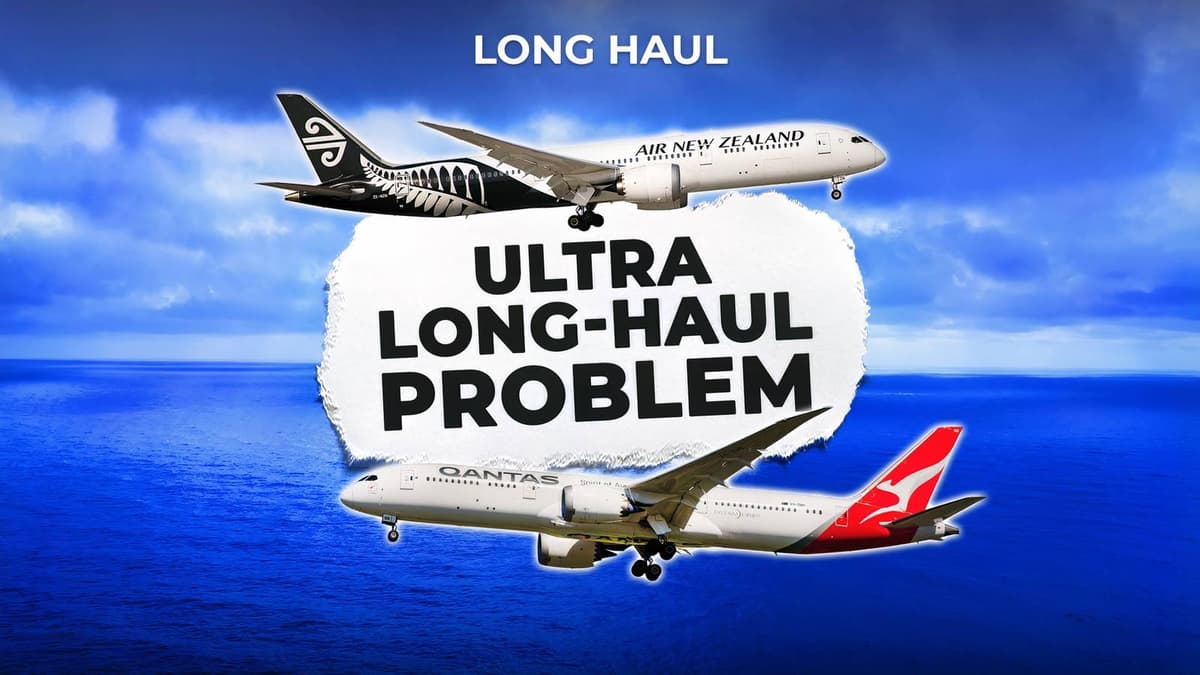
What Airlines Don’t Tell You About Ultra Long Flights: Qantas vs Air New Zealand
Companies Mentioned
Why It Matters
Ultra‑long‑haul routes can redefine global connectivity, yet their profitability hinges on aircraft efficiency, pricing strategy, and demand elasticity, influencing airline balance sheets and competitive dynamics.
Key Takeaways
- •A350/787 fuel efficiency fuels ultra‑long‑haul expansion
- •Qantas’ Perth‑London suffers low load factors
- •Air NZ’s premium pricing sustains Auckland‑London
- •Operating costs rise sharply beyond 15‑hour flights
Pulse Analysis
The resurgence of ultra‑long‑haul flights reflects a confluence of aircraft technology and market ambition. Modern wide‑bodies such as the Airbus A350‑900ULR and Boeing 787‑10 offer up to 25 percent lower fuel burn per seat compared with older platforms, turning routes that once required a stopover into viable nonstop services. Airlines capitalize on this efficiency to tap untapped demand, especially between secondary hubs that lack direct connections. However, the economics are nuanced; while fuel savings are significant, the extended flight time inflates crew salaries, maintenance cycles, and catering costs, all of which must be offset by higher yields or robust passenger volumes.
Qantas and Air New Zealand provide a case study in how strategy determines success on these demanding routes. Qantas launched the Perth‑London service with the promise of a seamless 17‑hour journey, but the airline has struggled to fill seats consistently, leading to an average load factor below 70 percent. The high operating cost per available seat‑kilometer (CASK) forces the carrier to price tickets competitively, eroding margins. In contrast, Air New Zealand’s Auckland‑London flight targets premium travelers willing to pay a 20‑30 percent premium for a non‑stop experience, allowing the airline to maintain a healthier yield despite similar CASK pressures. The carrier also integrates the route into a broader network of Pacific connections, boosting ancillary revenue.
Looking ahead, the sustainability of ultra‑long‑haul services will depend on further advances in engine efficiency, potential use of sustainable aviation fuels, and dynamic pricing models that reflect passenger willingness to pay for time savings. Airlines may also explore hybrid models, such as offering a limited‑frequency schedule paired with high‑value loyalty incentives, to mitigate risk. As consumer expectations evolve toward faster, more convenient travel, carriers that master the balance between cost control and premium pricing are poised to capture the next wave of long‑distance demand, reshaping global air travel patterns.
What Airlines Don’t Tell You About Ultra Long Flights: Qantas vs Air New Zealand
Comments
Want to join the conversation?
Loading comments...