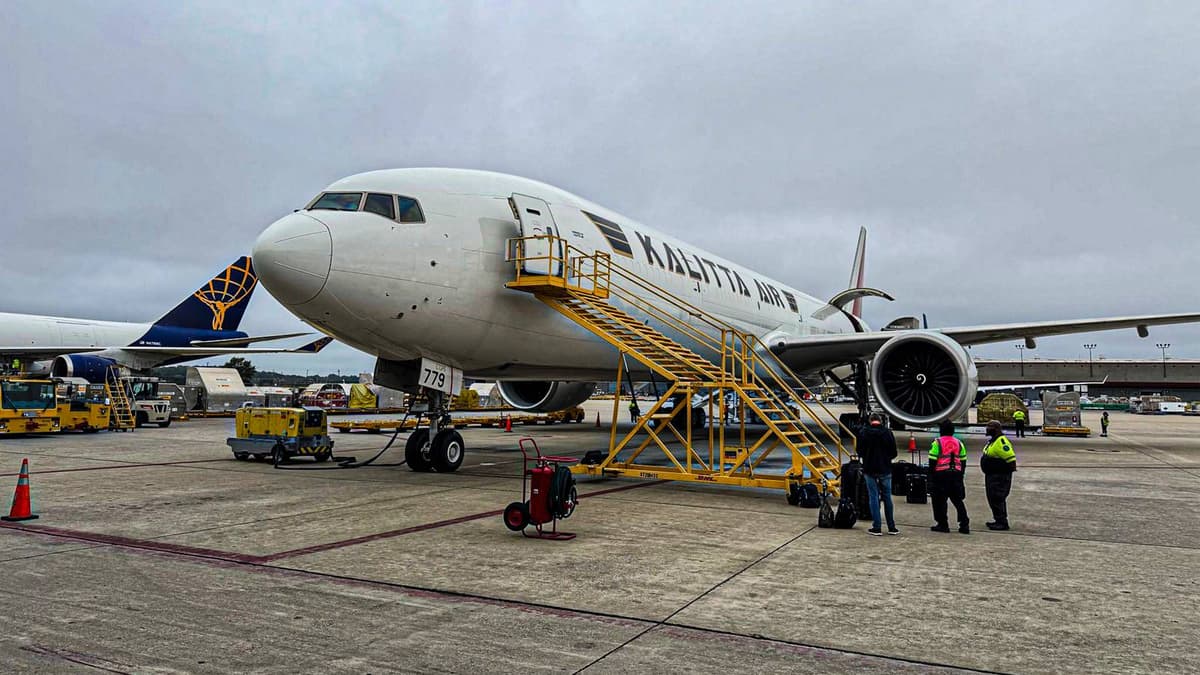
Why Airlines Are Cutting Open Retired Boeing 777s & Turning Them Into Freighters
Why It Matters
The conversion bridges the capacity gap on high‑density e‑commerce routes, letting carriers replace aging 747s without waiting for new builds. It accelerates fleet modernization while preserving cash flow for cargo operators.
Key Takeaways
- •Kalitta Air received first 777‑300ERSF in Sep 2025, seven by year‑end
- •777‑300ERSF adds main‑deck cargo door, boosting volume to 811 m³
- •Conversion keeps wings, engines, landing gear unchanged, cutting costs vs new build
- •777‑200F holds 25% less volume than 777‑300ERSF, limiting e‑commerce capacity
- •777‑300ERSF gives 14% more volume than a converted 747‑400
Pulse Analysis
The air‑cargo sector faces a looming capacity crunch as the iconic Boeing 747 freighter, the workhorse of heavy lift since the 1970s, reaches the end of its service life. While the Boeing 777‑200F fills part of the gap, its smaller fuselage limits cubic‑meter capacity, a critical metric for e‑commerce‑driven routes where volume, not weight, drives revenue. Operators therefore need a larger‑bodied freighter that can be deployed quickly, without the long lead times of brand‑new aircraft.
Enter the 777‑300ERSF conversion, a program that repurposes retired 777‑300ER passenger jets. The process involves cutting a main‑deck cargo door into the rear fuselage and replacing the composite passenger floor with reinforced aluminum decking, while retaining the original wings, engines, and landing gear. This structural overhaul restores load‑bearing integrity and creates a freight‑ready interior capable of handling palletized cargo. Because the airframe’s core components remain untouched, conversion costs are markedly lower than purchasing a new freighter, and delivery timelines shrink dramatically—an attractive proposition for carriers facing immediate demand.
Kalikka Air’s rapid adoption illustrates the market’s appetite. After signing on in 2020, the carrier took delivery of two converted jets in September 2025 and expanded to seven by year‑end, using the aircraft primarily for ACMI and charter services where payload flexibility is paramount. The 777‑300ERSF’s 811 cubic‑meter volume outstrips the 777‑200F by roughly 14% and offers a 25% volume advantage over a converted 747‑400, translating into higher revenue per flight on dense e‑commerce lanes. As more airlines retire 777‑300ER passenger fleets, the conversion pathway promises to reshape the heavy‑freight landscape, delivering a scalable, cost‑effective bridge to the next generation of air cargo capacity.
Why Airlines Are Cutting Open Retired Boeing 777s & Turning Them Into Freighters
Comments
Want to join the conversation?
Loading comments...