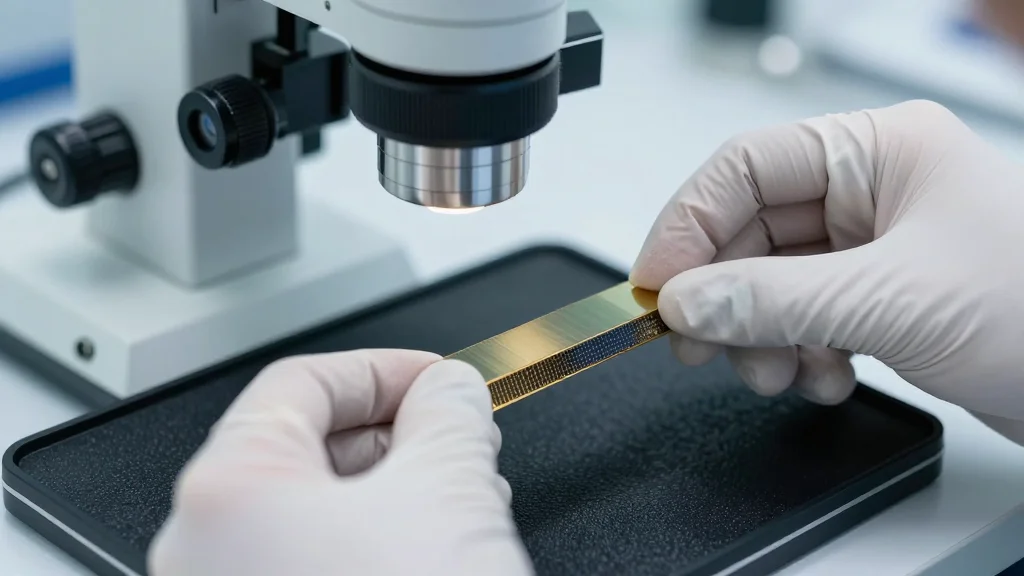
AI Model Automates Etch Profile Analysis for Faster MEMS Manufacturing
Key Takeaways
- •VLSet‑AE reaches 96% accuracy, cutting SEM analysis time to seconds.
- •Prediction error averages 3.65% across nine critical MEMS dimensions.
- •Model trains in 20 seconds, infers in 1.2 seconds, outpacing rivals.
- •Physical constraints enable consistent results under noisy SEM conditions.
Pulse Analysis
Deep reactive ion etching (DRIE) is the workhorse for high‑aspect‑ratio MEMS structures, but its quality hinges on precise etch profile inspection. Traditionally, engineers slice wafers, capture scanning electron microscopy (SEM) images, and manually trace contours—a labor‑intensive step that can consume up to two hours per image and introduce 15‑20% error. As MEMS devices become more complex and production volumes rise, this manual bottleneck threatens both throughput and yield, prompting a search for automated, reliable alternatives.
Enter VLSet‑AE, a variational level set autoencoder that embeds the physics of material removal directly into its neural architecture. By treating etched contours as dynamic interfaces rather than static pixel patterns, the model interprets low‑contrast, noisy SEM data with unprecedented fidelity. In benchmark tests against seven advanced models, VLSet‑AE delivered 96% recognition accuracy, trained in just 20 seconds, and produced predictions in 1.2 seconds per image. Its average error of 3.65% across nine key dimensions—including scallop depth, profile angle, and bow width—demonstrates a level of precision previously reserved for expert analysts.
The implications extend beyond speed. Real‑time, AI‑driven inspection enables closed‑loop process control, allowing manufacturers to adjust etch recipes on the fly based on immediate feedback. This data‑rich approach shortens the experimentation cycle, accelerates design‑for‑manufacturability, and reduces scrap rates. As the technology matures to handle more extreme DRIE conditions and varied image qualities, it could become a standard component of smart fabs, reinforcing the industry’s shift toward automated, data‑centric production pipelines.
AI model automates etch profile analysis for faster MEMS manufacturing
Comments
Want to join the conversation?