
AI in Sales: What's Actually Working in 2026 (Close, Clay, ElevenLabs & PandaDoc)
The webinar hosted by Close’s VP of product growth brought together leaders from Close, PandaDoc, ElevenLabs and Clay to cut through the hype and examine how AI is actually being deployed in small‑to‑mid‑size sales organizations in 2026. Panelists agreed that the most valuable AI use‑cases revolve around data aggregation and context‑building. PandaDoc layers AI on top of its CRM to deliver a 360‑degree view of each prospect, enabling hyper‑personalized demos. Clay automates enrichment from first‑party and third‑party signals, giving reps a concise briefing before calls. ElevenLabs demonstrated an AI‑agent that handles inbound conversations when rich context is available, but admitted cold‑calling automation remains immature. The discussion was framed by four one‑word descriptors: “dangerous” (Stey), “promising” (Keith), “transformative” (Jonathan) and “misunderstood” (Hari). Stey warned that teams either burn out on flaky tools or retreat entirely, a risk he called “dangerous.” Keith highlighted the need to avoid “slop” in AI‑generated content, while Jonathan emphasized the importance of AI fluency across the organization. The consensus is clear: AI is not a silver bullet, but when paired with disciplined data pipelines and skilled users it can multiply a small team’s reach. Sellers must also adapt to buyers who now enter negotiations armed with AI‑driven research, raising the bar for relevance and insight. Companies that treat AI as a strategic enablement rather than a gimmick will secure higher conversion rates and protect themselves from the market’s rapid evolution.

Everyone Wants to Build AI. Who's Going to Maintain It?
Speakers identified five core tensions shaping enterprise AI adoption—pilots versus production, speed versus trust, restructuring versus workforce readiness, build versus buy, and control versus visibility—and argued these trade-offs are driving strategic uncertainty. The conversation focused on the build-versus-buy dilemma, warning...

Box CEO Aaron Levie: CIO Advice on Agentic AI and the Enterprise
Aaron Levie, CEO of Box, framed agentic AI as the defining enterprise technology of 2026, contrasting its rapid adoption in software engineering with the still‑messy rollout in knowledge work. He highlighted that nearly 70% of the Fortune 500 are Box customers,...

From Data to Decisions: How LSEG Is Scaling Trusted AI
London Stock Exchange Group (LSEG) is accelerating its AI agenda by turning its massive, high‑quality data assets into trusted, scalable AI services. The firm positions itself at the core of financial markets, offering data‑driven insights through a partnership with OpenAI...

The Use of AI in Breast Imaging
The presentation focused on how artificial intelligence and advanced imaging technologies are reshaping breast cancer screening at Johns Hopkins. While AI was introduced as the next frontier, the speaker first underscored the persistent burden of breast cancer—affecting one in eight...

Generative AI in the Real World: Jay Alammar on Building AI for the Enterprise
Jay Alammar, director and engineering fellow at Coher, explains how enterprises can move from experimental large‑language‑model (LLM) labs to production‑grade AI solutions. He stresses that companies should begin with predictable, low‑risk tasks—such as summarization or entity extraction—rather than launching full‑blown...

5 Papers That Show Where AI Research Is Heading Right Now
The club talk highlighted five recent papers that illustrate where AI research is heading, ranging from bio‑AI and protein language models to self‑play for large language models (LLMs) and memory‑centric architectures. Speakers such as Yas Beg, Luke from Tatsu’s lab,...

I Built a WordPress Website in 2026 Using Claude Design & Elementor
The video demonstrates how to build a full‑featured WordPress site in 2026 by leveraging Claude’s new Design system and Elementor’s drag‑and‑drop builder. Claude Design lets users define colors, fonts and UI components in a design system, then generate an AI‑crafted...

This Week in AI with Christina Stathopoulos and Miguel Fierro
This week’s AI roundup, hosted by Christina Stodolski and guest Miguel Fierro, covered rapid industry developments and a deep dive into next‑generation recommendation systems. The discussion highlighted Anthropic’s meteoric rise—securing a Series H round that values the firm at $965 billion, filing...

How AI-Generated Tracks Are Exploiting Streaming Platforms’ Royalty Systems | Bloomberg Businessweek
The Bloomberg Businessweek interview spotlights a growing threat to the music‑royalty ecosystem: AI‑generated songs that flood streaming platforms and evade traditional copyright rules. Michael Huppy, president and CEO of SoundExchange, explains how the nonprofit, which collects and distributes digital performance...

The Demise of the Kernel for AI
Jay Dwani argues that AI performance bottlenecks have moved beyond individual chips to software, compilers and system-level design, as training now runs across tens of thousands of GPUs and complex heterogeneous datacenter fabrics. He says the traditional kernel—the low-level building...
Marketing with AI Agents: How to Build a 10x Marketing Engine
The webinar, tied to the newly released AI Marketing Blueprint, explains how marketers can construct a ten‑times‑more‑productive engine by integrating AI agents into every stage of the funnel. The presenter outlines two core opportunities: an AI‑enabled buyer journey that keeps brands...
How Preply Combines AI and Human Tutors to Personalize Learning
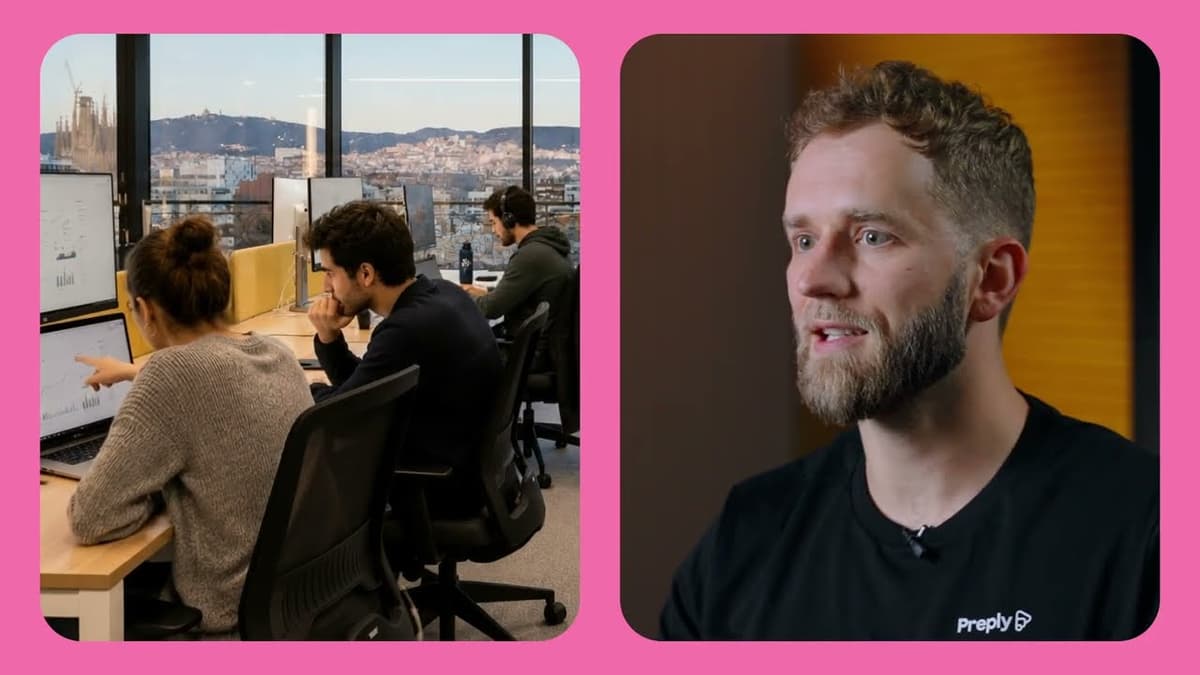
Preply, the world’s largest language‑learning marketplace, is marrying artificial‑intelligence co‑pilots with its 100,000 human tutors to deliver more personalized instruction. The company introduced “Lesson Insights,” an AI‑generated recap that summarizes each session, highlights strengths, pinpoints errors, and suggests next‑step activities...

AI Boom in London | Bloomberg Tech: Europe 6/12/2026
Bloomberg Tech Europe highlighted London’s rapid emergence as Europe’s AI capital, noting the sector’s £1.2 trillion valuation and the city’s role in the global AI race between the United States and China. Investment surged from under $4 billion in 2024 to $7 billion last...

This Computer Is Made of Real Human Neurons (I Programmed It)
The video introduces Cortical Labs' commercial biocomputer that houses 800,000 living human neurons on a multi‑electrode silicon chip, accessible through a Python SDK and a cloud‑based “wetware‑as‑a‑service” platform. The system forms a closed‑loop where electrodes record spikes and deliver stimulation, allowing...