Key Takeaways
- •AI‑Able adds AI to legacy systems, retaining constraints
- •AI‑Ready unifies data and equips hardware for seamless AI
- •AI‑Native embeds intelligence, enabling autonomous, self‑optimizing operation
- •Shift from reactive to proactive drives efficiency and new business models
Pulse Analysis
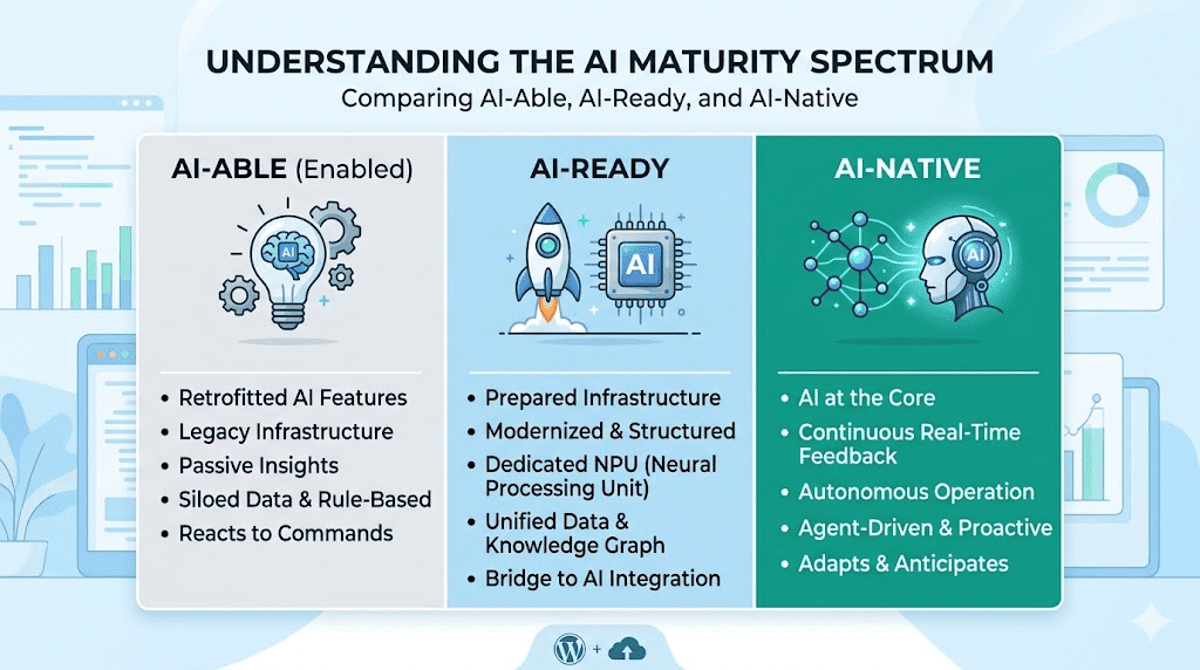
Enterprises are racing to embed artificial intelligence across their technology stacks, but not all AI implementations deliver the same strategic value. The distinction between AI‑Able, AI‑Ready, and AI‑Native provides a roadmap for organizations to assess where they stand and what investments are required. AI‑Able solutions, often quick retrofits, can produce superficial insights but typically suffer from siloed data and limited scalability. In contrast, AI‑Ready architectures focus on data hygiene, unified knowledge graphs, and hardware acceleration such as neural processing units (NPUs) capable of trillions of operations per second, laying the groundwork for more sophisticated models without disrupting existing workflows.
The true competitive edge emerges with AI‑Native designs, where intelligence is baked into the DNA of platforms and devices. These systems operate autonomously, continuously learning from real‑time feedback loops and managing their own lifecycle. For example, an AI‑Native building management platform can dynamically balance energy consumption, grid demand, and occupant comfort without human‑programmed rules, while generative software interfaces adapt instantly to user intent. This shift from reactive, rule‑based operation to proactive, predictive behavior reduces operational overhead, improves resource utilization, and opens avenues for innovative services that were previously impossible.
For decision‑makers, recognizing the maturity level of their AI initiatives is crucial for budgeting and talent acquisition. Moving from AI‑Ready to AI‑Native often requires deeper integration of data pipelines, investment in edge‑optimized hardware, and a cultural shift toward continuous learning systems. Companies that successfully make this transition can differentiate themselves in crowded markets, achieve higher ROI on AI spend, and future‑proof their operations against rapid advances in machine‑learning capabilities. The AI‑Native paradigm thus represents not just a technical evolution but a strategic imperative for sustained growth.
AI-Native The Concept: “It’s in the DNA.”
Comments
Want to join the conversation?