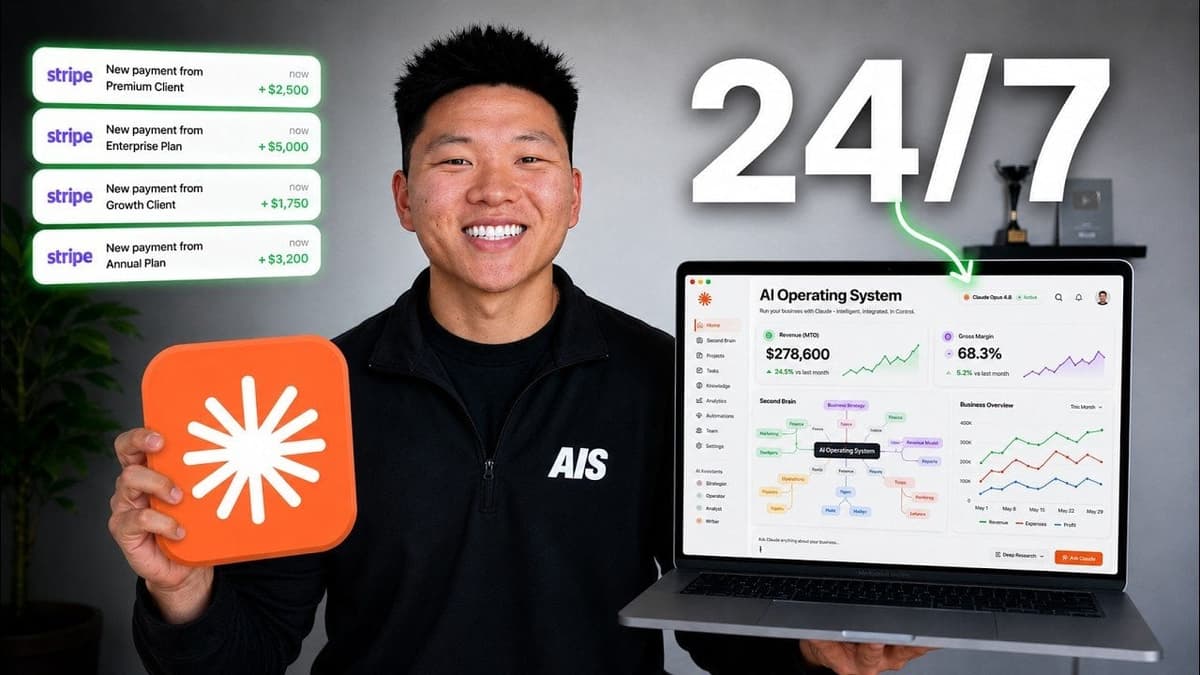
Automate Your Daily Workflows by Building an AIOS with Claude Opus 4.8
Key Takeaways
- •Claude Opus 4.8 can serve as a central AI operating system.
- •Four C’s framework (Context, Connections, Capabilities, Cadence) structures automation.
- •Integrations with ClickUp, Google Workspace, QuickBooks, Slack boost productivity.
- •Iterative testing and feedback loops refine AIOS performance over time.
- •Permission layers and audits mitigate automation risks and ensure oversight.
Pulse Analysis
The rise of generative AI has shifted from isolated assistants to comprehensive operating systems that orchestrate entire business workflows. Claude Opus 4.8, Anthropic’s latest model, offers the compute power and contextual awareness needed to act as a central brain for daily operations. When deployed as an AI Operating System, it can ingest data from multiple sources, make decisions, and generate outputs without human prompting for each step. This paradigm aligns with the broader industry push toward hyper‑automation, where a single AI layer replaces a patchwork of niche tools.
The Four C’s framework provides a practical blueprint for building that layer. Context supplies detailed goals; Connections link the AI to platforms such as ClickUp for task tracking, Google Workspace for document handling, QuickBooks for finance, and Slack for communication. Capabilities are trained modules that automate reports, draft emails, or reconcile invoices, while Cadence enforces a steady rhythm of recurring jobs. By feeding precise inputs, organizations keep token consumption in check, preserving budget while maintaining high‑quality responses. The Three M’s—Mindset, Method, Machine—ensure the system scales as needs evolve.
Automation inevitably introduces governance challenges, so the guide stresses permission layers, phased‑trust models, and regular audits to safeguard sensitive data. An iterative rollout—testing in sandbox environments, gathering performance metrics, and refining prompts—creates a feedback loop that continuously improves accuracy. For enterprises, the payoff is measurable: reduced manual labor, consolidated licensing fees, and faster decision cycles. As AIOS adoption matures, firms that embed these controls while leveraging Claude Opus’s flexibility will capture the efficiency premium and stay ahead in a rapidly automating market.
Automate Your Daily Workflows by Building an AIOS with Claude Opus 4.8
Comments
Want to join the conversation?