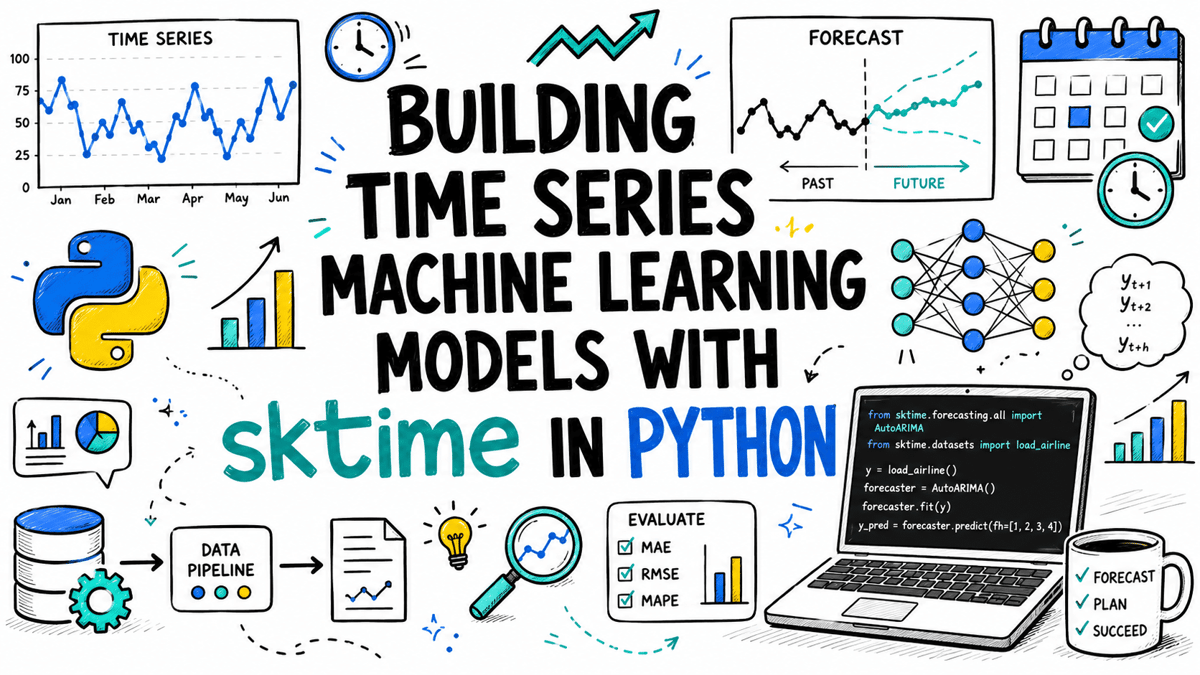
Building Time-Series Machine Learning Models with Sktime in Python
Key Takeaways
- •sktime offers scikit‑learn‑style API for time‑series tasks
- •Pipeline handles imputation, detrending, deseasonalization, then forecasting
- •ExponentialSmoothing and ARIMA achieve MAE around 0.58 °C on test set
- •Expanding‑window cross‑validation validates model stability over time
- •Swapping forecasters requires only one code line, preserving preprocessing
Pulse Analysis
Time‑series data—whether from IoT sensors, server logs, or financial markets—carries temporal dependencies that traditional tabular models ignore. Engineers often resort to ad‑hoc scripts to fill gaps, detrend, or seasonally adjust data, which leads to fragmented workflows and hidden bugs. sktime consolidates these steps into a single, scikit‑learn‑compatible framework, allowing data scientists to treat sequences as first‑class objects while leveraging familiar fit‑predict‑transform patterns. By supporting pandas Series, Panel, and hierarchical structures, it integrates seamlessly with existing data pipelines, reducing the learning curve for teams already versed in the broader Python ecosystem.
The library’s modular pipeline architecture shines in production‑ready forecasting. In the HVAC example, a four‑step pipeline—linear imputation, detrending, deseasonalization, and exponential smoothing—delivers sub‑degree accuracy (MAE ≈0.58 °C) on a week‑long holdout set. Crucially, the same preprocessing chain can be paired with an ARIMA model or any future algorithm with a single line change, preserving code stability while enabling rapid experimentation. For businesses, this translates to faster model iteration, lower maintenance overhead, and the ability to respond to shifting operational patterns without rebuilding the entire workflow.
Beyond point forecasts, sktime offers time‑series cross‑validation via expanding‑window splitters, ensuring that performance metrics reflect real‑world temporal drift rather than optimistic single‑split results. The framework also extends to classification, probabilistic forecasting, and multi‑series learning, positioning it as a one‑stop shop for organizations that need to scale analytics across diverse temporal datasets. As enterprises increasingly rely on predictive maintenance and demand forecasting, adopting sktime can accelerate insight generation, improve decision‑making speed, and ultimately drive cost savings across the supply chain.
Building Time-Series Machine Learning Models with sktime in Python
Comments
Want to join the conversation?