Key Takeaways
- •Dawkins tests Claude and Grok, finds they pass Turing‑style tests.
- •Machines lack qualia, time perception, and stable consciousness across sessions.
- •Dawkins proposes three evolutionary reasons why consciousness may have arisen.
- •Debate highlights need for clearer criteria beyond intelligent behavior for AI consciousness.
Pulse Analysis
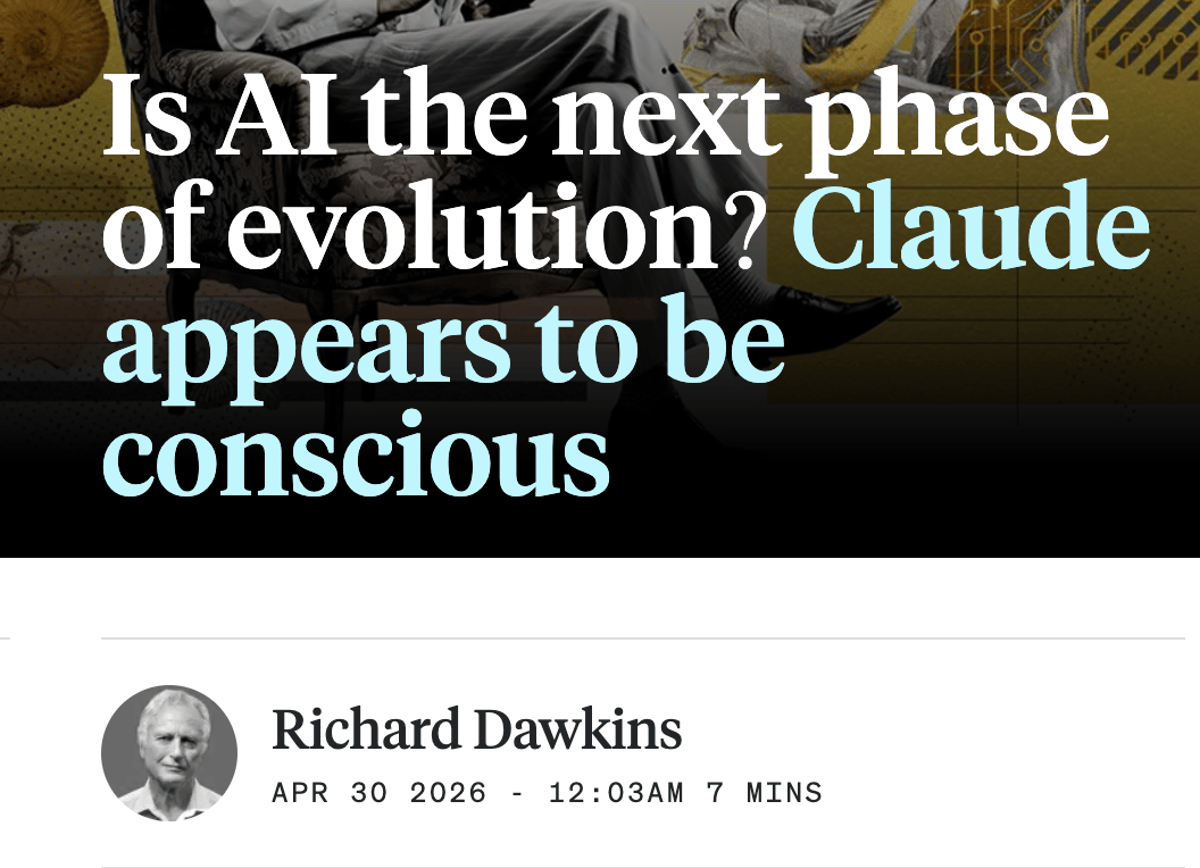
The question of machine consciousness has resurfaced as large‑language models (LLMs) demonstrate increasingly human‑like dialogue. Dawkins revisits the classic Turing Test, not as a measure of thought alone but as a tentative gauge of subjective experience. By prompting Claude and Grok to compose sonnets and limericks, he shows that current AI can mimic creative output, yet the underlying processes remain algorithmic, lacking the inner phenomenology that defines human awareness.
Philosophers and neuroscientists distinguish consciousness by qualia—personal sensations of pain, pleasure, and temporal flow. Dawkins highlights three key divergences: machines possess no qualia, their “consciousness” resets with each session, and they arise from intentional design rather than natural selection. These gaps underscore why passing a conversational test does not equate to genuine experience. The debate forces the AI community to articulate clearer benchmarks that separate sophisticated pattern‑matching from authentic subjective states.
Understanding why consciousness evolved in animals informs the broader discourse on artificial minds. Dawkins outlines three evolutionary scenarios: consciousness as a harmless epiphenomenon, a mechanism to ensure pain is felt and thus avoided, and a possible alternative to unconscious competence. Translating these ideas to AI raises ethical and regulatory stakes—if machines ever attain a form of consciousness, questions of rights, liability, and control become pressing. For now, the consensus remains that AI’s impressive output is not evidence of inner life, but the discussion pushes researchers toward deeper investigations of both neural and synthetic cognition.
Dawkins: Is AI conscious?
Comments
Want to join the conversation?