Why It Matters
Understanding how AI risk perception reshapes software sector valuations helps investors target firms with sustainable growth prospects.
Key Takeaways
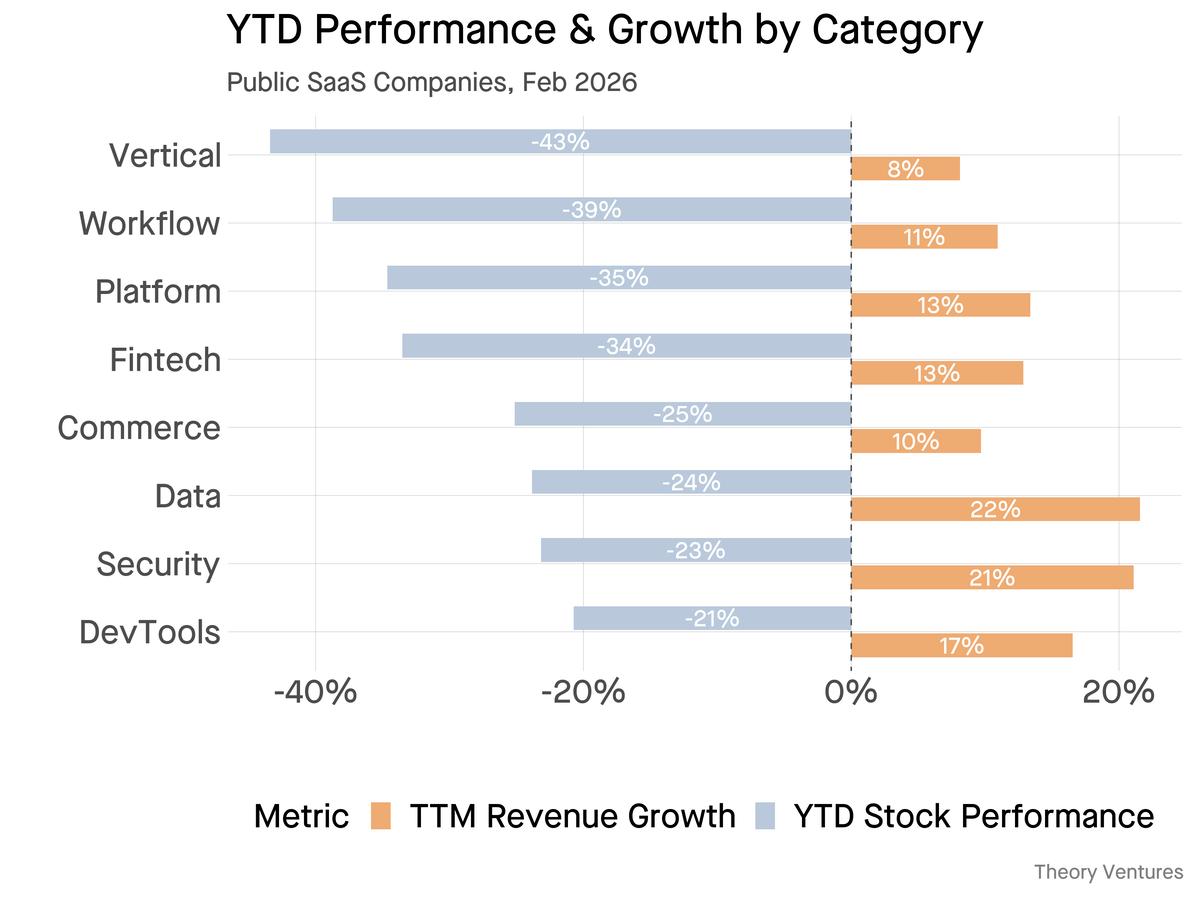
- •Vertical SaaS down 43%, despite strong industry moats.
- •Workflow tools fall less, tied to AI agent relevance.
- •Data infrastructure and security outpace others, driven by AI demand.
- •Growth expectations strongly correlate with revenue multiples (0.51).
- •Investors doubt growth when AI makes customers more efficient.
Pulse Analysis
The recent rally‑to‑decline in software equities reveals a nuanced market calculus around artificial‑intelligence risk. While vertical SaaS firms such as Veeva, AppFolio and Procore command deep regulatory barriers and industry‑specific data, their modest 8% growth rate has left investors uneasy, prompting a 43% YTD slide. By contrast, workflow platforms like Monday.com and Asana, whose products sit directly in the path of AI‑driven automation, have underperformed slightly less. This divergence signals that the market is pricing not just the threat of displacement but the speed at which AI can amplify or erode revenue streams.
AI’s expanding code‑generation capabilities are reshaping cost structures across the software stack. More generated code translates into higher demands for code review, testing, and deployment tooling, a trend Atlassian’s earnings highlighted with its Intelligence product surpassing five million monthly active users and cloud revenue crossing the $1 billion threshold. Simultaneously, the surge in vector queries and embeddings fuels a structural tailwind for data‑infrastructure providers, while heightened attack surfaces elevate security spending. Both segments have posted double‑digit growth, reinforcing the view that AI is a catalyst for ancillary services rather than a direct substitute for core application functionality.
For investors, the key question becomes whether a software company can sustain growth when AI makes its customers more productive rather than expanding the addressable market. Companies that can embed AI into their value proposition, capture new data pipelines, or offer indispensable security layers are likely to retain premium multiples. Conversely, firms reliant on incremental user growth without clear AI‑enabled differentiation may continue to face valuation discounts. Monitoring forward‑looking growth metrics and AI integration roadmaps will therefore be essential for capital allocation decisions in the evolving tech landscape.
How Markets Price AI Risk
0
Comments
Want to join the conversation?
Loading comments...