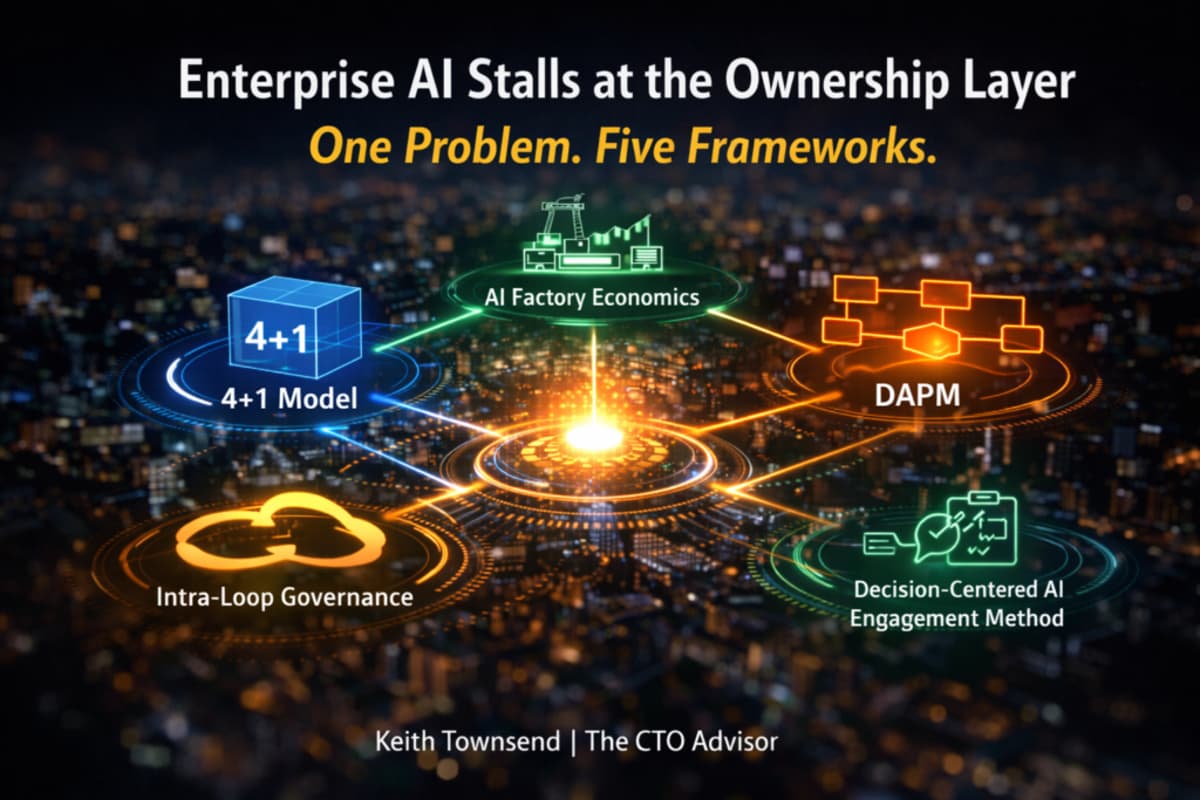
One Problem, Five Frameworks: Why Enterprise AI Stalls — and How to Fix It
Key Takeaways
- •Responsibility, not model choice, stalls enterprise AI projects
- •AI Factory Economics reveals hidden operating costs beyond inference
- •DAPM clarifies decision authority to prevent drift and escalation
- •Intra‑Loop Governance manages decisions within autonomous AI cycles
- •Start with decision friction, not use cases, for successful AI adoption
Pulse Analysis
Enterprises have spent years debating which models, vendors, and hardware configurations best suit their AI ambitions. The real bottleneck, however, lies in the shift of decision‑making authority from humans to algorithms—a responsibility gap that surfaces once systems begin to route work, enforce policy, or act autonomously. When ownership of judgment is invisible, organizations encounter stalled deployments, compliance headaches, and escalating operational costs. Recognizing this, the revised 4+1 Enterprise AI Field Manual reframes AI implementation as a governance challenge rather than a purely technical one.
The manual consolidates five complementary frameworks. The 4+1 Infrastructure Model maps responsibility across compute, data, execution, reasoning, and applications, making hidden hand‑offs explicit. AI Factory Economics quantifies the true cost of oversight, rework, and monitoring, exposing why cheap inference can become expensive at scale. The Decision Authority Placement Model (DAPM) assigns clear ownership of runtime judgments, preventing drift and escalation loops. Intra‑Loop Governance tackles decision points that occur inside autonomous cycles, ensuring reliability before human intervention. Finally, the Decision‑Centered AI Engagement Method (DCAIEM) advises teams to start with decision friction, design AI as a shared capability, and target mundane cross‑department decisions first.
For leaders, the practical takeaway is to embed these frameworks early in the AI lifecycle. The Town of Vail case study demonstrates that assigning ownership to each layer of the 4+1 model enabled five production AI use cases to launch in three months, powered by a municipal data center. By treating governance as an architectural layer, enterprises can align AI speed with management redesign, reducing pilot‑to‑production friction and safeguarding compliance. Adopting the 4+1 approach positions companies to scale AI responsibly, turning promise into measurable business value.
One Problem, Five Frameworks: Why Enterprise AI Stalls — and How to Fix It
Comments
Want to join the conversation?