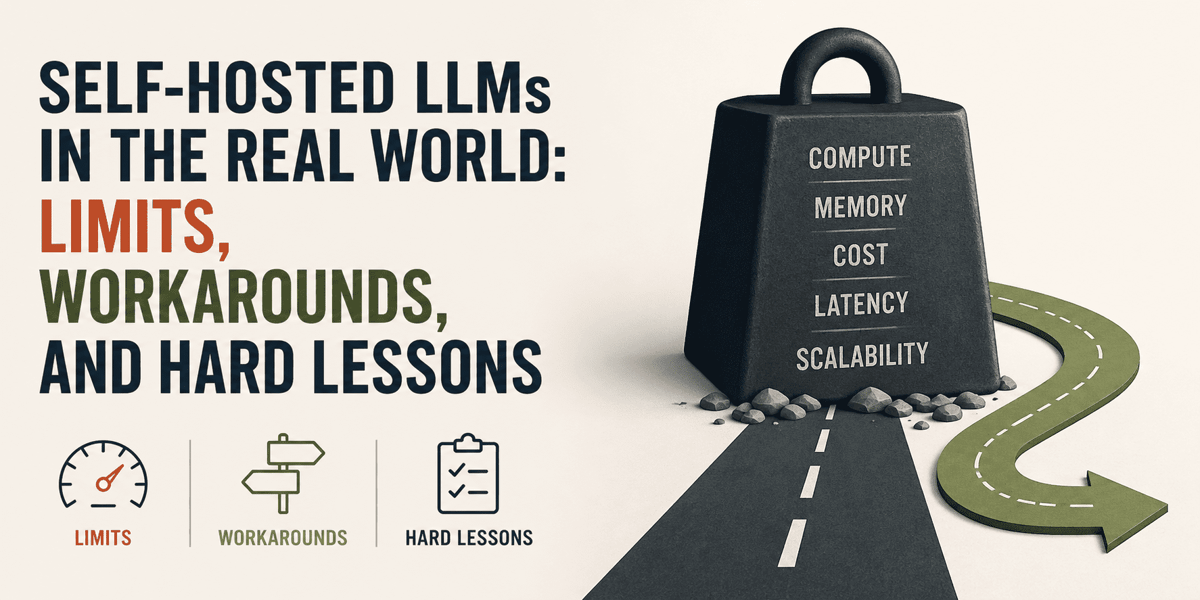
Self-Hosted LLMs in the Real World: Limits, Workarounds, and Hard Lessons
Key Takeaways
- •7B model needs ≥16 GB VRAM; 13B/70B need multi‑GPU or quantization
- •Quantizing to INT4 cuts memory but harms reasoning and structured output
- •Context windows fill quickly; aggressive chunking essential for RAG pipelines
- •Latency often 10‑15 s per response, slowing development loops
- •Prompt templates must match model family; mismatches cause incoherent outputs
Pulse Analysis
Self‑hosted large language models have surged in appeal as companies seek to eliminate API fees and keep proprietary data on‑premise. Yet the hardware reality is stark: a modest 7 B model already requires a GPU with at least 16 GB of VRAM, and scaling to 13 B or 70 B parameters forces multi‑GPU clusters or aggressive quantization techniques such as INT4. While quantization trims memory footprints and speeds up inference, it often sacrifices the nuanced reasoning needed for tasks like structured JSON output, forcing teams to empirically test each precision level before committing.
Beyond raw compute, operational frictions emerge from context management and latency. Retrieval‑augmented generation pipelines quickly exhaust a 4 K token window, prompting developers to adopt aggressive chunking and history trimming strategies. Meanwhile, inference latency of 10‑15 seconds per response hampers interactive use cases and elongates the development feedback loop, even when streaming mitigates perceived slowness. Optimized serving stacks like vLLM or properly tuned Ollama instances can shave milliseconds, but the fundamental cost of GPU cycles remains a decisive factor for batch versus real‑time workloads.
Strategically, the hard lessons outlined signal a shift toward niche, task‑specific models rather than a one‑size‑fits‑all approach. Fine‑tuning with LoRA or QLoRA can tailor a base model to domain‑specific language, but success hinges on high‑quality, curated datasets rather than sheer volume. Enterprises must therefore balance the allure of data sovereignty against the tangible expenses of hardware, quantization trade‑offs, prompt engineering, and fine‑tuning overhead. A realistic roadmap embraces incremental pilots, rigorous benchmarking, and a willingness to adopt smaller, purpose‑built models that align with existing infrastructure budgets.
Self-Hosted LLMs in the Real World: Limits, Workarounds, and Hard Lessons
Comments
Want to join the conversation?