Key Takeaways
- •Ollama Modelfile embeds system prompts and parameters into reusable model variants
- •Lower temperature (0.1‑0.2) yields deterministic outputs ideal for code generation
- •KV cache quantization (q8_0, q4_0) cuts VRAM usage up to 75%
- •Environment variables like OLLAMA_NUM_PARALLEL control parallel instances and memory
- •Flash Attention flag boosts speed on supported GPUs while reducing memory
Pulse Analysis
Local language models are gaining traction as companies seek to avoid third‑party API fees and protect sensitive data. Ollama’s Modelfile bridges the gap between raw model weights and production‑ready services by allowing developers to bake system instructions, sampling settings, and context limits directly into a model artifact. This declarative approach reduces per‑request overhead, ensures consistent behavior across deployments, and simplifies version control—key advantages for regulated industries such as finance and healthcare that demand reproducible AI pipelines.
Performance tuning goes beyond the Modelfile; server‑level environment variables let operators align the Ollama daemon with their hardware profile. Adjusting OLLAMA_NUM_PARALLEL, OLLAMA_KEEP_ALIVE, and KV‑cache precision (q8_0 or q4_0) can shrink VRAM footprints by up to three‑quarters, enabling 8‑bit quantized models to run on consumer‑grade GPUs. Enabling Flash Attention further accelerates attention calculations, turning quadratic scaling into a more manageable workload. These knobs give IT teams the flexibility to balance throughput, latency, and cost without sacrificing model quality.
The broader implication is a shift toward AI‑first infrastructure where organizations host and fine‑tune models in‑house. By mastering Ollama’s configuration stack, engineers can build specialized agents—ranging from deterministic code assistants to creative brainstorming bots—while maintaining full control over data residency and compute budgets. As hardware accelerators evolve and open‑source models grow in capability, tools like Ollama will be central to democratizing high‑performance, private AI deployments across the enterprise.
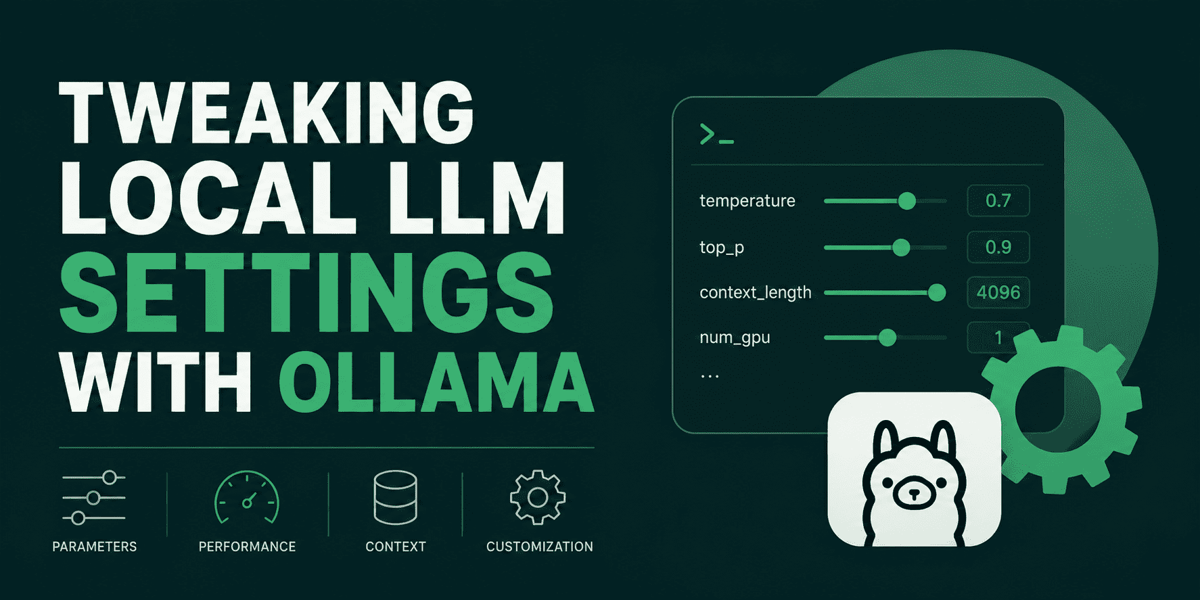
Tweaking Local Language Model Settings with Ollama
Comments
Want to join the conversation?