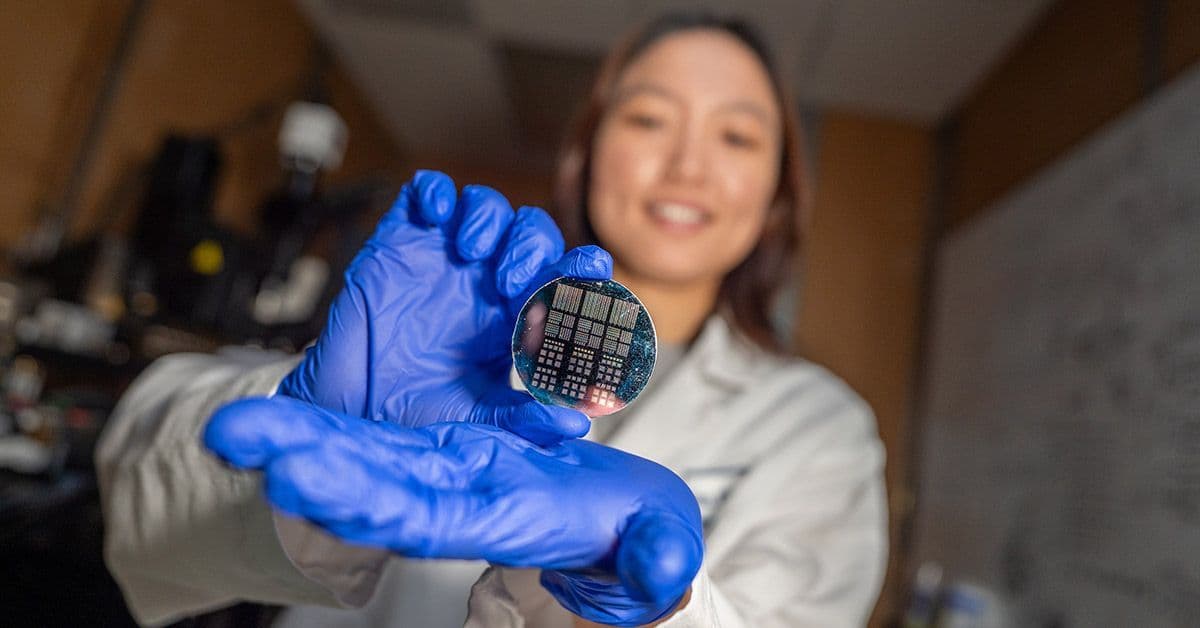
UC San Diego Combines Memory and Computation to Enhance Energy-Efficient AI
•March 12, 2026
0
Key Takeaways
- •Integrated memory and compute on single chip reduces data transfer
- •Hydrogen‑doped nickelate provides volatile memory via resistance modulation
- •Spatiotemporal computing captures both timing and spatial patterns
- •Demonstrated faster speech digit recognition and early seizure detection
- •Energy use ~0.2 nJ per operation enables edge AI deployment
Summary
UC San Diego engineers have built a brain‑inspired hardware platform that merges memory and computation on a single chip. The device uses hydrogen‑doped perovskite nickelate to create nodes that store and process signals together, enabling spatiotemporal computing. In simulations it outperformed conventional time‑based methods in spoken‑digit recognition and early epileptic‑seizure detection, while consuming only about 0.2 nanojoules per operation. The breakthrough promises more compact, energy‑efficient AI for wearables and edge sensors.
Pulse Analysis
Neuromorphic computing has emerged as a response to the energy and latency limits of traditional von Neumann architectures, where separate memory and processing units force costly data shuttling. UC San Diego’s new platform tackles this head‑on by co‑locating storage and logic on a single silicon substrate, mirroring how biological neurons intertwine synaptic memory with electrical signaling. This integration not only trims the data‑movement overhead but also opens the door to truly parallel, brain‑like computation that scales with the complexity of modern AI workloads.
At the heart of the system lies a hydrogen‑doped perovskite nickelate, a quantum material whose resistance can be tuned by moving hydrogen ions under voltage pulses. Each node acts as a short‑term memory element, retaining recent signal information while programmable junctions handle longer‑term storage. Because all nodes share the same crystalline substrate, electrical disturbances propagate across the network, producing collective dynamics akin to ionic fluid in the brain. This spatiotemporal computing paradigm evaluates inputs across both time and space, delivering richer feature extraction than purely temporal methods.
The practical implications are significant for edge AI markets. Consuming roughly 0.2 nanojoules per operation, the chip can run sophisticated pattern‑recognition tasks—such as speech digit classification or early seizure detection—on battery‑powered wearables and remote sensors without draining power. As demand for on‑device intelligence grows in healthcare, industrial IoT, and autonomous systems, hardware that blends neuromorphic efficiency with scalable fabrication could reshape the competitive landscape, prompting larger firms to explore similar material‑based approaches.
Comments
Want to join the conversation?