Key Takeaways
- •AI agents now execute end‑to‑end data‑science pipelines autonomously.
- •LangGraph, AutoGen, and smolagents provide production‑grade orchestration.
- •Data scientists must master prompt engineering and tool integration.
- •Agent observability tools like LangSmith enable debugging of multi‑step flows.
- •New roles such as AI Systems Designer and AgentOps Engineer emerge.
Pulse Analysis
The rise of agentic AI marks a fundamental transition from static large‑language‑model queries to autonomous systems that can perceive, reason, act, and self‑correct. By embedding tool access directly into the model’s reasoning loop, agents can iteratively fetch datasets, run statistical tests, and refine outputs without human prompts. This capability is fueled by advances in compute, richer APIs, and open‑source orchestration libraries, positioning autonomous agents as the next layer of data‑science productivity.
Production‑grade frameworks—LangGraph’s graph‑based state management, AutoGen’s multi‑agent conversational patterns, and smolagents’ minimalist Python execution—have turned experimental code into reliable pipelines. Data scientists now delegate routine exploratory data analysis, model selection, and hyperparameter tuning to agents, freeing them to evaluate results and steer strategy. Mastery of prompt engineering, robust tool contracts, and observability platforms like LangSmith or Langfuse becomes as critical as statistical knowledge, because debugging an agent’s reasoning chain requires granular logging of each tool call and decision point.
Strategically, organizations that embed agentic workflows gain faster time‑to‑insight and can scale expertise across domains. The emerging job titles—AI Systems Designer, AgentOps Engineer, and domain‑specialized agent developer—reflect a split between users of agents and builders of the underlying infrastructure. Professionals should start modestly: deploy a single agent with two well‑defined tools, validate its outputs, then expand to multi‑agent architectures while instituting rigorous monitoring. By adopting this incremental approach, data‑science teams can harness the productivity lift of autonomous agents while maintaining control over critical evaluative judgments.
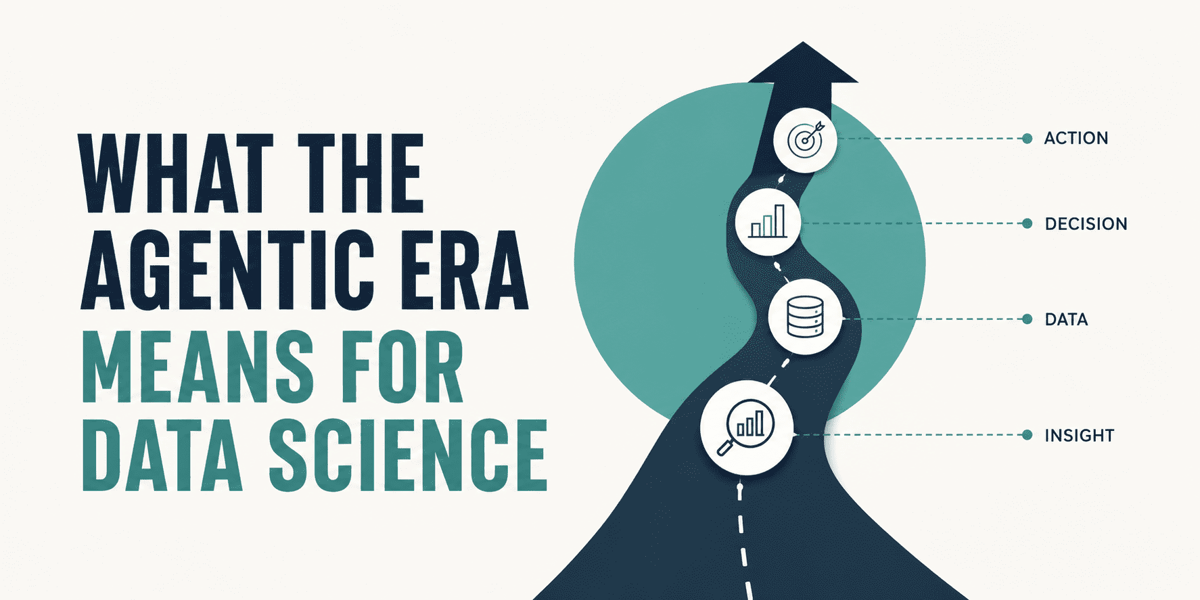
What the Agentic Era Means for Data Science
Comments
Want to join the conversation?