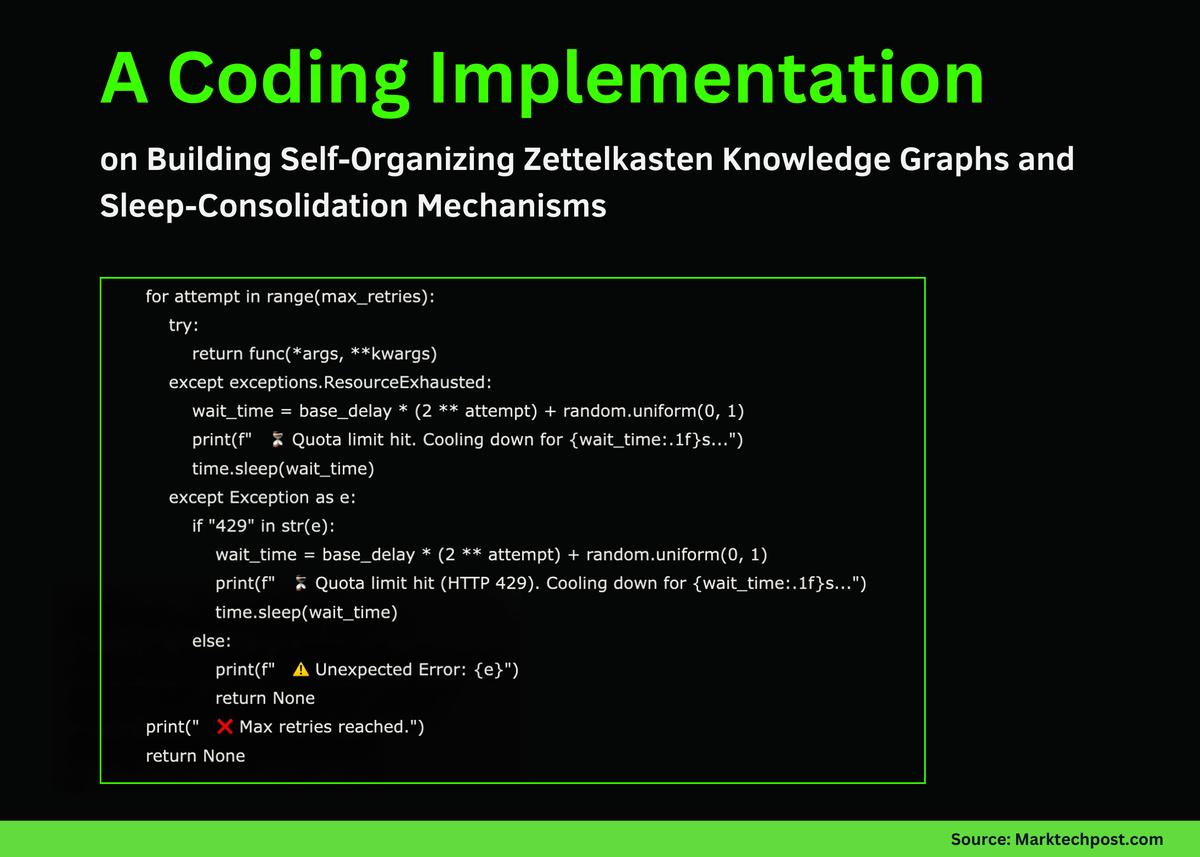
A Coding Implementation on Building Self-Organizing Zettelkasten Knowledge Graphs and Sleep-Consolidation Mechanisms
•December 26, 2025
0
Companies Mentioned

Why It Matters
By giving autonomous agents a dynamic, graph‑based memory that can consolidate and retrieve insights, the approach mitigates fragmented context and enables more coherent, long‑term interactions, a critical step toward truly intelligent assistants.
Key Takeaways
- •Agentic AI splits inputs into atomic facts.
- •Embeddings create semantic links in real time.
- •Consolidation phase generates high‑level insights.
- •Query engine answers using graph‑based context.
- •Visualization aids debugging and knowledge inspection.
Pulse Analysis
The rise of agentic AI has exposed a fundamental limitation in traditional prompt‑and‑response pipelines: memory fragmentation. When an AI assistant processes a stream of information over days or weeks, it often loses context, forcing developers to rebuild state manually. The Zettelkasten‑style memory system presented in this tutorial addresses that gap by treating each piece of knowledge as an atomic node, enriched with vector embeddings and linked through semantic similarity. This graph‑centric design mirrors how human brains organize concepts, allowing the agent to navigate relationships dynamically rather than relying on flat retrieval tables.
Beyond ingestion, the "sleep" consolidation phase introduces a biologically inspired mechanism where the system periodically abstracts higher‑order insights from clusters of tightly connected facts. By prompting Gemini to synthesize these clusters into concise insight nodes, the memory evolves from a collection of raw data points into a structured hierarchy of understanding. This not only reduces redundancy but also equips the agent with emergent reasoning capabilities, enabling it to answer complex queries with distilled knowledge rather than surface‑level matches.
From a business perspective, such a living memory architecture can transform enterprise AI deployments. Customer support bots, project management assistants, and research analysts can maintain continuity across interactions, delivering personalized recommendations that reflect cumulative learning. Moreover, the built‑in visualization tools provide stakeholders with transparent access to the knowledge graph, facilitating auditability and compliance. As organizations scale AI‑driven workflows, integrating self‑organizing memory systems will become a competitive differentiator, turning raw data streams into actionable intelligence.
A Coding Implementation on Building Self-Organizing Zettelkasten Knowledge Graphs and Sleep-Consolidation Mechanisms
0
Comments
Want to join the conversation?
Loading comments...