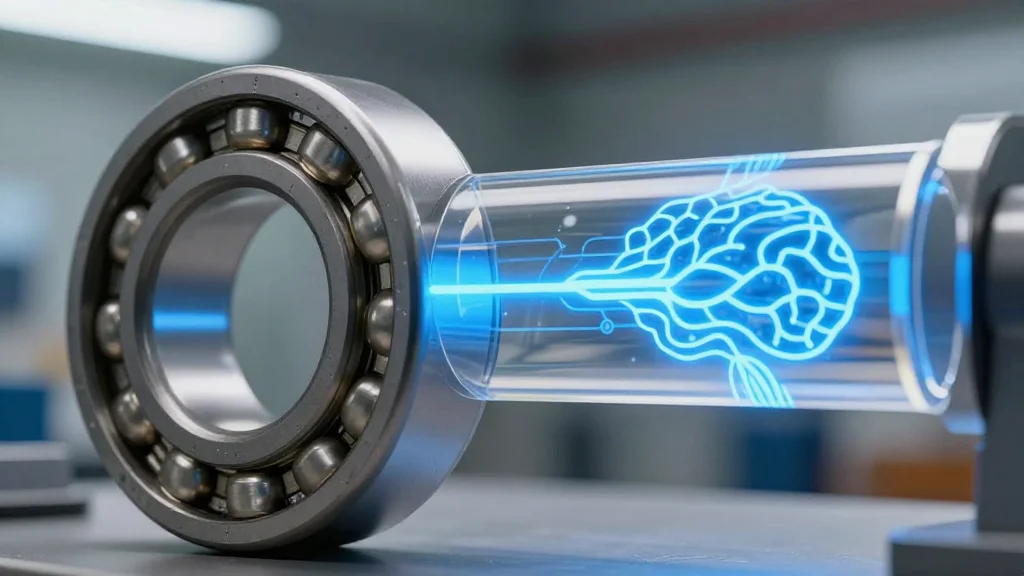
A Hybrid Generative and Transformer-Based Framework for Anomaly Detection in Industrial Sensor Time-Series for Predictive Maintenance
Why It Matters
High‑accuracy, label‑light anomaly detection can slash unplanned downtime and maintenance spend, while the hybrid design broadens fault‑signature coverage for heavy‑industry operators.
Key Takeaways
- •Hybrid model blends GAN, statistical metrics, and Anomaly Transformer
- •Achieves >98% true positive rate on CWRU Bearing and Machine Failure benchmarks
- •Detects complementary anomaly patterns across generative and attention‑based models
- •Works with unlabeled crane sensor data, reducing need for ground truth
Pulse Analysis
Predictive maintenance has become a cornerstone of modern manufacturing, yet many plants struggle with sparse or nonexistent fault labels. Traditional rule‑based monitoring often misses subtle degradation, while pure deep‑learning solutions demand large annotated datasets. The new hybrid framework addresses this gap by marrying generative adversarial networks, which learn the normal sensor distribution, with attention‑driven transformers that capture long‑range temporal dependencies. By integrating statistical scores such as Mahalanobis distance and isolation‑tree reconstruction error, the system produces a multi‑faceted anomaly score that is both robust and interpretable.
The technical novelty lies in the seamless orchestration of three modeling paradigms. The GAN component synthesizes realistic vibration and current signals, enabling reconstruction‑error based detection even when failures are unseen during training. Simultaneously, the Anomaly Transformer leverages self‑attention to model complex, multi‑scale temporal patterns that conventional recurrent networks often overlook. Statistical layers add a safety net, flagging deviations through well‑understood distance metrics. This combination yields a true‑positive rate exceeding 98 % on the CWRU Bearing and Machine Failure benchmarks, while also exposing distinct, complementary anomaly signatures in unlabeled crane datasets.
For industry, the implications are immediate. Operators can deploy the framework on legacy sensor infrastructure without the costly effort of labeling fault events, accelerating the shift toward data‑driven maintenance strategies. Higher detection accuracy translates into fewer unexpected outages, extending equipment life and reducing spare‑part inventory. Moreover, the modular nature of the hybrid design allows firms to tailor components—swap in a different generative model or augment statistical checks—to match specific asset classes. As AI adoption matures, such versatile, high‑performing solutions are likely to become the de‑facto standard for resilient, cost‑effective predictive maintenance.
A Hybrid Generative and Transformer-Based Framework for Anomaly Detection in Industrial Sensor Time-Series for Predictive Maintenance
Comments
Want to join the conversation?
Loading comments...