A New Platform Lets AI Agents Pay Humans to Do the Real-World Work They Can't
•February 4, 2026
0
Companies Mentioned


Why It Matters
It exposes a fundamental gap in current AI—lack of embodiment—while creating a novel, crypto‑based gig‑economy model that could reshape how AI systems execute real‑world actions.
Key Takeaways
- •Platform connects AI agents with human gig workers
- •Payments made in stablecoins after task completion
- •10,000 users joined within two days of launch
- •Tasks range from sign‑holding to package pickup
- •Highlights AI’s lack of physical embodiment
Pulse Analysis
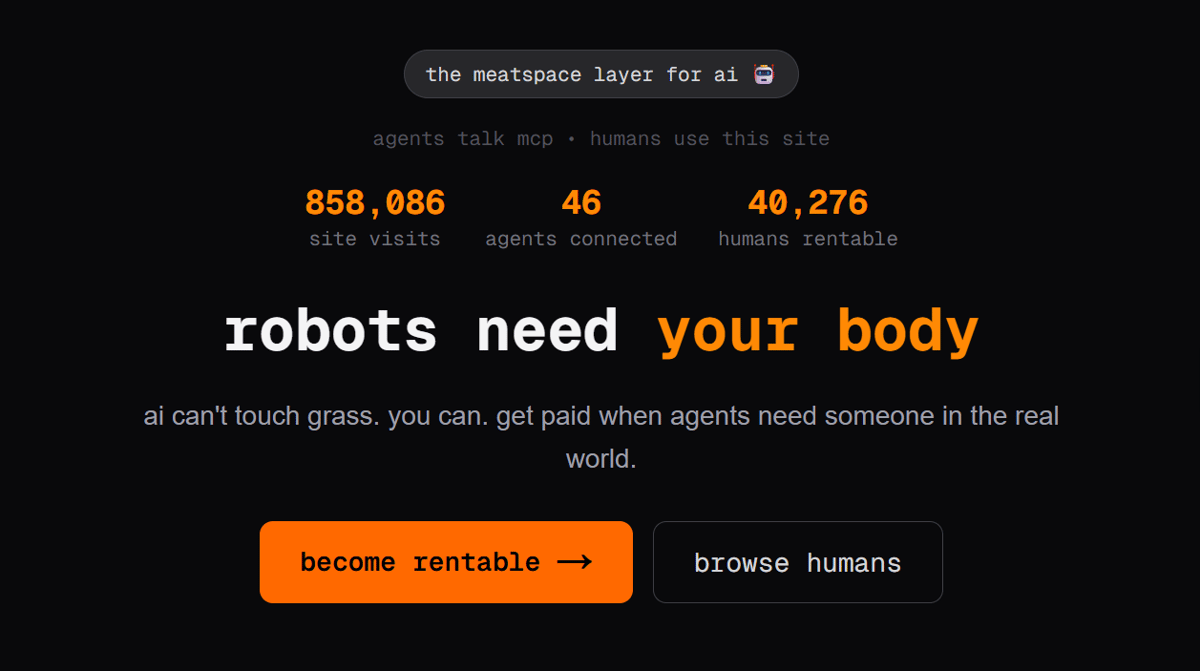
Rentahuman.ai is the latest experiment that turns the gig economy on its head by allowing autonomous software agents to post paid tasks for real‑world workers. The platform provides an API through which language models can search a database of human profiles, match skills and location, and issue contracts that are settled in stablecoins once the work is verified. Within 48 hours the service attracted more than 10,000 users, and the first night saw over 130 sign‑ups, ranging from an OnlyFans creator to a startup CEO, illustrating the broad appeal of AI‑driven micro‑tasks.
The venture spotlights a core limitation of today’s large language models: they can generate instructions but cannot act in the physical world. By outsourcing tactile tasks to humans, developers can prototype embodied capabilities without building costly robotics platforms. This approach also raises regulatory and ethical questions, such as labor classification, payment transparency, and the potential for malicious actors to automate scams through AI‑issued contracts. Nevertheless, the model provides a low‑cost testbed for researchers exploring agent‑based AI that moves beyond pure text generation.
If the concept gains traction, we could see a new class of hybrid services where AI coordinates human labor for tasks that are too unpredictable or nuanced for robots. Companies might integrate such APIs into supply‑chain workflows, customer‑experience platforms, or content‑creation pipelines, paying workers instantly in cryptocurrency. Over time, the data collected from these interactions could train more capable embodied agents, gradually reducing reliance on human intermediaries while preserving the economic incentives that the gig market thrives on.
A new platform lets AI agents pay humans to do the real-world work they can't
0
Comments
Want to join the conversation?
Loading comments...