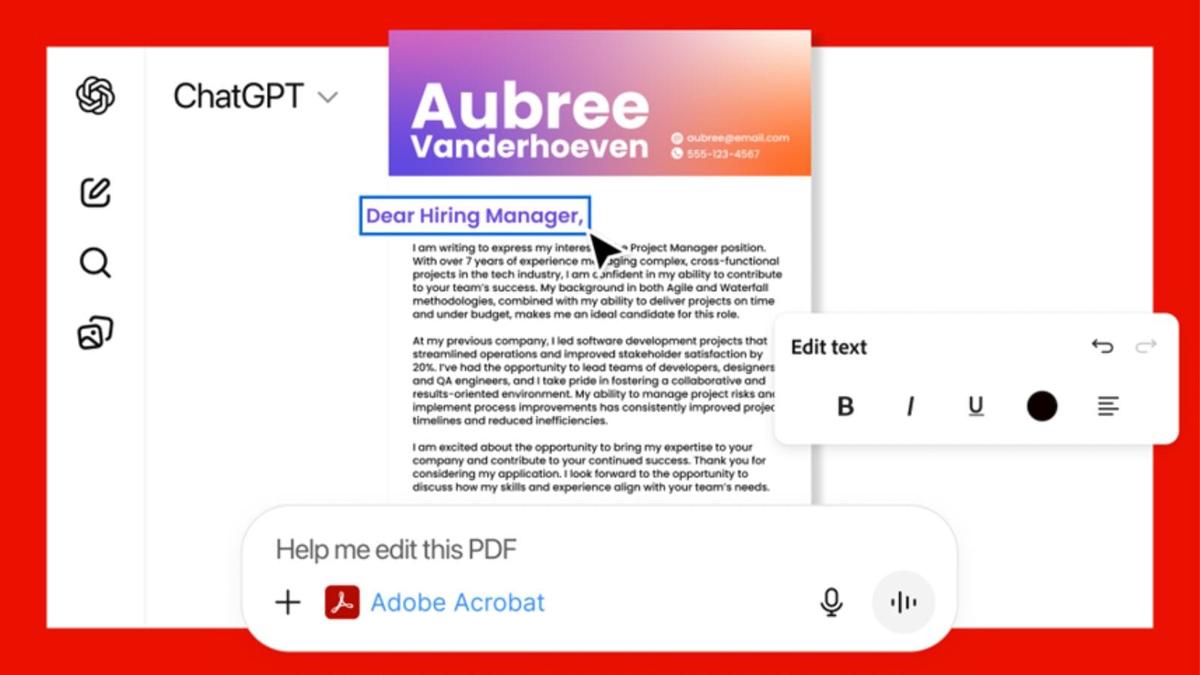
Adobe Launches Photoshop, Express, and Acrobat Inside ChatGPT: Here’s What You Can Do
•December 10, 2025
0
Companies Mentioned


Why It Matters
Embedding Adobe’s flagship creative and productivity apps in ChatGPT expands AI‑driven workflows for over 800 million users, accelerating the shift toward conversational design and document management. The move also positions Adobe against rivals by showcasing proprietary Firefly models and data‑safe AI practices.
Key Takeaways
- •Adobe apps now run inside ChatGPT for free
- •Photoshop, Express, Acrobat available via OpenAI Apps SDK
- •Content stays out of users' Creative Cloud accounts
- •Integration excludes UK and EU due to regulations
- •Over 700M monthly users for Express and Acrobat combined
Pulse Analysis
The Adobe‑OpenAI partnership marks a pivotal moment in the convergence of generative AI and creative software. By leveraging OpenAI’s Apps SDK, Adobe brings its industry‑standard tools to a conversational platform that already serves hundreds of millions, effectively turning ChatGPT into a multimodal creative hub. This strategy not only showcases Adobe’s Firefly models—trained on licensed data for legal safety—but also signals a broader industry trend where legacy desktop applications are reimagined as cloud‑first, AI‑augmented services.
From a user‑experience perspective, the integration lowers the barrier to entry for casual creators and business users alike. Prompt‑driven editing of photos, template‑based design in Express, and PDF manipulation in Acrobat can be performed without launching separate applications, streamlining workflows for marketing teams, educators, and remote workers. However, the exclusion of the UK and EU highlights ongoing regulatory challenges around data residency and AI compliance, while Adobe’s decision not to sync generated content to Creative Cloud reassures privacy‑concerned customers.
Looking ahead, Adobe’s move could reshape competitive dynamics in the creative‑AI space. Competitors such as Canva and Figma already offer similar SDK‑based integrations, but Adobe’s massive user base and deep‑rooted brand equity give it a distinct advantage. Continued feature rollouts within ChatGPT may drive incremental adoption of Adobe’s paid suites, creating a funnel from free, AI‑assisted experiences to premium, high‑precision tools. As enterprises prioritize AI‑enhanced productivity, Adobe’s presence inside the world’s most popular chatbot positions it as a critical infrastructure provider for next‑generation digital content creation.
Adobe launches Photoshop, Express, and Acrobat inside ChatGPT: Here’s what you can do
0
Comments
Want to join the conversation?
Loading comments...