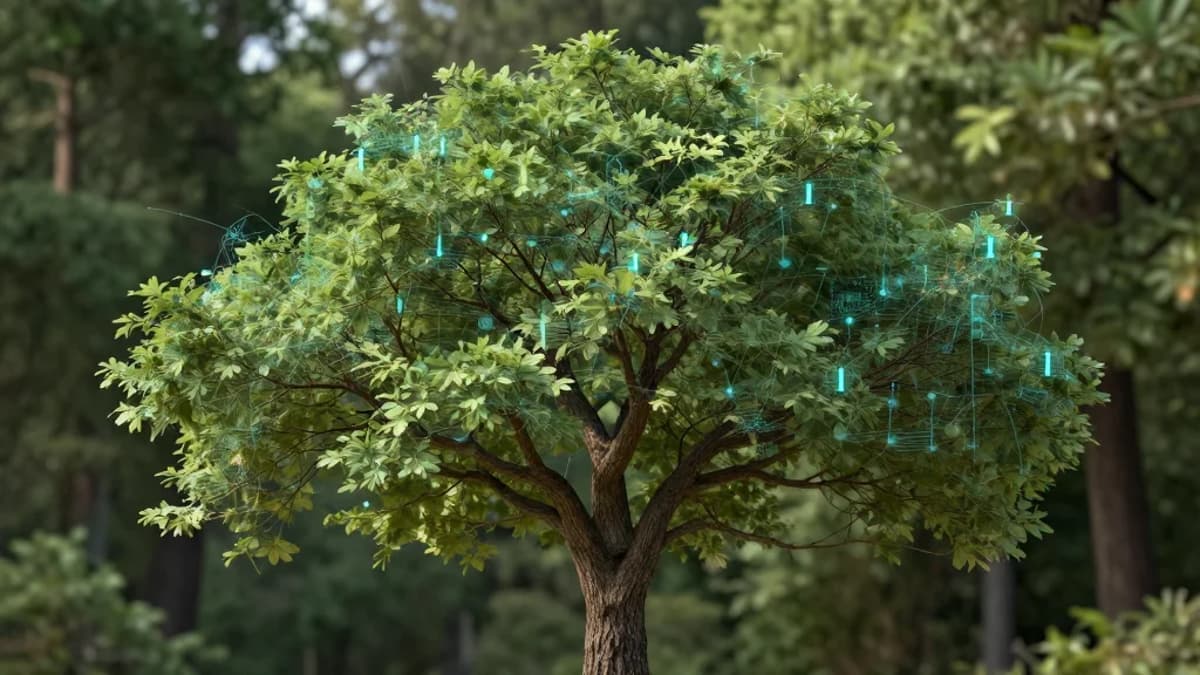
AI Helps Find Trees in a Forest: Researchers Achieve 3D Forest Reconstruction From Remote Sensing Data
•January 21, 2026
0
Why It Matters
TreeStructor transforms forest remote‑sensing by providing fast, detailed 3‑D reconstructions, improving carbon accounting, timber management, and ecological monitoring. Its scalability and sensor‑agnostic design make it a practical tool for both research and commercial forestry operations.
Key Takeaways
- •TreeStructor reconstructs entire forests from LiDAR point clouds
- •AI leverages repetitive tree geometry via a learned dictionary
- •Method processes hundreds of trees in minutes on standard hardware
- •Enables potential species identification through tree part dictionaries
- •Robust across terrestrial, backpack, and drone LiDAR sensors
Pulse Analysis
Accurate three‑dimensional forest models have long been a bottleneck for remote‑sensing applications. Traditional LiDAR processing excels with man‑made structures because of their regular geometry, yet natural vegetation presents stochastic, overlapping forms that confound conventional algorithms. Carbon‑stock assessments, biodiversity surveys, and timber inventory all suffer from incomplete or imprecise data, prompting a search for methods that can capture the full complexity of forest canopies and understories.
TreeStructor addresses these challenges by introducing a learned dictionary of tree components—trunks, branches, and sub‑structures—derived from millions of synthetic scans. An AI model ranks and matches segments of real‑world point clouds against this repository, replacing raw points with high‑fidelity meshes. This neural ranking pipeline runs on commodity hardware, delivering reconstructions for hundreds of trees within minutes and maintaining accuracy across terrestrial, backpack, and drone‑borne LiDAR platforms. The system’s ability to disentangle intertwined canopies and resolve occluded branches marks a significant leap over prior single‑tree extraction techniques.
Beyond technical novelty, the broader implications are substantial. Precise 3‑D forest maps enable more reliable carbon‑credit calculations, support sustainable harvest planning, and facilitate automated species identification as the dictionary expands to encode taxonomic signatures. While current limitations include difficulty detecting dead wood and understory vegetation, ongoing sensor improvements and richer training datasets promise to close these gaps. As forestry agencies and commercial operators adopt AI‑enhanced reconstruction, the industry moves toward data‑driven stewardship and more transparent environmental reporting.
AI helps find trees in a forest: Researchers achieve 3D forest reconstruction from remote sensing data
0
Comments
Want to join the conversation?
Loading comments...