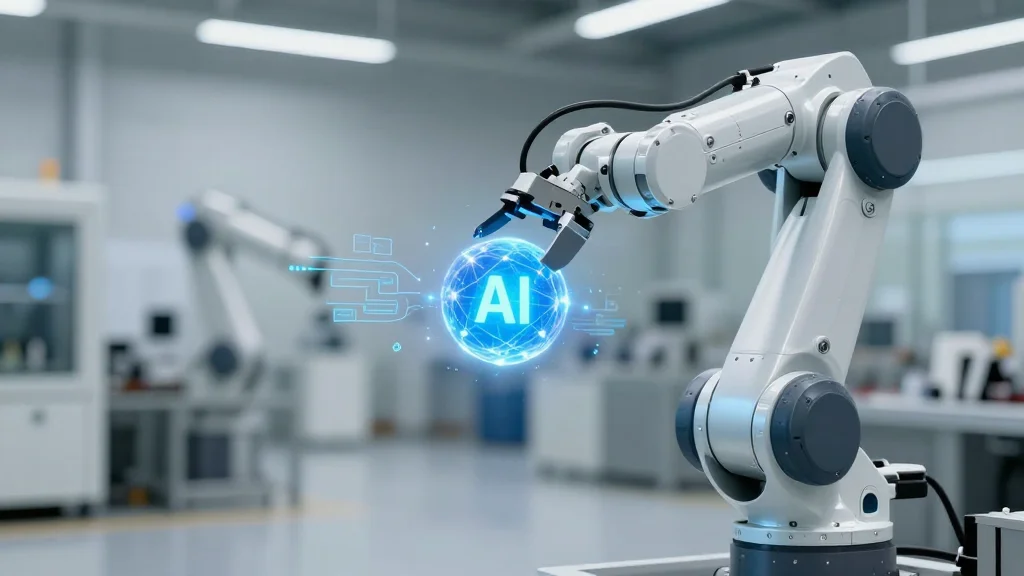
AI in Manufacturing 2026: Solutions, Benefits, Challenges & Implementation Strategy
Why It Matters
AI delivers measurable cost reductions and productivity gains, turning factories into self‑optimizing assets and reshaping competitive dynamics across all manufacturing sectors.
Key Takeaways
- •Predictive maintenance cuts downtime 35‑45% and saves up to 25% maintenance costs
- •Computer‑vision inspection reduces defects 30‑50% with 97‑99% detection accuracy
- •AI‑driven supply‑chain optimization delivers 150‑250% ROI and halves stockouts
- •Agentic AI automates work‑order creation, spare‑part allocation, and scheduling
Pulse Analysis
Manufacturers are at a strategic crossroads, pressured by costly unplanned downtime, quality defects, and volatile supply chains. AI’s ability to ingest high‑velocity sensor data, learn from historical patterns, and continuously refine predictions makes it uniquely suited to address these pain points. Early adopters report up to 45% reductions in equipment failures and nearly 50% lower defect rates, translating into billions of dollars saved and stronger ESG performance. The technology’s scalability—from edge‑deployed vision models to cloud‑based demand forecasting—means firms of any size can begin extracting value.
The most compelling ROI comes from four high‑impact solutions. Computer‑vision quality inspection now achieves 97‑99% detection accuracy, eliminating the need for costly manual sampling and slashing warranty claims. Predictive maintenance platforms leverage vibration, temperature, and acoustic data to anticipate failures days in advance, reducing maintenance spend by up to a quarter. AI‑driven supply‑chain engines integrate ERP, logistics, and external risk signals to rebalance inventory, delivering 150‑250% returns and cutting stock‑outs by half. Meanwhile, advanced demand‑forecasting models, such as Temporal Fusion Transformers, improve forecast error by 20‑50%, enabling leaner production schedules and better supplier negotiations.
Successful implementation requires a disciplined, business‑first approach. Companies should start with a narrowly scoped pilot—often predictive maintenance on critical assets—to prove value, standardize data pipelines, and secure executive buy‑in. Integration with legacy MES and ERP systems via APIs or middleware ensures AI insights reach the shop floor in real time. Overcoming challenges like data quality, workforce resistance, and cybersecurity demands robust governance and continuous training. Looking ahead, autonomous AI agents will manage procurement, scheduling, and logistics, while self‑optimizing factories adjust processes on the fly, positioning AI as the engine of the next manufacturing renaissance.
AI in Manufacturing 2026: Solutions, Benefits, Challenges & Implementation Strategy
Comments
Want to join the conversation?
Loading comments...