AI Learns to Work Around Metal 3D Printing Defects
Companies Mentioned
Why It Matters
Accelerating strength prediction for metal‑3D‑printed parts reduces development time and certification costs, a critical advantage for aerospace and automotive manufacturers seeking to scale additive‑manufacturing adoption.
Key Takeaways
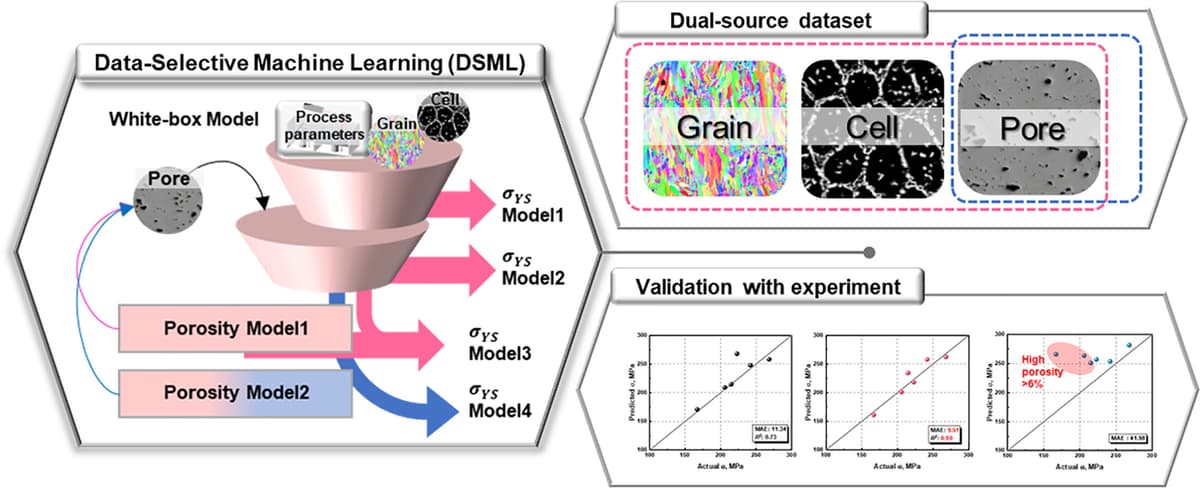
- •AI predicts AlSi10Mg strength within 9.51 MPa of measurements.
- •Model uses defect size and distribution as input variables.
- •Framework yields human‑readable equations linking void density to strength.
- •Trained on 44 full and 111 partial data points.
- •Limited to AlSi10Mg; broader material validation still needed.
Pulse Analysis
Additive manufacturing has long wrestled with microscopic voids that emerge during laser powder‑bed fusion, turning the very process that enables complex geometries into a reliability challenge. Traditional quality assurance relies on repeated mechanical testing, a time‑intensive and expensive bottleneck for high‑performance sectors such as aerospace and automotive. The new AI framework from POSTECH and KIMS reframes this problem by feeding defect characteristics—size, spatial distribution, and density—directly into a predictive model, sidestepping the need for exhaustive physical trials.
The core of the approach is data‑selective machine learning, which isolates the most influential process parameters and microstructural features to forecast yield strength. Unlike black‑box neural networks, the system produces explicit equations that map void density to load‑bearing capacity, offering engineers transparent insight into the underlying physics. Tested on Al‑Si‑Mg alloy samples, the model’s predictions fell within 9.51 MPa of measured values, outperforming existing techniques by a factor of four. Although the training set comprised only 44 fully labeled and 111 partially labeled builds, the results demonstrate that even modest datasets can yield high‑fidelity forecasts when the learning algorithm is carefully tuned.
For industry, the implications are twofold. First, designers can now anticipate mechanical performance during the concept phase, dramatically shortening development cycles and reducing material waste. Second, the interpretability of the model eases regulatory acceptance, a key hurdle for certifying critical components. Nevertheless, the framework’s current limitation to a single alloy and reliance on detailed microstructural data mean broader validation is essential before widespread deployment. As startups like Euler secure $2.2 million in funding to embed AI into real‑time defect detection, the convergence of predictive and diagnostic tools points toward a future where additive‑manufactured parts are certified by algorithmic assurance rather than exhaustive physical testing.
AI Learns to Work Around Metal 3D Printing Defects
Comments
Want to join the conversation?
Loading comments...