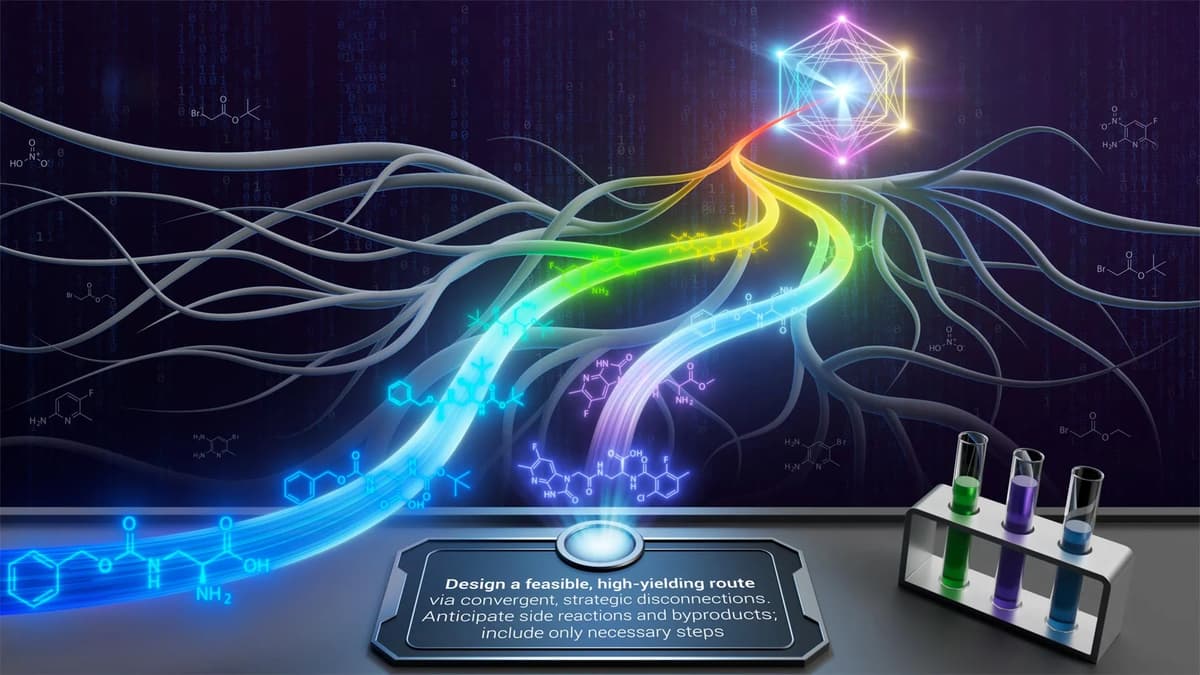
AI Lets Chemists Design Molecules by Simply Describing Them
Why It Matters
Synthegy accelerates drug‑discovery and material design by letting scientists steer complex synthesis planning with natural language, reducing trial‑and‑error cycles and expanding access to advanced computational tools.
Key Takeaways
- •Synthegy lets chemists describe synthesis goals in plain language.
- •LLM evaluates and ranks retrosynthetic pathways based on user instructions.
- •Double‑blind study showed 71.2% agreement with expert chemists.
- •Larger language models outperform smaller ones in chemical reasoning tasks.
- •Tool bridges synthesis planning and reaction‑mechanism analysis.
Pulse Analysis
Retrosynthetic planning has long been a bottleneck for chemists, requiring deep expertise to reverse‑engineer a target molecule into viable precursors. Traditional software can enumerate thousands of routes, yet they often overwhelm users with options that ignore practical constraints such as protecting‑group strategies or preferred reaction sequences. Synthegy disrupts this paradigm by embedding a large language model as a strategic evaluator, allowing researchers to articulate high‑level goals—like “avoid unnecessary protecting groups” or “form the aromatic ring early”—in everyday language. The AI then scores each candidate pathway against those directives, delivering a ranked shortlist that reflects both chemical feasibility and the chemist’s intent.
The core innovation lies in converting computationally generated pathways into textual descriptions that the language model can interpret. By leveraging the model’s contextual understanding, Synthegy not only ranks routes but also provides natural‑language rationales, making the decision process transparent. Validation with 36 professional chemists across 368 assessments showed a 71.2% concordance rate, indicating that the system’s judgments align closely with expert intuition. Moreover, larger LLMs consistently outperformed their smaller counterparts, underscoring the value of scale in capturing nuanced chemical reasoning.
For the pharmaceutical and materials sectors, this capability promises faster iteration cycles and lower R&D costs. Scientists can prototype synthetic strategies without exhaustive manual retrosynthesis, accelerating lead‑optimization and enabling rapid exploration of novel molecular scaffolds. As AI continues to mature, tools like Synthegy illustrate a collaborative future where language models act as knowledgeable assistants, democratizing access to sophisticated design workflows and potentially reshaping the economics of drug discovery.
AI lets chemists design molecules by simply describing them
Comments
Want to join the conversation?
Loading comments...