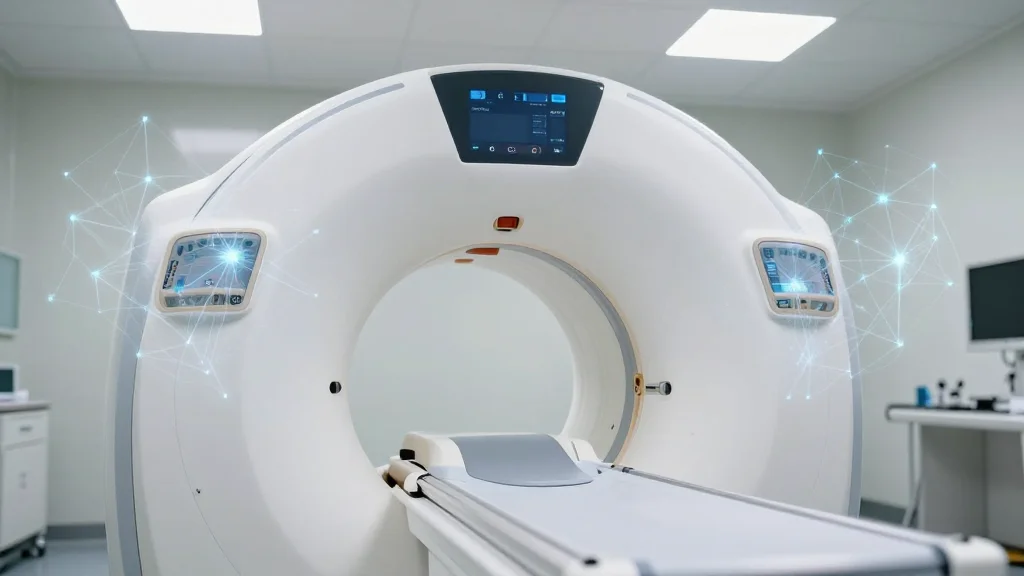
AI-Powered Medical Imaging: Turning Data Into Faster Diagnoses
Companies Mentioned
Why It Matters
By accelerating image analysis and reducing interpretive variability, AI eases radiology workforce strain and shortens time to treatment, directly enhancing patient outcomes and healthcare efficiency.
Key Takeaways
- •AI cuts MRI scan time up to 75% without quality loss
- •Deep‑learning reconstruction lowers CT radiation dose while preserving detail
- •U‑Net variants deliver pixel‑level segmentation for precise tumor volume measurement
- •AI triage algorithms prioritize emergency cases, speeding radiologist review
Pulse Analysis
The surge in imaging studies over the past decade has outpaced the supply of radiologists, creating bottlenecks that threaten timely patient care. AI addresses this gap by embedding intelligence at every stage of the pipeline. Before a scan even begins, natural‑language processing scans electronic health records to recommend optimal protocols, while during acquisition AI optimizes dose and scan range, cutting unnecessary radiation. In reconstruction, deep‑learning models denoise under‑sampled data, enabling MRI examinations that finish in a fraction of the traditional time without sacrificing diagnostic fidelity.
At the core of these capabilities are convolutional neural networks and encoder‑decoder architectures like U‑Net, which excel at pixel‑wise segmentation required for precise tumor volume calculations and organ delineation. Recent variants—U‑Net++, Attention U‑Net, and self‑configuring nnU‑Net—push accuracy further, while Vision Transformers promise broader contextual awareness across large fields of view. Though interpretability remains a concern, rigorous validation studies show AI can detect subtle pathologies, such as lung nodules, with sensitivity above 95%, often outperforming human readers in consistency and speed.
From a business perspective, AI‑enhanced imaging translates into measurable cost savings and revenue growth. Faster turnaround reduces patient length of stay, while lower radiation doses and shorter scan times increase scanner throughput, allowing facilities to serve more patients without additional capital equipment. Looking ahead, multimodal foundation models that fuse imaging with genomics, pathology and wearable data will deepen clinical insight, positioning AI as a collaborative partner rather than a replacement. Hospitals that adopt these integrated solutions early will gain competitive advantage through improved outcomes, higher operational efficiency, and stronger market differentiation.
AI-powered medical imaging: Turning data into faster diagnoses
Comments
Want to join the conversation?
Loading comments...