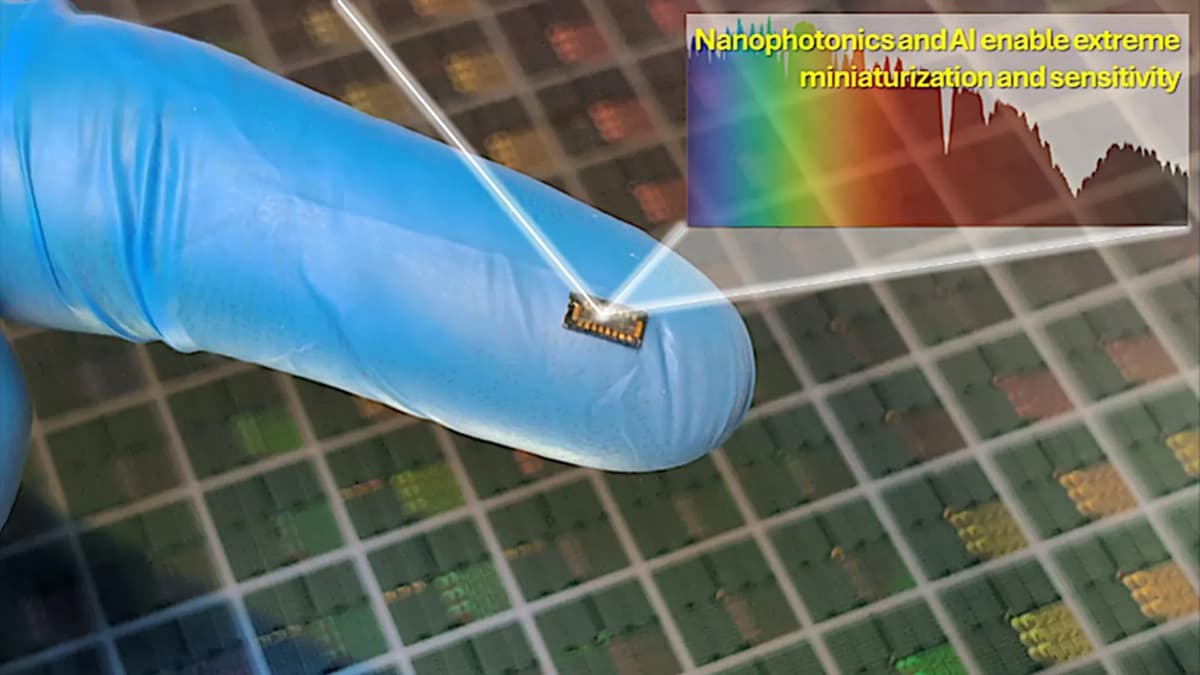
AI-Powered Spectrometer Chip Shrinks Lab Technology to the Size of a Grain of Sand
Why It Matters
The breakthrough collapses laboratory‑grade spectroscopy into a portable form factor, opening high‑precision sensing to field‑deployed and wearable devices and reducing cost and complexity for multiple industries.
Key Takeaways
- •AI reconstructs spectra from 16 silicon detectors.
- •Chip fits 0.4 mm², size of sand grain.
- •Photon‑trapping textures extend silicon sensitivity to 1100 nm NIR.
- •8 nm resolution achieved without bulk optics.
- •Enables portable medical, environmental, and food‑quality sensing.
Pulse Analysis
Traditional spectrometers rely on bulky optics to separate light, limiting their use to fixed laboratories. Recent advances in computational imaging have shown that machine‑learning models can infer spectral information from encoded sensor data, but practical implementations have struggled with size, noise, and wavelength coverage. The UC Davis team’s approach sidesteps physical dispersion entirely, leveraging a compact array of silicon photodiodes whose individual responses are subtly distinct. By feeding these raw signals into a fully connected neural network trained on thousands of calibrated spectra, the system solves the inverse problem and reconstructs a full spectrum with 8 nm resolution, a performance previously reserved for much larger instruments.
The technical linchpin is the photon‑trapping surface texture (PTST) applied to standard silicon detectors. This micro‑structured coating scatters incoming photons, increasing their path length within the silicon and boosting absorption in the near‑infrared region up to 1100 nm. Extending silicon’s native sensitivity beyond the visible range unlocks applications such as deep‑tissue biomedical imaging and NIR environmental monitoring, which were previously the domain of expensive InGaAs arrays. Coupled with high‑speed timing circuitry, the chip can also capture ultrafast photon lifetimes, enabling dynamic spectroscopy that can track rapid chemical reactions in situ.
The implications for the market are significant. A sub‑millimeter spectrometer that delivers laboratory‑grade accuracy can be integrated into handheld diagnostic tools, wearable health monitors, and drones for remote sensing, dramatically lowering barriers to entry for hyperspectral analytics. Industries ranging from precision agriculture to food safety stand to benefit from real‑time, on‑site chemical profiling without the need for costly equipment or specialized operators. As AI models continue to improve and manufacturing scales, the spectrometer‑on‑a‑chip could become a foundational component of the next generation of smart, data‑driven sensing platforms.
AI-powered spectrometer chip shrinks lab technology to the size of a grain of sand
Comments
Want to join the conversation?
Loading comments...