Why It Matters
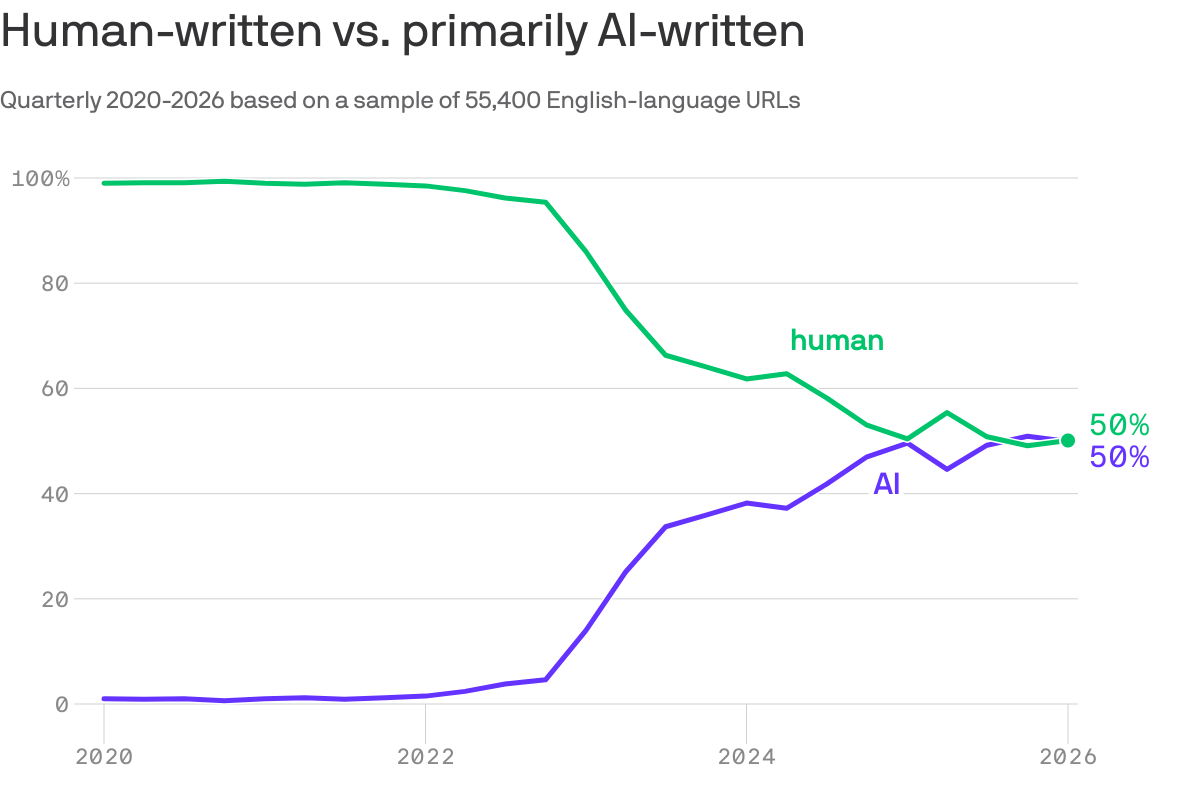
The plateau suggests AI has not yet displaced human writers, but the growing volume of machine‑generated text threatens to fuel a self‑reinforcing cycle that could lower content standards across the internet.
Key Takeaways
- •AI-generated articles plateau at ~50% of new content.
- •Growth spiked after ChatGPT launch, then stalled early 2025.
- •Graphite sampled 55,400 URLs, applying three AI-detection tools.
- •Feedback loop risk: AI trains on AI‑generated web content.
- •Human‑AI hybrid writing blurs line between original and assisted.
Pulse Analysis
The explosion of AI‑generated text began in earnest after OpenAI released ChatGPT in November 2022, prompting marketers, publishers and freelancers to experiment with large‑language models for speed and scale. Within months, AI‑assisted drafts flooded content farms, and by early 2023 a noticeable shift appeared in search engine results pages, where machine‑written articles often outranked human pieces on trending topics. This rapid adoption sparked alarm among journalists and SEO professionals, who feared that unchecked automation could erode editorial standards and dilute brand authority. Graphite’s latest study tempers those fears by showing that the share of purely AI‑generated articles has leveled off at roughly 50% of all new online pieces since early 2025.
The firm sampled 55,400 English‑language URLs from the Common Crawl archive, filtering for texts longer than 100 words and classifying them as articles or listicles. Each page was run through three independent detectors—Pangram, GPTZero and Copyleaks—and only those flagged as primarily AI‑written were counted. 9% in the first year and 48% in the second.
While the plateau suggests AI has not yet eclipsed human writers, the underlying dynamics raise new strategic questions for the digital ecosystem. As models continue to train on the very content they help produce, a self‑reinforcing loop could lower overall quality and make detection increasingly difficult. Publishers may need to adopt hybrid workflows, combining AI efficiency with human oversight, and invest in robust provenance tools to preserve credibility. For SEO strategists, the takeaway is clear: authentic, expertise‑driven content will remain a differentiator even as AI tools become more sophisticated.
AI writing hits a ceiling
Comments
Want to join the conversation?
Loading comments...