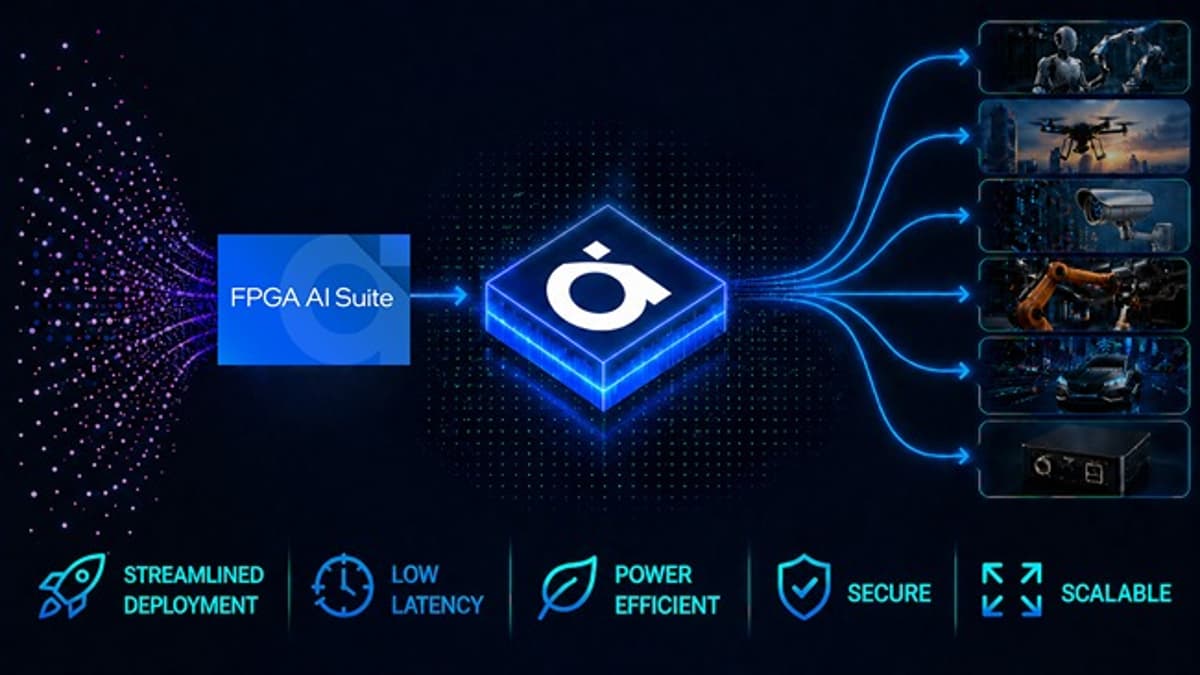
Altera Updates FPGA AI Suite for Edge AI Deployment
Why It Matters
The release gives developers a faster path to deploy high‑performance AI at the edge, reducing time‑to‑market and enabling safer, more responsive physical AI systems.
Key Takeaways
- •Spatial compiler maps neural nets directly onto FPGA hardware.
- •ASIC-like inference performance achieved with re‑programmable flexibility.
- •Deterministic low latency suits robotics, autonomous machines, video analytics.
- •Supports PyTorch, TensorFlow, OpenVINO; free up to 100k inferences.
- •Integrated with Agilex FPGAs, offering varied capacities for edge deployments.
Pulse Analysis
Edge AI is reshaping industries that require on‑device intelligence, from manufacturing robots to autonomous drones. Traditional CPUs and GPUs struggle to meet the strict power, latency, and determinism constraints of these workloads. Field‑Programmable Gate Arrays (FPGAs) have long offered a middle ground—customizable hardware with lower power draw—but programming them has been a barrier. Altera’s FPGA AI Suite 26.1.1 tackles this gap by introducing a spatial‑mapping compiler that automatically translates high‑level neural network graphs into streaming data‑flow pipelines on the chip. This approach eliminates the need for hand‑crafted RTL, accelerates development cycles, and yields performance that rivals fixed‑function ASICs while retaining the flexibility to update models post‑deployment.
The technical leap lies in the suite’s ability to treat the FPGA as a fabric of parallel compute lanes, mapping each layer of a model to dedicated hardware resources. By optimizing data movement and exploiting massive parallelism, the compiler reduces inference latency to deterministic sub‑millisecond levels and cuts power consumption, key metrics for battery‑operated edge devices. Integration with popular frameworks such as PyTorch, TensorFlow, and OpenVINO means data scientists can stay within familiar toolchains, while the free tier of 100,000 inferences lowers entry barriers for startups and research teams testing edge prototypes.
From a market perspective, Altera’s update positions its Agilex FPGA family as a compelling alternative to competing edge AI solutions from Nvidia, Intel’s own Movidius line, and emerging ASICs. The deterministic performance and re‑programmability appeal to regulated sectors—automotive, aerospace, and industrial automation—where safety and upgradability are paramount. As edge AI adoption accelerates, vendors that combine hardware efficiency with streamlined software stacks will capture the most lucrative contracts. Altera’s FPGA AI Suite 26.1.1 therefore not only advances the technical state of edge inference but also signals a broader shift toward flexible, low‑latency compute platforms in the next generation of physical AI systems.
Altera updates FPGA AI Suite for edge AI deployment
Comments
Want to join the conversation?
Loading comments...