Apple’s HyperCard Comes Back to Life in the Form of This Cool New Animated Browser
Why It Matters
By shifting AI interaction from text to immersive visuals, Flipbook could redefine how users learn, shop, and research online, opening new revenue streams for content platforms and edtech firms.
Key Takeaways
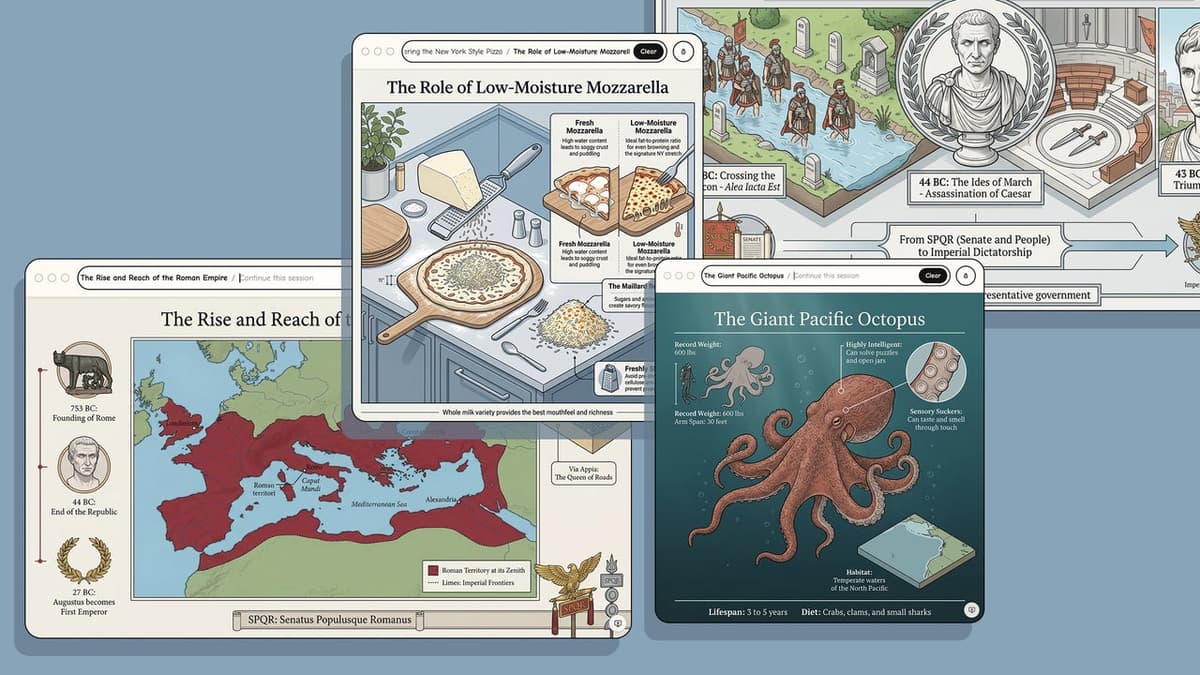
- •Flipbook visualizes LLM answers as interactive illustrated pages
- •Prototype uses image models to render text, buttons, and graphics
- •Clicking any region generates a new AI‑crafted knowledge card
- •Inspired by 1987 HyperCard, but powered entirely by generative AI
- •Current prototype is slow, with occasional hallucinations and animation glitches
Pulse Analysis
Flipbook represents a bold pivot in generative AI applications, moving away from the dominant text‑only chatbot paradigm toward a visual, exploratory experience. By feeding prompts into a browser‑style search bar, the system leverages image generation models to paint entire pages—text, navigation elements, and artwork—directly as pixels. This eliminates the need for HTML or separate UI components, delivering a seamless, immersive canvas that feels more like an interactive illustration than a traditional web page. Early users report a more intuitive sense of discovery, as each click spawns a fresh, AI‑crafted card that deepens the narrative.
The design philosophy harks back to Bill Atkinson’s 1987 HyperCard, which let users link hand‑drawn cards into a navigable stack. Flipbook modernizes that concept with generative AI, automatically generating the next visual card based on the exact region a user selects. While the prototype still suffers from latency and occasional factual errors—common hallucinatory traits of large language models—it demonstrates the feasibility of a spatial knowledge interface. The animated mode, powered by an LTX‑based video generation pipeline, hints at future fluid environments where static slides evolve into continuous visual journeys.
For businesses, Flipbook’s approach could unlock new monetization models across education, tourism, and e‑commerce. Imagine a travel site that lets users wander through AI‑rendered cityscapes, clicking landmarks to reveal itineraries, or an online textbook that illustrates complex concepts in real time. As the underlying models improve and server infrastructure scales, the technology may shift from novelty to a mainstream UI layer, prompting investors and product teams to explore visual AI browsers as the next generation of digital interaction.
Apple’s HyperCard comes back to life in the form of this cool new animated browser
Comments
Want to join the conversation?
Loading comments...