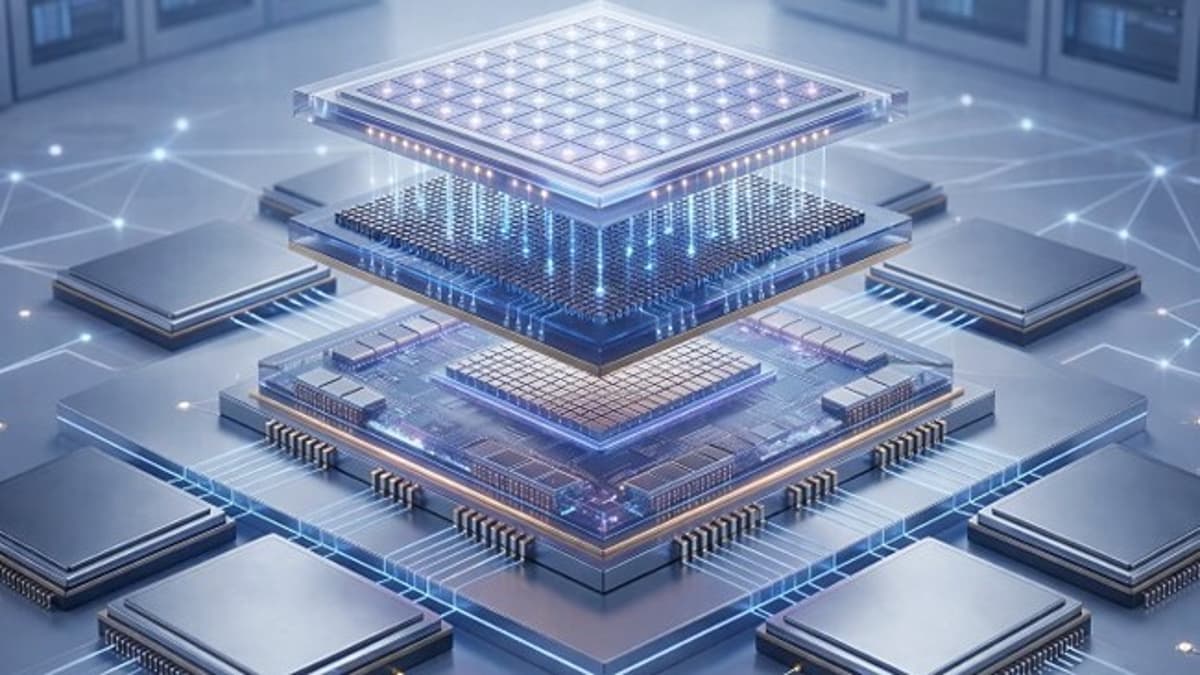
Artilux Unveils Inception Hybrid Optoelectronic AI Architecture
Why It Matters
Inception could reshape AI hardware by cutting energy use and chip size, enabling more cost‑effective, high‑density inference solutions across cloud, edge and on‑device markets.
Key Takeaways
- •Inception uses hybrid optoelectronic systolic array for AI GEMM.
- •Eliminates ALUs, achieving orders‑of‑magnitude power and area gains.
- •Compatible with standard CMOS nodes, no active cooling required.
- •First‑gen core targets >12,000 TOPS INT8 at ~50 mW/mm².
- •Enables full memory reuse, cutting bandwidth and data‑movement energy.
Pulse Analysis
The relentless growth of AI models has exposed the limits of conventional digital processors, which struggle with rising power draw, heat dissipation, and silicon real‑estate demands. Artilux’s Inception tackles these constraints by marrying photonic signal propagation with electronic control, creating a hybrid systolic array that executes matrix‑multiply operations in a single optical step. This fundamentally different physics‑based approach sidesteps the need for deep digital pipelines, delivering dramatic gains in energy per operation and chip footprint.
At the heart of Inception are optoelectronic neurons (OENs) that combine GaN micro‑LED emitters, GeSi photodetectors and in‑pixel memory. By encoding inputs and weights as light intensity and detecting the resulting product optically, the architecture performs massive parallel dot‑products without traditional ALUs. The system reuses data locally, slashing memory bandwidth and the associated energy cost of data movement—critical for transformer‑based workloads. Because the design leverages existing CMOS nodes, manufacturers can adopt it without costly fab upgrades, and the lack of active cooling simplifies system integration.
Commercially, Artilux’s roadmap positions Inception as a viable alternative for energy‑critical AI inference, especially at the edge where power budgets are tight. The announced first‑generation core promises over 12,000 TOPS (INT8) at roughly 50 mW per square millimeter, figures that rival or exceed many GPU‑based solutions while occupying a fraction of the area. If the company can scale production, Inception may pressure established AI chip makers to explore photonic hybrids, accelerating a broader industry shift toward ultra‑efficient, high‑density AI accelerators.
Artilux unveils Inception hybrid optoelectronic AI architecture
Comments
Want to join the conversation?
Loading comments...