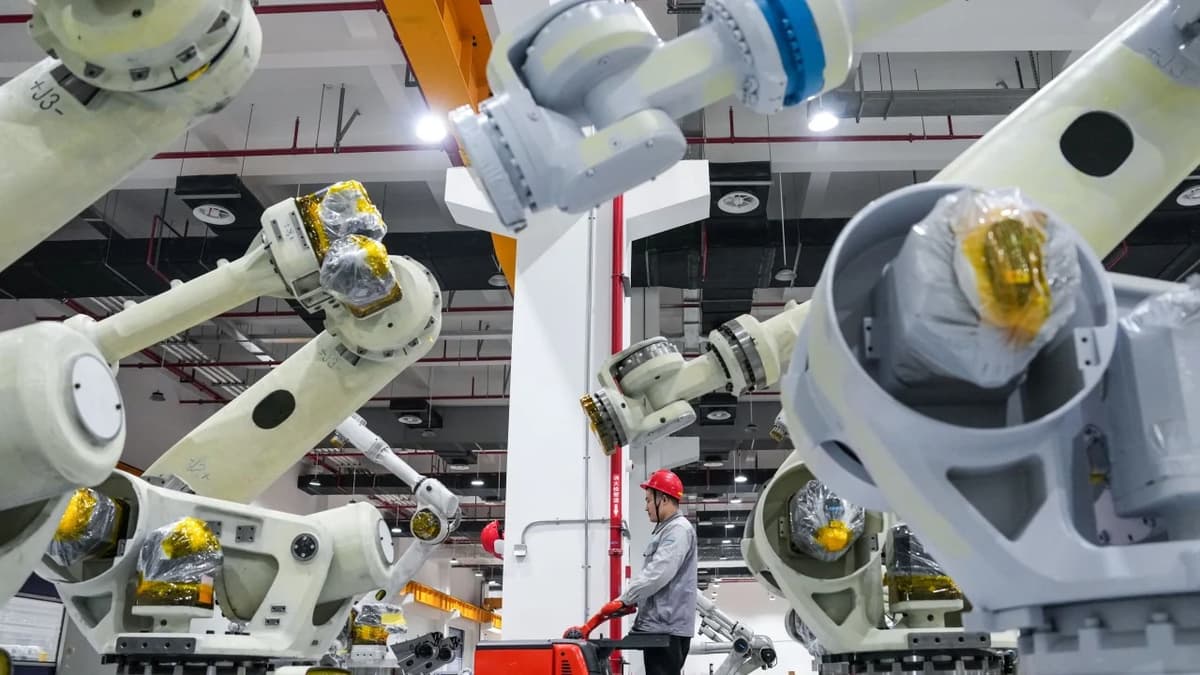
Asia’s Supply Chain Strengths Could Give It Edge over US in AI Race: Granite Asia’s Foo
Companies Mentioned
Why It Matters
The shift toward AI hardware and integrated supply chains accelerates commercialization, positioning Asia to dominate emerging markets and reshaping global competitive dynamics.
Key Takeaways
- •Asia's integrated supply chains accelerate AI hardware deployment
- •Venture capital shifts toward AI applications, not just models
- •Granite Asia manages $10 billion, backing firms like Baidu and Xpeng
- •Manycore Tech targets spatial intelligence for embodied AI training
- •Hardware components such as chips and robotics gain strategic importance
Pulse Analysis
The global AI competition is leaving the realm of pure software and entering the physical world, where robots, autonomous vehicles and smart factories will deliver measurable outcomes. Asia’s decades‑long manufacturing ecosystem—spanning China, Japan, South Korea and Southeast Asia—provides a dense network of component suppliers, assembly lines and engineering talent that can iterate AI‑enabled hardware far faster than the United States. This structural advantage shortens time‑to‑market for embodied AI solutions and positions the region to set industry standards in emerging sectors such as spatial intelligence and industrial automation.
Investors have taken note. Granite Asia, the former Asian arm of GGV Capital, now oversees roughly $10 billion in assets and has a track record of backing Chinese internet giants and mobility pioneers. Its senior managing partner, Jixun Foo, says capital is flowing toward companies that can demonstrate tangible use cases—robotics platforms, AI‑powered chips, and vision systems—rather than pure‑play model developers. A case in point is Manycore Tech, a spatial‑computing startup that debuted in Hong Kong and is building digital twins to train embodied AI agents, illustrating the shift from abstract algorithms to concrete, revenue‑generating products.
The hardware‑centric trajectory reshapes business models across the board. As AI moves from attention‑based advertising to outcome‑based automation, firms that control supply‑chain nodes for chips, optical modules and industrial equipment will capture disproportionate value. Foo expects a wave of AI‑related IPOs, but warns that superficial “AI” branding will be weeded out by market discipline. For U.S. companies, the challenge will be to secure reliable component sources and build partnerships that can match Asia’s scale, while policymakers grapple with the strategic implications of a hardware‑driven AI frontier.
Asia’s supply chain strengths could give it edge over US in AI race: Granite Asia’s Foo
Comments
Want to join the conversation?
Loading comments...