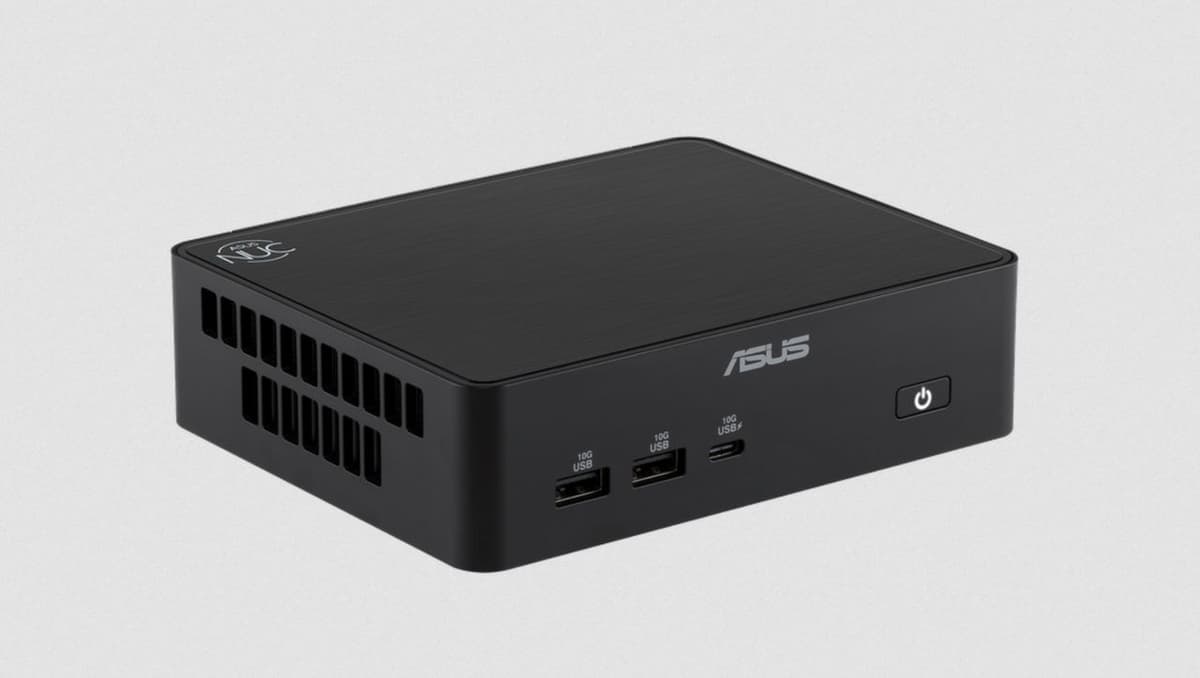
Asus Vies for Fastest Mini PC Ever with Panther Lake NUC 16 Pro — B390 GPU Inside the Core Ultra X9 388H Impresses but Won't Beat the 8060S
•January 10, 2026
0


Why It Matters
The NUC 16 Pro pushes the performance envelope for mini PCs, offering edge‑AI capabilities that could reduce reliance on larger workstations and accelerate adoption in enterprise and creative workflows.
Key Takeaways
- •Asus NUC 16 Pro uses Intel Core Ultra X9 388H
- •Integrated Arc B390 iGPU lags behind AMD Radeon 8060S
- •Device offers up to 180 TOPS AI compute
- •Supports 96 GB LPDDR5x, dual 2.5 G Ethernet, Wi‑Fi 7
- •Tool‑less chassis, dual M.2 Gen5/4, industrial I/O
Pulse Analysis
The mini‑PC segment has accelerated as AI workloads move to the edge, and Asus’s latest NUC 16 Pro arrives at CES 2026 with Intel’s Panther Lake platform. Built around the Core Ultra X9 388H, the board‑level processor is fabricated on Intel’s 18A node and promises up to 180 TOPS of combined CPU, GPU and NPU performance. That level of on‑device intelligence positions the NUC as a compelling alternative to larger workstations for developers and content creators who need low‑latency inference without sacrificing a compact footprint.
Integrated graphics remain a decisive factor for mini PCs, and Intel’s Arc B390 iGPU raises the bar for on‑chip performance. With 12 Xe cores, the B390 can handle 1080p gaming and media tasks, yet benchmark data shows AMD’s Radeon 8060S still leads in raw rasterization speed and synthetic scores. For creators whose workflows blend AI rendering with occasional GPU‑intensive applications, the B390 offers a balanced solution, while power‑constrained environments may still favor AMD’s offering for pure graphics throughput.
Beyond compute, the NUC 16 Pro packs enterprise‑grade features: up to 96 GB of LPDDR5x memory at 9600 MT/s, dual 2.5 G Ethernet, Wi‑Fi 7, Bluetooth 6.0, and TPM 2.0 for secure deployments. Its tool‑less chassis supports dual M.2 drives across PCIe Gen5 and Gen4, and includes RS‑232 and PCIe x1 ports for POS, IoT, and industrial applications. These connectivity and security options make the device attractive for edge servers, digital signage, and managed corporate fleets seeking high AI performance in a small, thermally efficient package.
Asus vies for fastest mini PC ever with Panther Lake NUC 16 Pro — B390 GPU inside the Core Ultra X9 388H impresses but won't beat the 8060S
0
Comments
Want to join the conversation?
Loading comments...