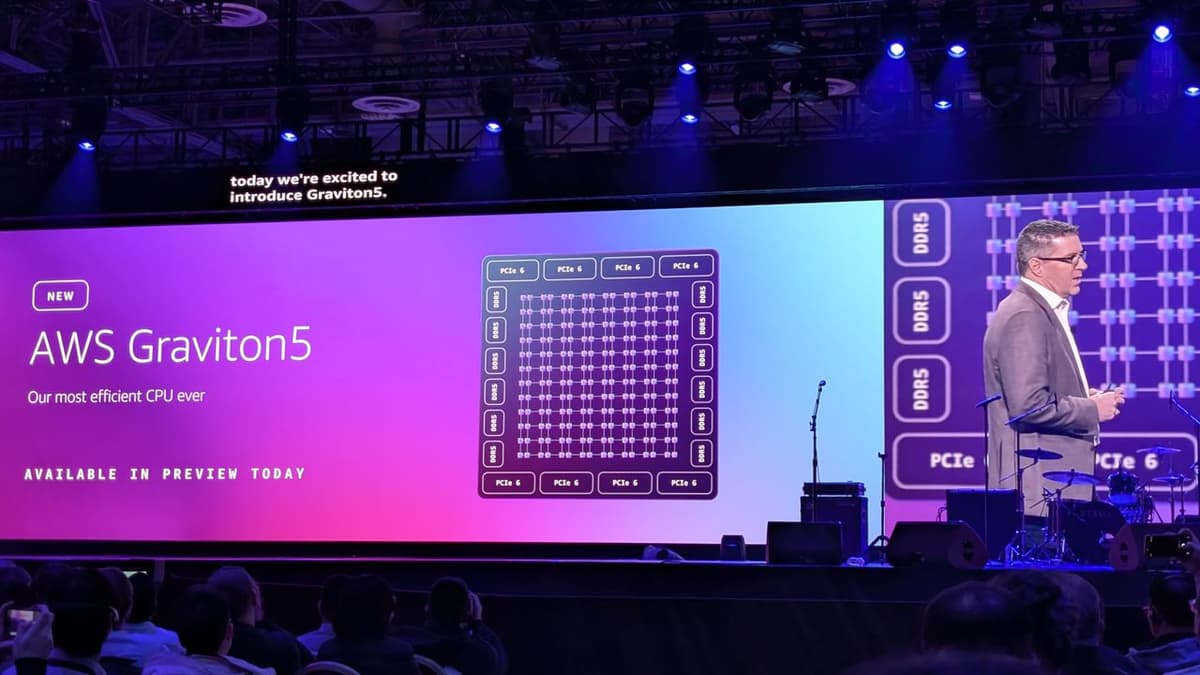
AWS Graviton5 Is Its Most Powerful and Efficient CPU to Date - and Could Mean Big Changes for Your Key Cloud Workloads
•December 4, 2025
0
Companies Mentioned


Why It Matters
Graviton5’s performance‑per‑watt advantage lowers cloud operating costs and accelerates data‑intensive workloads, giving AWS a competitive edge in the custom silicon market.
Key Takeaways
- •Graviton5 uses 3nm process, 192 cores.
- •L3 cache five times larger, boosting performance.
- •Up to 15% higher network, 20% more EBS bandwidth.
- •Supports high‑performance databases, analytics, app servers.
- •Adobe, Airbnb report major performance improvements.
Pulse Analysis
The launch of AWS Graviton5 marks a decisive step forward in cloud‑native silicon. Built on a 3 nm process, the chip packs 192 Arm‑based cores into a single package, delivering the highest core density ever seen on Amazon EC2. By shrinking transistor geometry, AWS reduces power draw while increasing clock efficiency, a combination that translates into lower total cost of ownership for customers. The architecture also integrates a dramatically larger L3 cache, a design choice that improves data locality and reduces latency for compute‑intensive tasks.
Performance gains extend beyond raw compute. Graviton5’s expanded L3 cache—more than five times that of its predecessor—provides each core with up to 2.6 × more cache, sharpening throughput for database queries and analytics pipelines. Faster memory channels further enable larger in‑memory datasets, while network bandwidth climbs up to 15 % and EBS throughput rises 20 % on average, with the largest instances seeing double the network capacity. Early benchmarks from Adobe and Airbnb show noticeable reductions in job runtimes and backup windows, confirming the chip’s ability to accelerate distributed workloads.
The introduction of Graviton5 also aligns with AWS’s sustainability agenda. The 3 nm node delivers superior performance per watt, helping enterprises meet carbon‑reduction targets while scaling workloads. From a market perspective, the move pressures competitors such as Microsoft Azure and Google Cloud to accelerate their own custom silicon roadmaps, intensifying the race for energy‑efficient, high‑density compute. For customers, the promise of lower latency, higher bandwidth, and reduced operating expenses creates a compelling case to migrate mission‑critical applications to the new M9g instances, reshaping cloud architecture decisions for the next decade.
AWS Graviton5 is its most powerful and efficient CPU to date - and could mean big changes for your key cloud workloads
0
Comments
Want to join the conversation?
Loading comments...