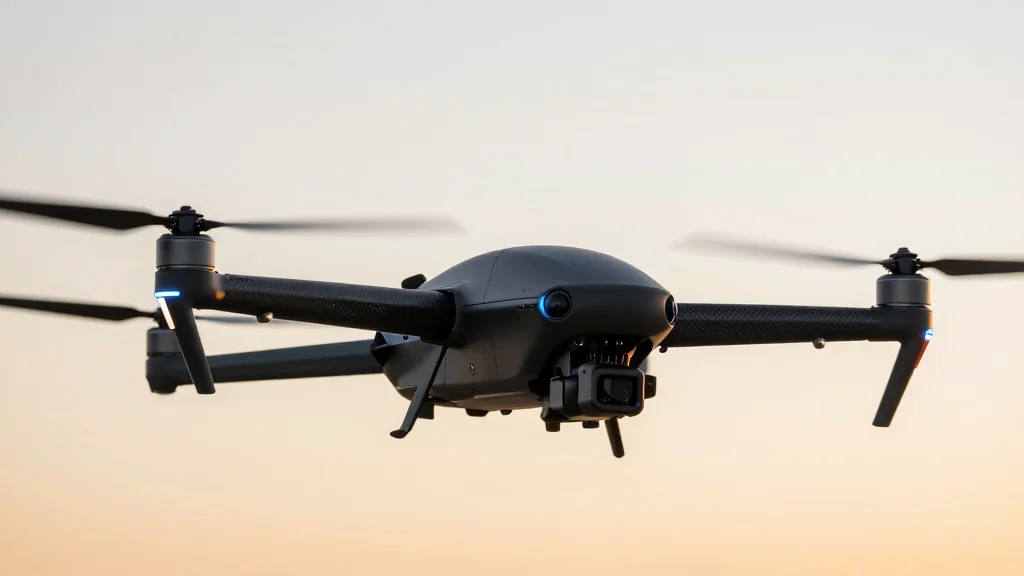
Billions Pour Into Autonomous Defense as AI Redefines Warfare
Companies Mentioned


Why It Matters
The capital influx accelerates the shift to software‑defined warfare, giving militaries cheaper, more precise autonomous capabilities that could redefine strategic calculations worldwide.
Key Takeaways
- •Anduril raised $5 billion to mass‑produce autonomous drones
- •Global private‑equity AI‑defense funding doubled YoY to $10.63 billion
- •Europe pledged over $5.6 billion for autonomous systems in 2025‑26
- •AI‑enabled drones achieved 3‑4× higher strike accuracy in Ukraine
- •Swarm software validated in 100,000 missions, attracting $2.8 million Ukraine contract
Pulse Analysis
The wave of financing behind AI‑driven defense reflects a broader strategic pivot toward autonomous systems. Anduril's $5 billion raise, backed by venture capital and sovereign investors, underscores confidence that edge AI and autonomous drones will become the backbone of future combat. This capital surge is not isolated; S&P Global reports private‑equity and VC funding for AI defense hit $10.63 billion in 2025, more than twice the previous year, while public spending topped $2.89 trillion. Such depth of investment fuels rapid prototyping, larger production runs, and the integration of sophisticated AI models directly on platforms, shortening the time from lab to battlefield.
The operational impact is already evident. In Ukraine, nearly 10,000 AI‑enabled drones have delivered strike accuracies three to four times higher than manned aircraft, demonstrating the tactical advantage of autonomous decision‑making under contested communications. Companies like Shield AI, True Anomaly, and Harmattan AI are expanding capabilities from surveillance to electronic‑warfare, while startups such as AnySignal provide real‑time RF jamming mitigation for satellite links. These advances are supported by government budgets—Germany’s defense spend reached $125 billion, and the U.S. DoD is seeking $54 billion for autonomous‑drone initiatives—ensuring that the technology scales across allied forces.
Looking ahead, the focus is shifting from single autonomous platforms to coordinated swarms. Edge‑AI processors now enable on‑board inference, allowing dozens or hundreds of drones to operate collaboratively without constant human oversight. Swarm‑focused firms like Swarmer have logged over 100,000 combat missions and secured a $2.8 million contract to embed their software in Ukrainian drones. As foundation models improve ISR fusion and mission planning, the cost per autonomous sortie is expected to plummet, making large‑scale swarm deployments feasible by the mid‑2030s. This convergence of AI, autonomy, and advanced sensing is poised to reshape global defense postures, prompting both opportunities and strategic challenges for policymakers.
Billions Pour into Autonomous Defense as AI Redefines Warfare
Comments
Want to join the conversation?
Loading comments...