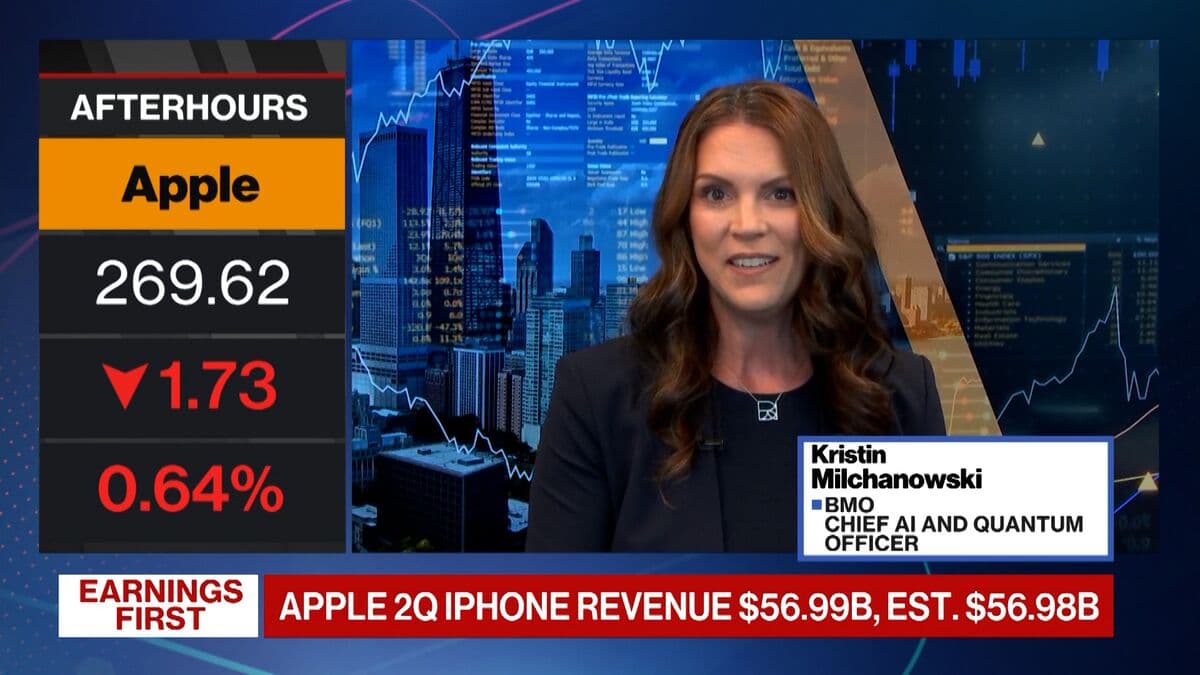
BMO's Milchanowski on Quantum's Banking Sector Impact
Companies Mentioned
Why It Matters
Quantum‑enhanced analytics promise faster, more accurate banking operations, giving early adopters a clear edge in cost efficiency and risk management. BMO’s strategic push signals the industry’s shift from hype to actionable deployment.
Key Takeaways
- •Quantum computing targets banking optimization, risk forecasting, cryptography
- •IBM aims for fault‑tolerant quantum computer by 2029
- •BMO created Institute for Applied AI and Quantum to guide strategy
- •AI‑quantum synergy enables current simulations to improve immediate AI models
- •Execution, not just adoption, drives measurable profit gains for banks
Pulse Analysis
The banking sector is on the cusp of a quantum breakthrough, driven by hardware milestones such as IBM’s roadmap to a fault‑tolerant quantum computer by 2029. Milchanowski’s remarks place this timeline within reach, suggesting that banks will begin to experiment with quantum‑enhanced workloads in the next two to three years. This near‑term horizon aligns with broader industry expectations that quantum advantage will first appear in highly parallel, data‑intensive tasks rather than in general‑purpose computing, making the financial services arena a prime testing ground.
At BMO, the focus converges on three high‑impact use cases: optimization of data‑center routing, risk‑forecasting models, and next‑generation cryptography. By coupling quantum algorithms with mature AI models, banks can simulate complex scenarios today and translate those insights into immediate operational gains. For example, quantum‑inspired optimization can reduce compute cycles for transaction routing, while quantum‑enhanced Monte Carlo simulations sharpen credit‑risk assessments. In cryptography, quantum‑resistant protocols are already being evaluated to safeguard client data against future decryption threats, positioning institutions ahead of regulatory expectations.
Strategically, BMO’s establishment of an Institute for Applied AI and Quantum reflects a disciplined approach to technology adoption. The institute aims to move beyond pilot projects, embedding quantum‑AI capabilities into client‑facing solutions that deliver at least a one‑basis‑point profit uplift. This emphasis on execution over mere experimentation addresses a market gap where many firms possess AI tools but lack coherent roadmaps for integration. As banks grapple with the dual challenges of scaling AI and preparing for quantum, those that institutionalize expertise and measurable outcomes will capture the next wave of competitive advantage.
BMO's Milchanowski on Quantum's Banking Sector Impact
Comments
Want to join the conversation?
Loading comments...